Place
Ayodhya
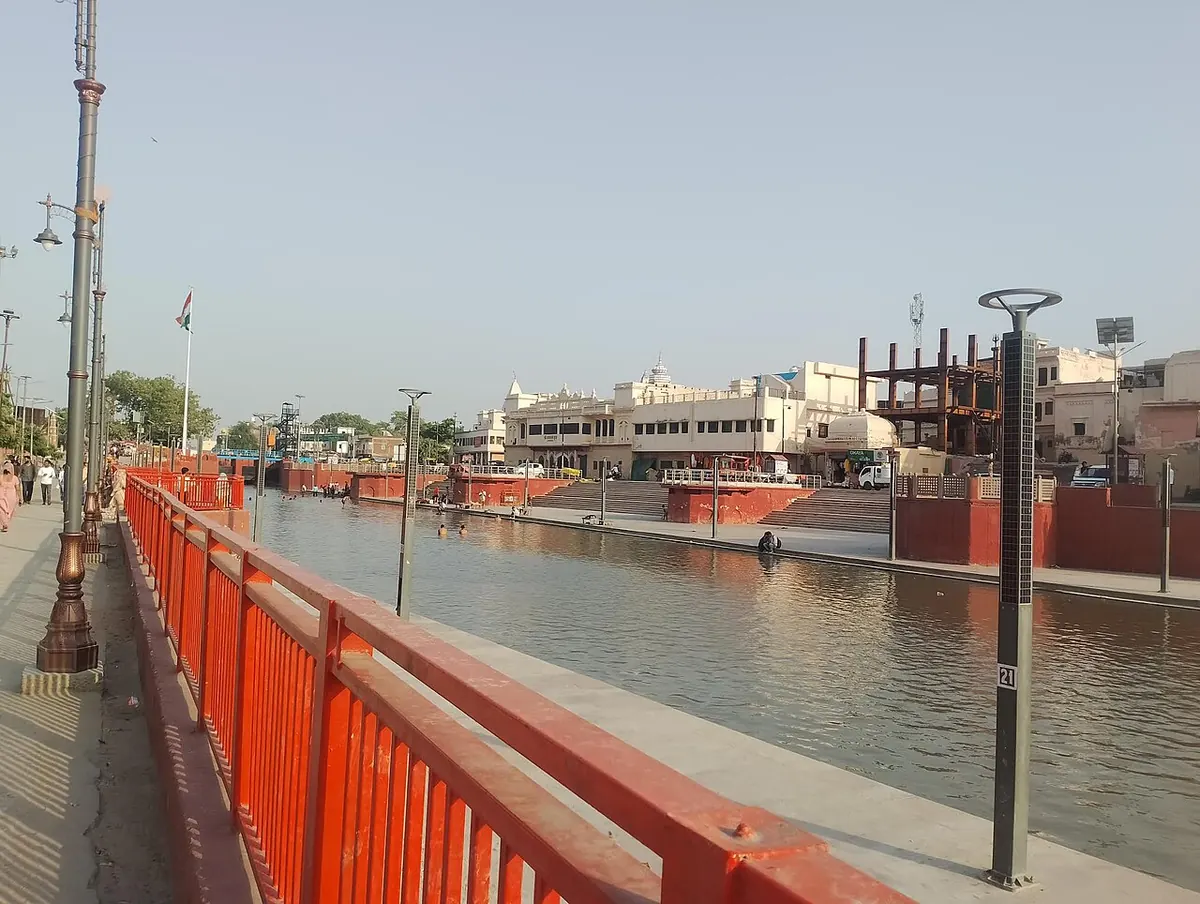
In the Ramayana, Ayodhya is the capital of the kingdom of Kosala, where Rama is born and later crowned. Today a town of that name in Uttar Pradesh is one of Hinduism's seven sacred cities, traditionally identified as Rama's birthplace.
- In the epicThe capital of Kosala on the Sarayu river, built by Manu; where Rama is born, and crowned on his return.
- In historyA town in Uttar Pradesh on the Ghaghara, called the Sarayu in its lower course. Scholars identify it with Saketa, known from Buddhist sources. Its ancient mounds are not yet properly excavated.
- In living traditionOne of Hinduism's seven sacred cities and traditionally Rama's birthplace, where Rama Navami is celebrated with special devotion.
Understand more
Simple
In the Ramayana, Ayodhya is a great walled city on the Sarayu river, capital of the kingdom of Kosala, ruled by Rama's father, King Dasharatha.
Rama is born there, leaves it for fourteen years of exile, and comes back to be crowned king.
Today there is a town called Ayodhya in Uttar Pradesh, on the same river. Hindus regard it as one of their seven sacred cities and traditionally identify it as Rama's birthplace. Archaeology has not yet told us much about the ancient city.
Detailed
Ayodhya in the epic
The Valmiki Ramayana opens its story in Kosala, a prosperous kingdom on the banks of the Sarayu river. Its capital, Ayodhya, is said to have been built by Manu himself. The epic describes broad royal roads sprinkled with water and strewn with flowers, arched gateways, busy markets, a deep moat, mansions like mountains, and the sound of drums and lutes everywhere. King Dasharatha rules from here.
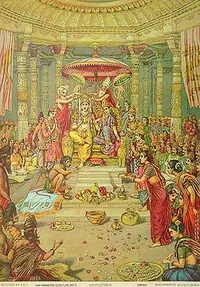
Rama is born in Ayodhya, leaves it for fourteen years of exile, and returns to be crowned. Explore next: Rama
Ayodhya in history
Today there is a town called Ayodhya in Uttar Pradesh, in northern India, on the Ghaghara river, which is called the Sarayu in its lower course. Scholars generally agree that it is the same place as Saketa, a town known from Buddhist sources, where the Buddha is said to have stayed. Few of its monuments are very old, and the mounds near the town that mark the ancient city have not yet been properly explored by archaeologists.
Ayodhya in living tradition
Hindus regard Ayodhya as one of their seven sacred cities and traditionally identify it as Rama’s birthplace and childhood home. Rama Navami, his birthday, is celebrated there with special devotion. Explore next: Rama Navami
The site traditionally identified as Rama’s birthplace was long disputed between Hindus and Muslims. A mosque, the Babri Masjid, was built there in the early 16th century and was demolished in 1992, and rioting that followed cost an estimated 2,000 or more lives. In 2019 India’s Supreme Court gave the site to Hindus and directed that a separate site be given for a mosque. A new temple, the Ram Mandir, was consecrated there on 22 January 2024.
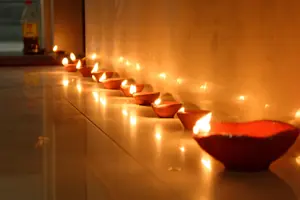
In North India, Diwali celebrates Rama’s homecoming to this city. Explore next: Diwali
Read it in the Ramayana
Five-minute chapters from the Valmiki Ramayana. More are being added book by book.
Start here: The Ramayana in seven books
Book 1 · Bala Kanda
- 1The first poem
- 2A king's wish for sons
- 3Four princes are born
- 4Vishvamitra asks for Rama
- 6Shiva's bow and the wedding
Book 2 · Ayodhya Kanda
- 7The crowning that wasn't
- 8Kaikeyi's two boons
- 9Rama accepts
- 10Across the Ganga to Chitrakuta
- 11A father's grief
- 12Bharata refuses the throne
- 13The sandals on the throne
Book 3 · Aranya Kanda
Book 4 · Kishkindha Kanda
Book 5 · Sundara Kanda
Book 6 · Yuddha Kanda
Book 7 · Uttara Kanda
Keep exploring
 Person or deityRama
 QuestionWhy did Rama go into exile?
 TraditionRama Navami
 TraditionDiwali
 StoryThe war in Lanka and Rama's return
 PlaceChitrakuta
Also named on this page
- Dasharatha
- Dasharatha was the king of Ayodhya and the father of Rama, Bharata, Lakshmana and Shatrughna.
- Manu
- Said in the epic to have built Ayodhya.
- The Buddha
- Buddhist sources say he stayed at Saketa, a town generally identified with Ayodhya.
Sources
- Valmiki Ramayana, Bala Kanda sarga 5 · Verified
- Valmiki Ramayana, Bala Kanda; Yuddha Kanda 1.18.8; sarga 128 · Verified
- Encyclopaedia Britannica, "Ayodhya" · Verified
- Encyclopaedia Britannica, "Rama Navami" · Verified