The Ramayana · Book 2, Ayodhya Kanda
The sandals on the throne
Chapter 13 of 41 · 5 min read · as told in the Valmiki Ramayana, Ayodhya Kanda
An army at the river
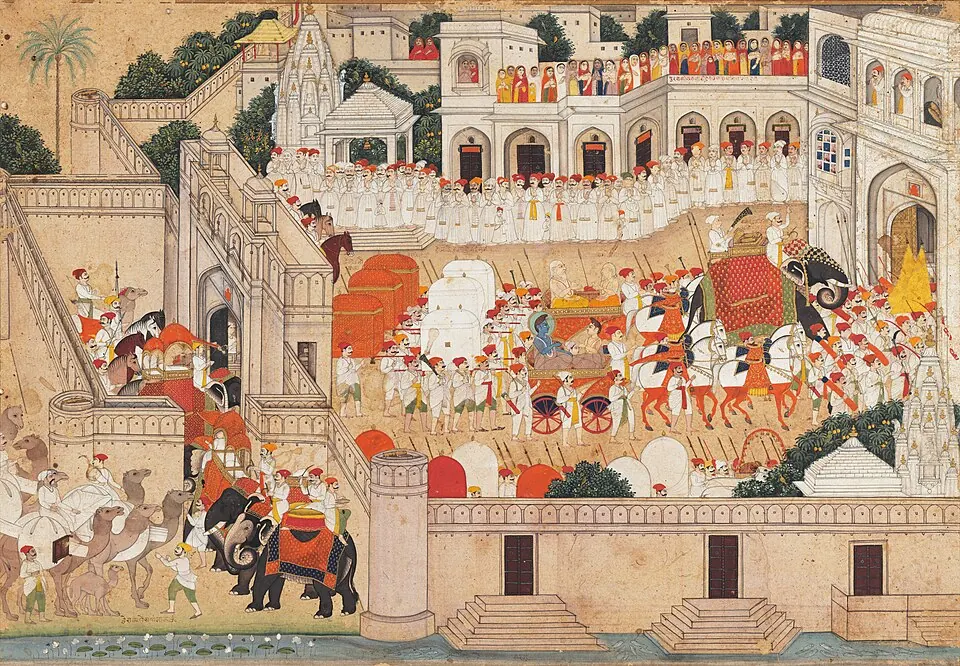
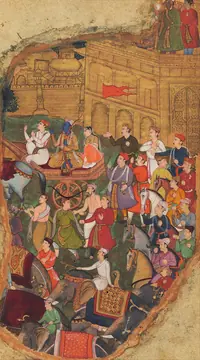
Bharata’s great army, with its elephants, chariots and banners, reached the Ganga and camped along its bank. On the far side, Guha, chief of the Nishadas and Rama’s friend, watched it with alarm. Had Bharata come to finish what his mother began, and harm Rama in the forest? Guha posted his men along the river and readied five hundred boats. If Bharata meant Rama no harm, the army could cross. Then he went out with gifts to meet him.
Bharata answered him calmly. Rama is my eldest brother, he said, like a father to me, and I am going to bring him back from the forest. Guha was overjoyed: who else, he said, would give up a kingdom that had come to him so easily? The army crossed the river. At Prayaga, the sage Bharadvaja welcomed Bharata and all his followers as his guests, and pointed the way to Chitrakuta.
“Bharata has come out of love”
At Chitrakuta, Rama was sitting with Sita by the river Mandakini when dust rose to the sky and the noise of an army sent the wild elephants running. Lakshmana climbed a tall sala tree and looked out. He saw chariots, horses and elephants, and on one chariot a banner with the kovidara tree, Bharata’s banner.
Lakshmana burned with anger. Bharata had been crowned, he said, and had come to kill them both. Put out the fire, hide Sita in a cave, string your bow. He would fight Bharata and his army there on the mountain.
Rama calmed him. What need of bow and sword, he asked, when it is Bharata who has come? He would never take a kingdom won by harming a brother, any more than he would eat poisoned food. Bharata loved them, Rama said. He had heard of their exile, his heart was full of grief, and he had come to offer Rama the kingdom. If it is the kingdom you want, Rama added, I will ask Bharata to give it to you, and he will. Lakshmana was ashamed, and climbed down from the tree.
At the leaf hut
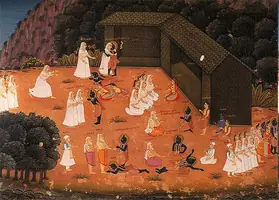
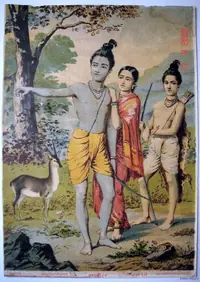
Bharata left the army below and hurried ahead with Shatrughna, asking Vasishtha to bring the mothers after him. Following the signs Lakshmana had left on the path, he found the leaf hut, with the sacred fire burning before it, and inside, Rama in bark clothes and matted hair, sitting on the ground with Sita and Lakshmana.
Bharata was overcome. His brother, who should be seated in the royal hall, was sitting among wild animals because of him. He ran forward weeping and fell before he reached Rama’s feet. He could say only one word, “Arya”, noble one, and nothing more. Shatrughna too bowed at Rama’s feet, weeping. Rama raised them both and held them, and his tears fell with theirs.
Then Bharata gave Rama the news he did not yet know. Their father had died, grieving for Rama, remembering him to the end. Rama, as the son his father had loved most, should offer water for him.
The queens arrived with Vasishtha. At the river they found the offering Rama had made for his father, a little ingudi pulp on sacred grass, and Kausalya wept to think that a king’s son had nothing better to offer. Rama rose and touched his mothers’ feet, and Kausalya held Sita like a daughter.
Two brothers, one promise
Bharata pleaded. In our family the younger cannot be king while the eldest lives, he said. Come home and be crowned. The people are waiting for you as farmers wait for rain. He fell at Rama’s feet.
Rama took him into his lap. You are wise, he said, and you can protect the earth: rule with the counsel of good ministers. But he would not break his father’s promise, not even if the moon lost its light, the Himalaya its snow, or the ocean its shore. And do not resent Kaikeyi, he told Bharata, whatever she did. Treat her as your mother.
The sages who had gathered to watch praised both brothers, and asked Bharata to accept Rama’s word.
The golden sandals
Then Bharata asked for one thing. He set before Rama a pair of sandals adorned with gold, and asked him to step onto them. Rama stepped onto them, stepped off, and gave them to his brother.
Bharata bowed to the sandals and made his vow. For fourteen years he would wear matted hair and bark, eat fruits and roots, and live outside the city. The kingdom would be in the sandals’ keeping. And if Rama did not return when the fourteen years were over, Bharata would enter the fire.
Rama agreed, embraced Bharata and Shatrughna, and sent them home. Bharata worshipped the sandals, walked around Rama, and set them on the head of the finest elephant. The mothers were too choked with tears to say goodbye. Rama bowed to them all and went into his hut, weeping.
The kingdom held in trust
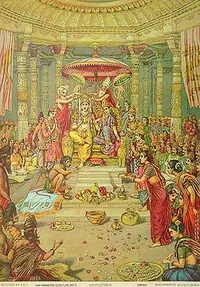
Bharata settled his mothers in Ayodhya, and then went to the village of Nandigrama. There, dressed as a sage, he set Rama’s sandals on the throne and raised the royal umbrella over them. The kingdom is a trust Rama has left with me, he told the elders. When he returns I will put the sandals back on his feet and give him back his kingdom. Every matter of state, every gift, was laid first before the sandals.
At Chitrakuta, Rama found that every corner reminded him of Bharata, his mothers and the people of Ayodhya. So he, Sita and Lakshmana left the mountain, and walked on towards the hermitage of the sage Atri and the great forests beyond.
End of chapter 13.
In this chapter
 Person or deityBharata
 Person or deityRama
 Person or deityLakshmana
 Person or deitySita
 Person or deityShatrughna
- Person or deityVasishtha
- Person or deityKausalya
- Person or deitySumitra
 Person or deityKaikeyi
 Person or deityDasharatha
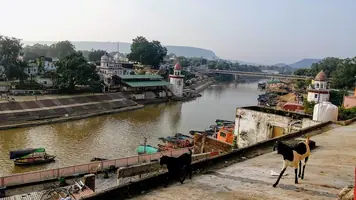 PlaceChitrakuta
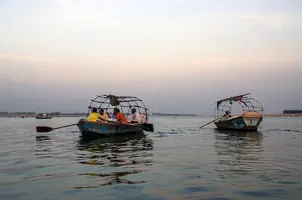 PlacePrayagraj
 PlaceAyodhya
Also named in this chapter
- Guha
- Chief of the Nishadas at the Ganga and Rama's friend, who at first fears Bharata's army.
- Bharadvaja
- The sage at Prayaga, who welcomes Bharata and his army on the way to Chitrakuta.
- Atri
- A sage whose hermitage Rama, Sita and Lakshmana go to after leaving Chitrakuta.
Keep exploring
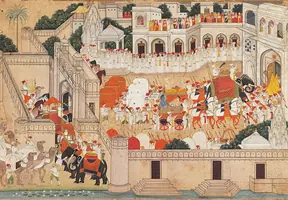
Sources
- Valmiki Ramayana, Ayodhya Kanda 2.84.1–18 · Verified
- Valmiki Ramayana, Ayodhya Kanda 2.85.7–13 · Verified
- Valmiki Ramayana, Ayodhya Kanda sarga 91 · Verified
- Valmiki Ramayana, Ayodhya Kanda 2.96.1–31; 2.97.1–31 · Verified
- Valmiki Ramayana, Ayodhya Kanda 2.99.1–42 · Verified
- Valmiki Ramayana, Ayodhya Kanda 2.101.1–9; 2.103.1–32 · Verified
- Valmiki Ramayana, Ayodhya Kanda 2.112.1–31 · Verified
- Valmiki Ramayana, Ayodhya Kanda sarga 115 · Verified
- Valmiki Ramayana, Ayodhya Kanda sargas 116–117 · Verified