The Ramayana · Book 1, Bala Kanda
The first poem
Chapter 1 of 41 · 4 min read · as told in the Valmiki Ramayana, Bala Kanda
A question for Narada
In his hermitage, the sage Valmiki put a question to Narada, a sage given to austerity and learning. Was there anyone in the world today, he asked, who was both good and strong? Someone who knew dharma, who was grateful, truthful and firm in his vows? Someone who wished every being well, who had mastered himself and conquered anger, and whose anger in battle even the gods would fear?
Narada, who knew all three worlds, was glad to answer. Such qualities are rarely found together, he said, but he knew one man who had them all. He was born in the line of Ikshvaku, and people knew him by the name Rama.
Narada described him. Rama was self-controlled and steady, wise and well-spoken, a great archer, true to his word and devoted to the good of his people. He was deep like the ocean and as firm as the Himalaya. He was like Vishnu in valour and like the moon to look at, as patient as the earth, as generous as Kubera, and in truth like Dharma itself.
The story in brief
Then Narada told the whole story, briefly. King Dasharatha, seeing his son’s virtues, wished to make him heir. But Queen Kaikeyi claimed two boons the king had once promised her: Rama’s exile, and the throne for her son Bharata. Bound by his word, the king sent his beloved son away. Lakshmana followed out of love, and Sita followed as the star Rohini follows the moon.
Narada went on: the years in the forest, Ravana carrying Sita away, friendship with Hanuman and Sugriva, Hanuman’s leap across the ocean, the bridge, Ravana’s defeat, and Rama’s return to Ayodhya and his long and happy rule. When he had finished, Narada left.
The grieving bird
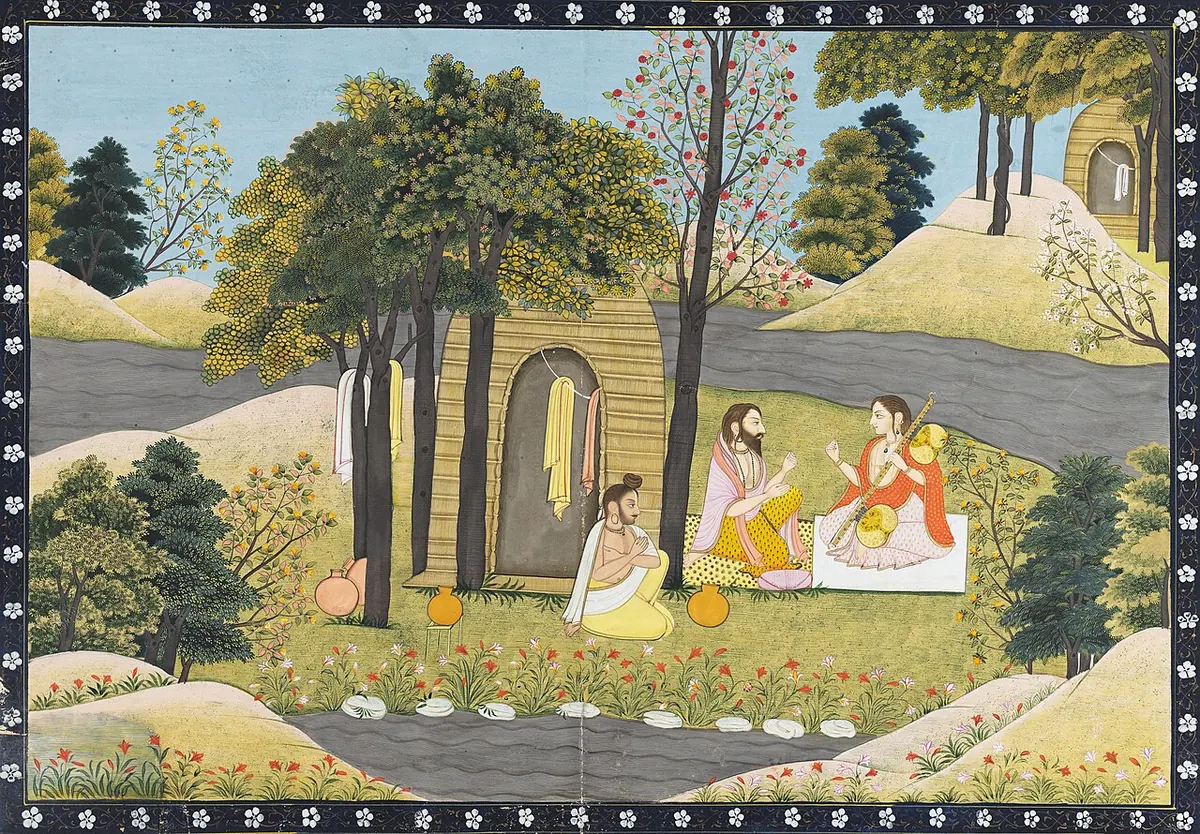
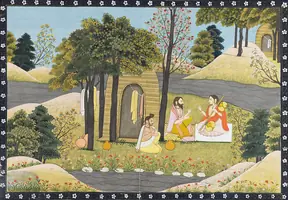
Soon after, Valmiki went to bathe in the Tamasa, a river not far from the Ganga. Its water was clear and calm. “Look, Bharadvaja,” he said to his disciple, “how lovely this bathing place is.” He took his bark garment and wandered into the woods nearby.
There he saw a pair of krauncha birds, never apart, calling sweetly to each other. As he watched, a hunter shot the male dead before his mate’s eyes. She cried out for him, a cry that stirred pity in anyone who heard it.
Moved by compassion, Valmiki said that this was adharma, a wrong. And words burst out of him: O hunter, may you never find lasting honour, for you have killed one of this loving pair.
A new kind of verse
Then he wondered what he had said. As he turned it over, he saw that his words had come out in a measured pattern, four quarters with equal syllables, a rhythm that could be sung. Since it was born of his sorrow, he said, let it be called a shloka, a verse.
His disciple learned it by heart, and the teacher was pleased. Valmiki finished bathing and walked back to the hermitage, still thinking about what had happened.
Brahma’s visit
At the hermitage, Brahma, the four-faced creator, came to see him. Valmiki rose in wonder and honoured him. But even as they sat together, his mind kept returning to the bird, and he repeated the new verse aloud.
Brahma smiled. It is indeed a shloka you have made, he said. It was by his will that this gift of speech had arisen in Valmiki. Now Valmiki should use it to tell the story of Rama, as he had heard it from Narada: what was known and what was hidden, about Rama, Lakshmana, Sita and the rakshasas. All of it would become clear to him, and nothing in his poem would be untrue. As long as mountains stand and rivers flow on the earth, Brahma said, the Ramayana would be told.
Then Brahma vanished. Valmiki’s disciples chanted the new verse again and again, delighted, and Valmiki resolved to tell the whole of Rama’s story in this measure.
Two young singers
The epic says the finished poem had twenty-four thousand verses in five hundred chapters, arranged in six books and a final part, the Uttara. Valmiki wondered who could carry it into the world. Just then, two young brothers who lived in the hermitage came and touched his feet. They were Kusha and Lava, princes learned in the Vedas, with sweet voices.
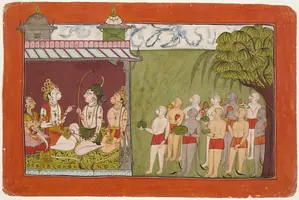
Valmiki taught them the whole poem. They learned it by heart and sang it to gatherings of sages, who were moved to tears and praised them. They sang it in the streets and along the royal roads, and there Rama himself saw them. He brought them into his court, sat on his throne among his brothers and ministers, and asked them to sing. And he listened.
So the Ramayana begins with its own beginning: a poem born from compassion for a grieving bird, sung by two boys to the king it is about. Who those boys really were, the epic reveals only near its end.
End of chapter 1.
In this chapter
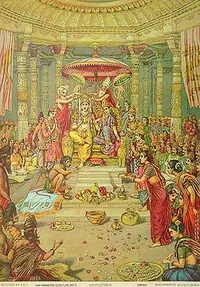 Person or deityRama
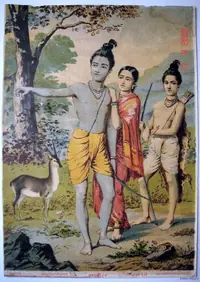 Person or deitySita
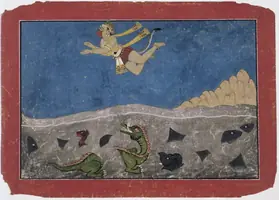 Person or deityHanuman
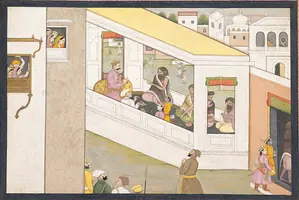 Person or deityDasharatha
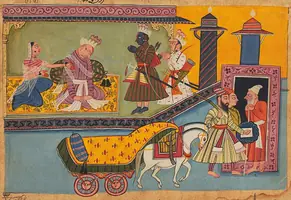 Person or deityKaikeyi
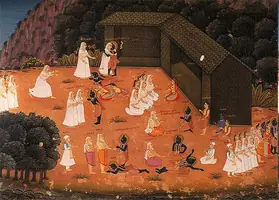 Person or deityBharata
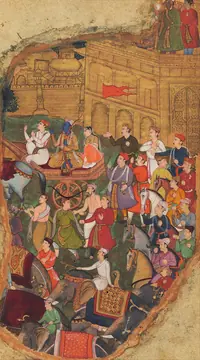 Person or deityLakshmana
- Person or deityRavana
 PlaceAyodhya
 Person or deitySugriva
Also named in this chapter
- Narada
- A sage who knows all three worlds. He tells Valmiki the story of Rama in brief, then returns to the world of the gods.
- Valmiki
- The sage-poet of the Ramayana. This chapter tells how he came to compose it.
- Bharadvaja
- Valmiki's disciple, who goes with him to the river Tamasa and learns the first verse by heart.
- Brahma
- The four-faced creator. He visits Valmiki and tells him to tell Rama's story in this new kind of verse.
- Kusha and Lava
- Two young princes living in Valmiki's hermitage, who learn the whole poem and sing it, at last before Rama himself.
- Ikshvaku
- The royal line Rama was born into.
- Vishnu
- Narada compares Rama's valour to Vishnu's.
- Kubera
- Narada compares Rama's generosity to Kubera's.
- Dharma
- Narada says that in truthfulness Rama is like Dharma itself.
- Rohini
- A star. Narada says Sita followed Rama as Rohini follows the moon.
Keep exploring
 QuestionWhat is the Ramayana, and who wrote it?
 QuestionWhy are there so many versions of the Ramayana?
- StoryThe Ramayana in seven books
Sources
- Valmiki Ramayana, Bala Kanda 1.1.1–19 · Verified
- Valmiki Ramayana, Bala Kanda 1.1.19–97 · Verified
- Valmiki Ramayana, Bala Kanda 1.2.3–41 · Verified
- Valmiki Ramayana, Bala Kanda 1.4.1–32 · Verified