The Ramayana · Book 2, Ayodhya Kanda
A father's grief
Chapter 11 of 41 · 5 min read · as told in the Valmiki Ramayana, Ayodhya Kanda
An empty chariot
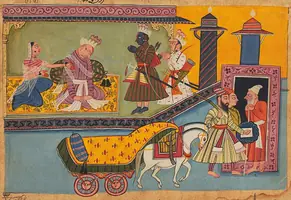
Sumantra drove back towards Ayodhya with a heavy heart. At dusk on the third day he reached the city and found it silent, as if no one lived there.
Then the people saw him, and thousands ran to the chariot. “Where is Rama?” I left him at the Ganga, Sumantra told them, and came back as he asked. When they heard that Rama had crossed the river, the crowd cried out. We will never see him again, they said, at festivals, at weddings, at the great gatherings. He looked after this city like a father.
Sumantra covered his face and drove on to the palace. Through seven courtyards he heard women weeping, and whispers: how would anyone face Kausalya now? In the eighth courtyard he found the king, pale and withered with grief.
Sumantra bowed and gave Rama’s message word for word: we do not grieve, and we will return in fourteen years. The king heard it in silence, and fell senseless to the floor. Kausalya, leaning on Sumitra, lifted him. Speak to the messenger, she urged him: Kaikeyi is not here, there is nothing to fear. Then she too collapsed, and the wailing in the palace spread through the whole city.
A husband and wife
In the days that followed, Kausalya’s grief turned to bitter words for the king. Dasharatha, already crushed, sank into thought. Two sorrows weighed on him now: Rama’s exile, and an old wrong he had never forgotten.
Trembling, his head bowed and his hands folded, he asked Kausalya to forgive him. She had always been gentle, he said, even to those who opposed her. Do not speak harshly to someone already broken by sorrow.
Kausalya wept. She lifted his folded hands to her head and asked his pardon in turn. Grief, she said, destroys courage, learning and every kind of steadiness. It is a worse enemy than any blow. Five nights without Rama had felt like five years. Night fell, and the king slept a little.
What happened by the Sarayu
At midnight on the sixth night after Rama left, Dasharatha woke, and told Kausalya the story at last.
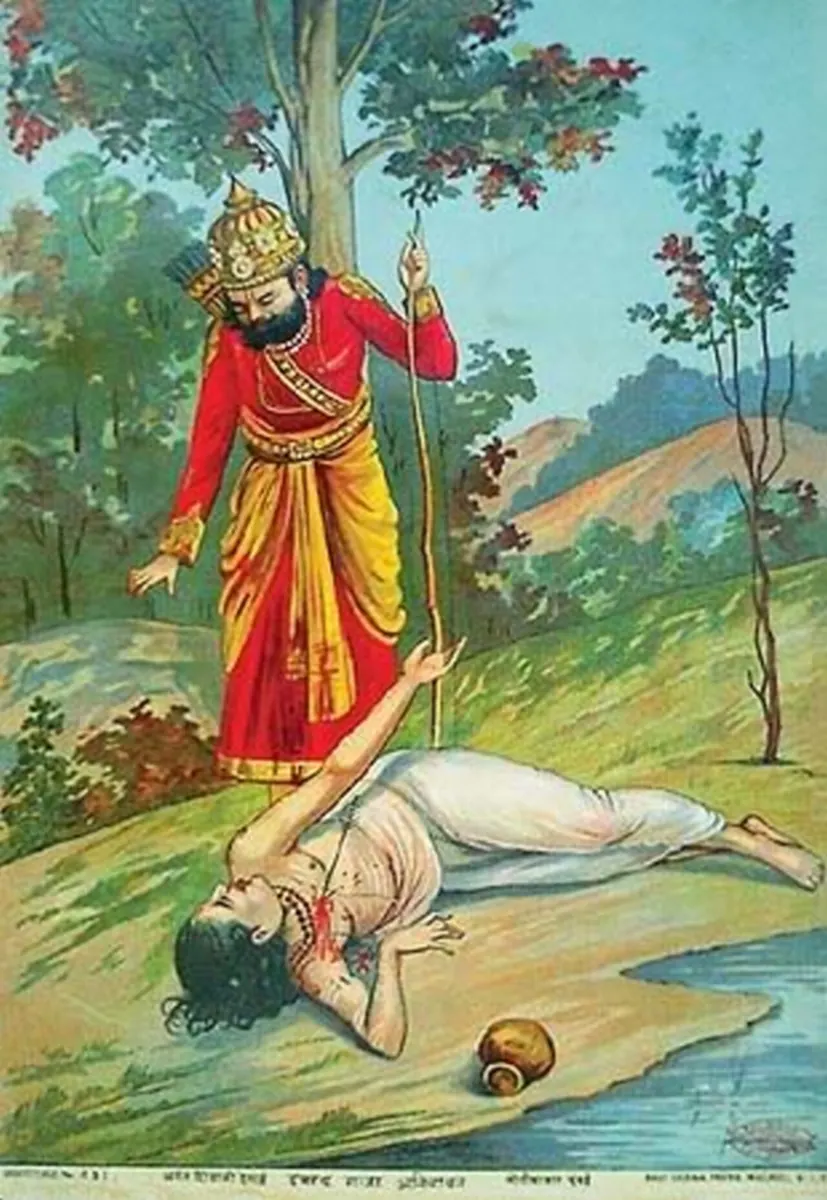
Every action bears its fruit, he began. Long ago, before she married him, when he was a young crown prince, he had been proud of one skill above all: he could hit a target he could only hear. One night in the rainy season, he took his bow to the bank of the Sarayu and waited alone in the dark by a watering place for an elephant or a buffalo to come and drink.
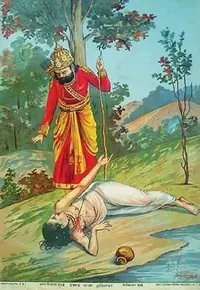
He heard a sound like an elephant drinking, and let his arrow fly. A human cry answered him.
He ran to the river and found a young ascetic lying on the bank, his matted hair loose, his water pot overturned, his body pierced by the arrow. Why have you struck me? the young man asked. I have harmed no one. He grieved less for himself than for his parents, old and blind, who were waiting for the water. Go to my father, he said, and tell him what has happened, before he curses you. Then he asked the prince to pull out the arrow. Dasharatha drew it out, and the young man died.
The blind parents
Dasharatha filled the pot and carried it along the narrow path to the hermitage. The old couple were sitting together, speaking only of their son. Hearing footsteps, the father called out: why have you been so long? Your mother is worried.
Haltingly, Dasharatha told them who he was and what he had done. Because he had confessed, the old man said, and had done it unknowingly, his family would be spared the worst. He asked to be taken to his son. The parents touched the boy’s body and mourned him. Who will recite the scriptures to me now? the father asked. Who will bring us roots and fruits? They made the water offering for their son, and the young man, in a shining form, rose to heaven, comforting his parents and promising they would soon join him.
Then the old man spoke his curse. As I die grieving for my son, so you too will die grieving for a son. Then he and his wife gave up their lives.
The curse comes home
Now that curse had ripened, Dasharatha said. What he had done to Rama had come back to him. He could no longer see Kausalya, he told her: touch me. Would Rama ever touch him again? He felt his memory slipping, and said that Yama’s messengers were hurrying him away.
Blessed are those, he said, who will see Rama come home to Ayodhya in the fifteenth year. His heart was sinking, his senses fading like a lamp whose oil is spent. He called out for Rama, for Kausalya, for Sumitra. And there, with Rama’s mother and Sumitra beside him, grieving for his exiled son, King Dasharatha died after midnight.
Dawn in the palace
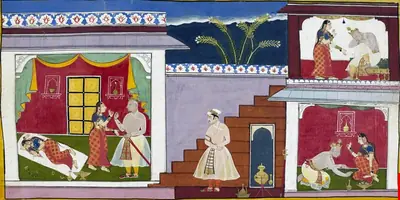
At dawn the bards and singers came as they did every morning, to wake the king with songs and blessings. The attendants waited with scented water in golden vessels. The sun rose, and the king did not stir.
The women who served him touched him, and found no sign of life. Their cry woke Kausalya and Sumitra, who touched the king and fell to the ground. Kaikeyi and the other queens fainted. The whole palace filled with weeping. Ayodhya had lost its king, and none of his four sons was there.
End of chapter 11.
In this chapter
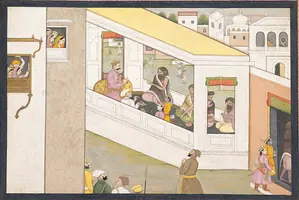 Person or deityDasharatha
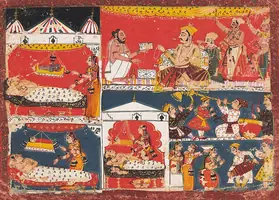 Person or deityKausalya
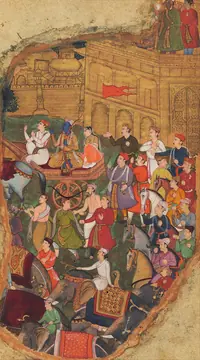 Person or deitySumitra
 Person or deityKaikeyi
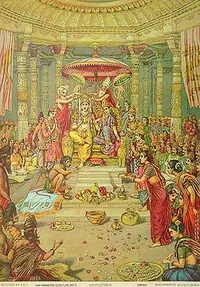 Person or deityRama
- Person or deityLakshmana
 PlaceAyodhya
Also named in this chapter
- Sumantra
- King Dasharatha's charioteer, who brings back Rama's message from the Ganga.
- Yama
- The god of death and of dharma; the dying king says Yama's messengers are hurrying him on.
Keep exploring
 QuestionWhy was King Dasharatha cursed?
 QuestionWhy did King Dasharatha keep a promise that broke his heart?
Sources
- Valmiki Ramayana, Ayodhya Kanda 2.57.1–34 · Verified
- Valmiki Ramayana, Ayodhya Kanda 2.62.1–21 · Verified
- Valmiki Ramayana, Ayodhya Kanda 2.63.1–55 · Verified
- Valmiki Ramayana, Ayodhya Kanda 2.64.3–79 · Verified
- Valmiki Ramayana, Ayodhya Kanda 2.65.1–29 · Verified