The Ramayana · Book 6, Yuddha Kanda
The return to Ayodhya
Chapter 37 of 41 · 3 min read · as told in the Valmiki Ramayana, Yuddha Kanda
Indra’s boon
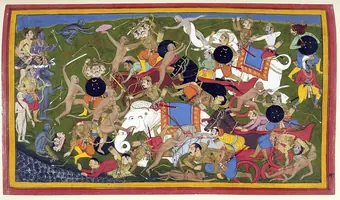
When the war was over, Indra, king of the gods, offered Rama a gift. Rama did not ask for anything for himself. Let the vanaras who died for me live again, he said, and go home to their families. Wherever they go, let there be fruit and flowers, even out of season, and clear rivers.
Indra granted it. All over the battlefield the fallen vanaras and bears stood up, whole and strong, as if waking from sleep. The gods urged Rama to go home to Ayodhya, where Bharata and his mothers were waiting.
The Pushpaka
Vibhishana begged Rama to stay a while in Lanka and be honoured as a guest. Rama thanked him, but would not stay. My heart is with Bharata, he said. He came all the way to Chitrakuta to beg me to return, and I refused him. I must go to him now.
So Vibhishana brought out the Pushpaka, the aerial chariot built by Vishvakarma for Kubera, which Ravana had taken from him. It shone like the sun, hung with bells and set with jewels, and it could carry them to Ayodhya in a single day.
The world from the sky
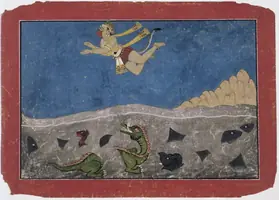
The Pushpaka rose into the air, and Rama showed Sita the way they had come.
There is the battlefield, he said, where Ravana fell. There is the bridge Nala built for your sake, and the place on the shore where Vibhishana came to me, holy now in all the three worlds. There is Kishkindha, where Sugriva is king. At Sita’s wish they stopped there, and Tara and the other vanara women came aboard, eager to see Ayodhya.
On they flew, and Rama pointed out each place: Lake Pampa, where he had grieved for her; the forest where Jatayu fell; the hermitages of the sages; Chitrakuta; the Ganga; and at last the river Sarayu. Look, Sita, he said. There is Ayodhya, my father’s city. Bow to it.
Good news runs ahead
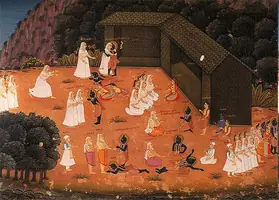
They came down first at the hermitage of the sage Bharadvaja, where the Ganga and the Yamuna meet. The sage told Rama that Bharata was waiting for him, with Rama’s sandals placed before him. When Bharadvaja offered a boon, Rama asked that the trees on the road to Ayodhya bear fruit out of season, and they did.
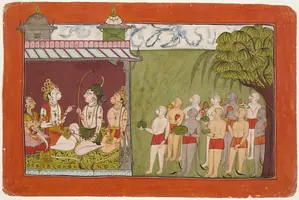
Rama sent Hanuman ahead to find Bharata and tell him that Rama was coming home, with Sita and Lakshmana beside him. Bharata was overjoyed. He showered Hanuman with gifts: a hundred thousand cows and more than a hundred villages.
Brothers again
Bharata came out from Nandigrama to meet him, carrying the sandals he had kept on the throne for fourteen years. When the Pushpaka came down, he placed them at Rama’s feet and gave back the kingdom he had held in trust.
The crowning
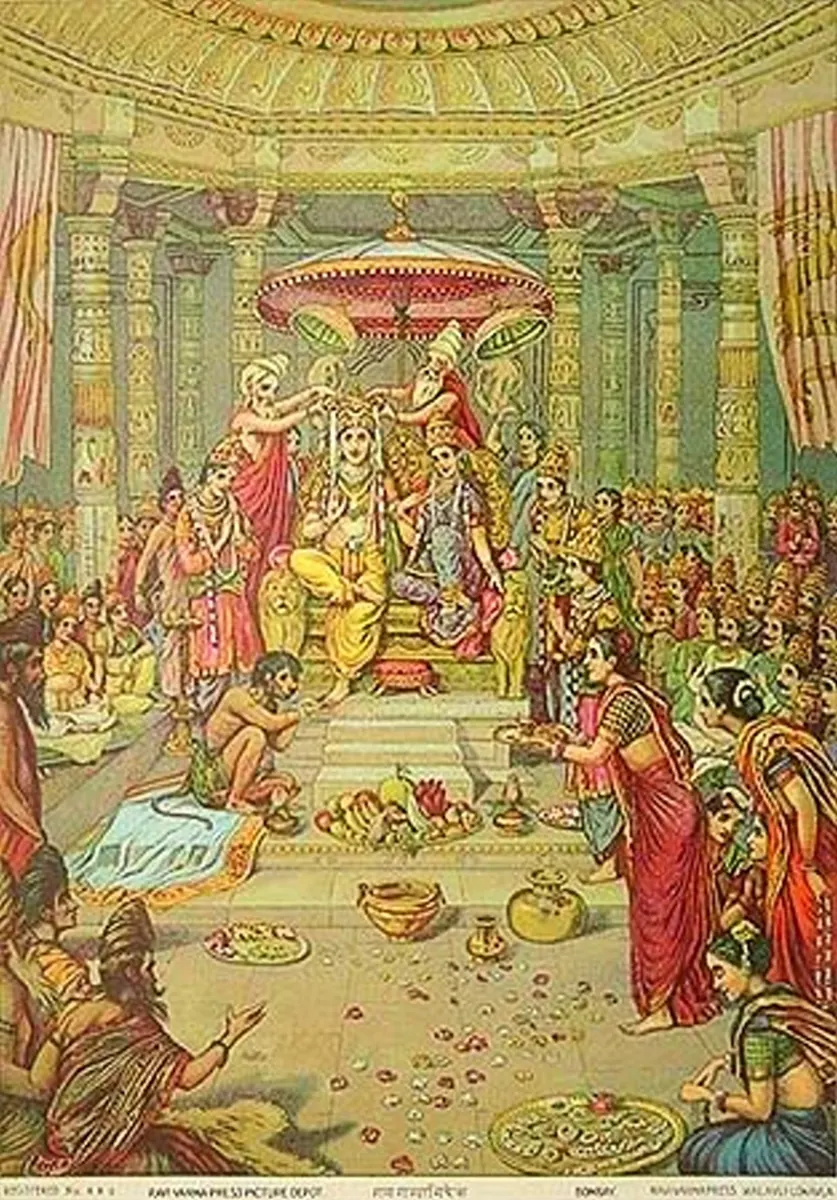
The sages, led by Vasishtha, consecrated Rama with water brought from the four oceans and five hundred rivers, and Vasishtha placed the crown on his head. The epic describes the years that followed as a time without disease, fear or theft, when rain fell on time and the trees bore fruit.
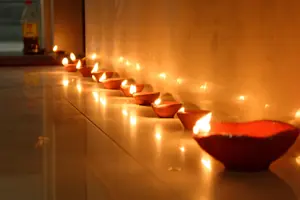
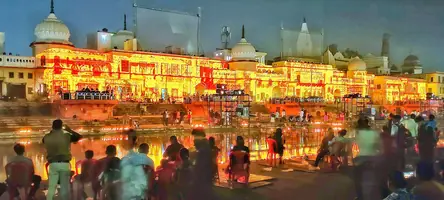
In many parts of India, Rama’s homecoming is remembered at Diwali, the festival of lamps.
Here the war ends, and the story of the epic’s main books with it. The last book, the Uttara Kanda, tells what came afterwards.
End of chapter 37.
In this chapter
 Person or deityRama
 Person or deitySita
 Person or deityLakshmana
 Person or deityVibhishana
 Person or deitySugriva
 Person or deityHanuman
 Person or deityBharata
- Person or deityVasishtha
- Person or deityRavana
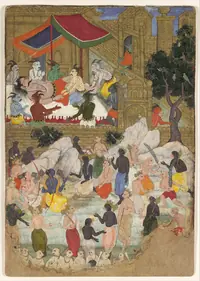 PlaceLanka
 PlaceAyodhya
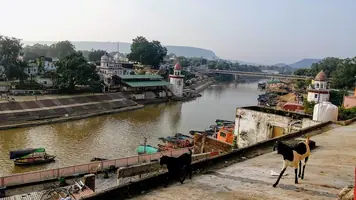 PlaceChitrakuta
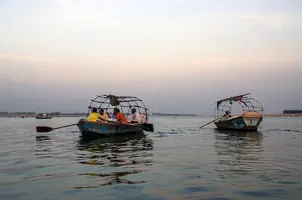 PlacePrayagraj
Also named in this chapter
- Indra
- King of the gods, who grants Rama a boon.
- Kubera
- The god of wealth, from whom Ravana had taken the Pushpaka.
- Vishvakarma
- The divine craftsman, who built the Pushpaka.
- Tara
- The queen of Kishkindha, who travels to Ayodhya with Sita.
- Bharadvaja
- A sage at whose hermitage by the Ganga and Yamuna Rama stops on the way home.
Keep exploring
Sources
- Valmiki Ramayana, Yuddha Kanda 6.123.1–24 (vedapath numbering) · Verified
- Valmiki Ramayana, Yuddha Kanda 6.124.1–30 (vedapath numbering) · Verified
- Valmiki Ramayana, Yuddha Kanda 6.126.1–57 (vedapath numbering) · Verified
- Valmiki Ramayana, Yuddha Kanda sarga 127 · Verified
- Valmiki Ramayana, Yuddha Kanda sarga 128 (vedapath numbering) · Verified
- Valmiki Ramayana, Yuddha Kanda 6.127.16–61 · Verified
- Valmiki Ramayana, Yuddha Kanda 6.128.2–106 · Verified
- Encyclopaedia Britannica, "Diwali" · Verified