The Ramayana · Book 2, Ayodhya Kanda
Across the Ganga to Chitrakuta
Chapter 10 of 41 · 5 min read · as told in the Valmiki Ramayana, Ayodhya Kanda
The first night
The chariot stopped at evening on the bank of the river Tamasa. This is the first night of our exile, Rama told Lakshmana: do not grieve. The forest around them seemed empty and sad, as if even the birds and animals were hiding.
Rama thought of his father and mother, and comforted himself that Bharata, who was good and kind, would console them. He was glad Lakshmana had come, to help protect Sita. That night he drank only water. Sumantra spread a bed of leaves on the riverbank, and while Rama and Sita slept, Lakshmana sat up talking with Sumantra about Rama until the sun rose.
Many citizens of Ayodhya had followed them out of the city, and they lay asleep under the trees, determined to bring Rama home. At dawn Rama looked at them and made a choice. They would give up their lives, he said, before giving up on him, and he did not want them to suffer for his sake. So the three left quietly while the people slept. Rama had Sumantra drive north for a while and then turn back, so that no one could follow their tracks.
Guha at the Ganga
They crossed the rich land of Kosala, with its fields, groves and herds, and at its edge Rama turned to say farewell to Ayodhya and its guardian gods. Then they came to the Ganga, the holy river that flows through the three worlds, and stopped for the night at Shringaverapura, under a great ingudi tree.
Guha, chief of the Nishadas and Rama’s friend, as dear to him as his own self, came out with his elders and kinsmen and embraced him. This place is yours, as Ayodhya is yours, Guha said, and he offered food, drink, beds and all his land.
Rama thanked him warmly and asked after his family and his people. But he had taken a vow as an ascetic, he said, and would live on fruits and roots. He accepted only fodder for the horses, which his father loved. That night Rama drank only water and lay on the bare ground. Guha, bow in hand, kept watch beside Lakshmana until morning.
Sumantra goes home
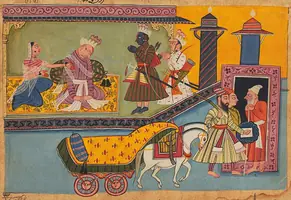
At dawn Guha brought a sturdy boat. Rama told Sumantra to take the chariot home. Sumantra wept and begged to come with them. How could he drive an empty chariot into Ayodhya? How could he face Kausalya?
Rama was gentle but firm. Sumantra must go back, so that Kaikeyi would believe the exile was real and not suspect the king of breaking his word. He gave Sumantra messages: tell the king that we do not grieve and will return in fourteen years. Honour all three mothers, Kausalya, Sumitra and Kaikeyi alike. Let Bharata be called home and made crown prince.
Then Rama asked Guha for the sap of a banyan tree, and he and Lakshmana matted their hair with it, like forest sages. Rama took leave of Guha, and they stepped into the boat. In the middle of the river, Sita folded her hands and prayed to the Ganga to protect them, promising offerings when they came home safely. On the far bank Rama set the order they would keep in the forest: Lakshmana in front, Sita in the middle, Rama behind. On the shore, Sumantra watched them grow small, and turned back in tears.
Bharadvaja’s advice
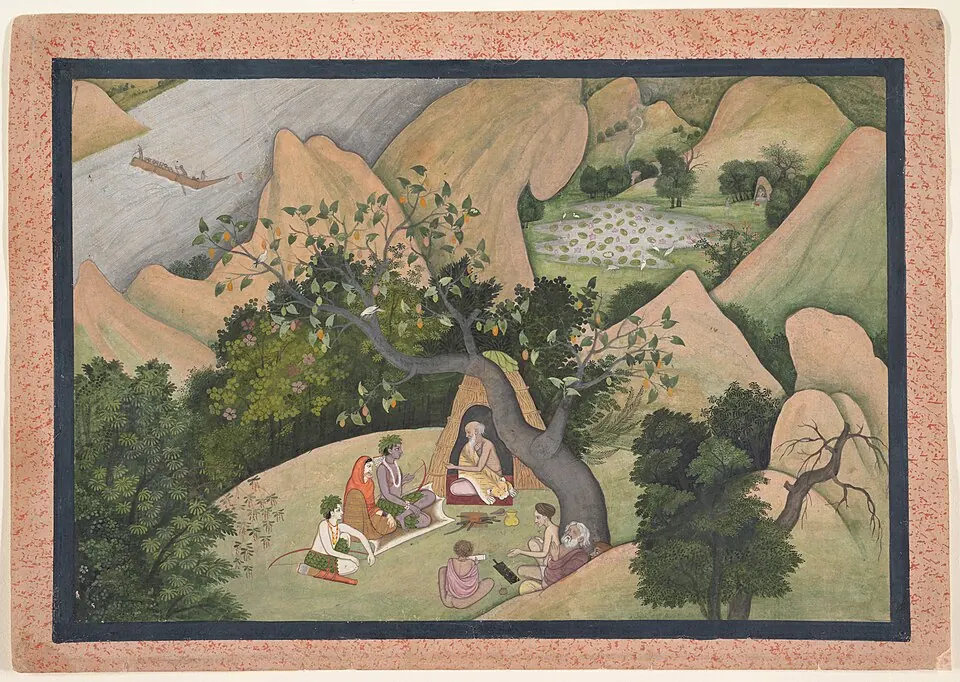
After a night under a great tree they walked on all day, and towards evening they saw a column of smoke rising and heard the roar of two great rivers meeting. Rama knew they were near the hermitage of the sage Bharadvaja, at Prayaga, where the Ganga joins the Yamuna.
The sage was tending his sacred fires, surrounded by disciples. Rama introduced himself, Sita and Lakshmana, and Bharadvaja welcomed them with water, fruits and roots. Stay here, he offered: this place where the rivers meet is holy and peaceful.
Rama gently declined. It was too close to the towns, he said, and people would keep coming to see them. Could the sage suggest somewhere quieter? Bharadvaja named Chitrakuta, a holy mountain ten krosas away, full of honey, fruits and waterfalls, where great sages had lived.
Across the Yamuna
In the morning the sage gave them directions and walked a little way with them, like a father seeing off his sons. At the Yamuna the brothers lashed logs into a raft, spread it with bamboo and grass, and Lakshmana made Sita a seat of reeds. In midstream Sita prayed to the river, and on the far bank she folded her hands before a great banyan and walked around it, praying that Rama’s vow would be fulfilled and that she would see Kausalya and Sumitra again.
They walked on with Sita between them. She kept asking Rama the names of the trees and flowers she had never seen, and Lakshmana brought her branches in bloom.
A home on Chitrakuta
The next day they reached Chitrakuta. Rama showed Sita the trees heavy with fruit, honeycombs, peacocks and herds of elephants. This, he said, is a place where we can live happily.
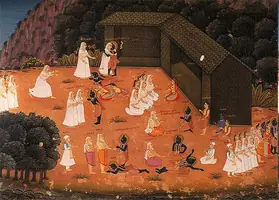
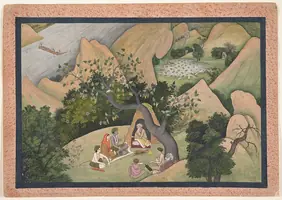
They bowed at the hermitage of the sage Valmiki, who welcomed them. Then Rama asked Lakshmana to build a home. Lakshmana cut timber and built a hut thatched with leaves, and Rama, pleased, performed the rites to bless it. The three went in, sheltered from the wind.
Living by the mountain and the river Malyavati, Rama set aside the sorrow of leaving the city. He did not yet know what was happening in Ayodhya.
End of chapter 10.
In this chapter
 Person or deityRama
 Person or deitySita
 Person or deityLakshmana
 Person or deityDasharatha
 Person or deityBharata
 Person or deityKaikeyi
 Person or deityKausalya
- Person or deitySumitra
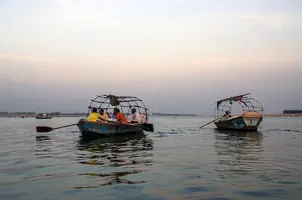 PlacePrayagraj
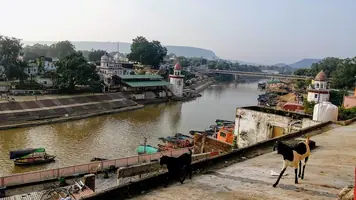 PlaceChitrakuta
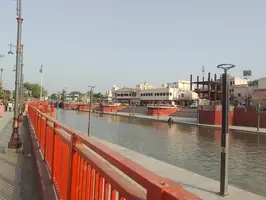 PlaceAyodhya
Also named in this chapter
- Sumantra
- King Dasharatha's charioteer, who drives the exiles to the Ganga and is sent home with Rama's messages.
- Guha
- Chief of the Nishadas at Shringaverapura and Rama's dear friend, who ferries them across the Ganga.
- Bharadvaja
- The sage whose hermitage stands where the Ganga meets the Yamuna; he sends Rama to Chitrakuta.
- Valmiki
- The sage and poet of the Ramayana, whose hermitage the exiles visit at Chitrakuta.
Keep exploring
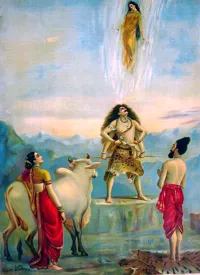
Sources
- Valmiki Ramayana, Ayodhya Kanda 2.46.1–34 · Verified
- Valmiki Ramayana, Ayodhya Kanda 2.50.1–51 · Verified
- Valmiki Ramayana, Ayodhya Kanda 2.52.1–102 · Verified
- Valmiki Ramayana, Ayodhya Kanda 2.54.1–43 · Verified
- Valmiki Ramayana, Ayodhya Kanda 2.55.1–34 · Verified
- Valmiki Ramayana, Ayodhya Kanda 2.56.1–38 · Verified