The Ramayana · Book 2, Ayodhya Kanda
Rama accepts
Chapter 9 of 41 · 4 min read · as told in the Valmiki Ramayana, Ayodhya Kanda
A father who cannot speak
Rama came into Kaikeyi’s rooms and found his father sitting pale and broken, with Kaikeyi beside him. He bowed to his father, then to Kaikeyi. The king could only say “Rama” and weep. He could not look at his son.
Rama had never seen his father like this. Had he offended him without knowing? Was the king ill? Had something happened to Bharata or Shatrughna, or to one of the queens? He turned to Kaikeyi and asked her to tell him the truth.
The king was not angry, Kaikeyi said. He simply could not bring himself to say what was in his heart. She would tell Rama everything, if Rama promised to do what the king had promised.
Rama was hurt that she even had to ask. At his father’s word, he said, he would enter fire or drink poison. Tell me what the king wants, and I will do it. Rama does not say one thing and do another.
So Kaikeyi told him: the war long ago, the two boons, and what she had now asked for. Bharata would be crowned, and Rama would go to the Dandaka forest that very day, to live for fourteen years with matted hair and a deerskin.
“So be it”
Rama did not waver. He would go, he said, and gladly. His only pain was that his father had not told him himself. For Bharata he would give up the kingdom, his wealth, even his life. Let messengers ride to bring Bharata home. To serve his father’s word, he said, was the highest dharma.
The king cried out and fainted. Rama bowed at his father’s feet and at Kaikeyi’s, walked around them in respect and left. As he passed the vessels prepared for his crowning, he walked around them too. He set aside the royal umbrella and sent away the chariot. Those who saw him noticed no change at all in his face. Behind him walked Lakshmana, his eyes full of tears and anger.
A mother’s grief, a brother’s anger
Queen Kausalya had spent the morning praying to Vishnu for her son. When Rama told her, she collapsed in grief. If he left, she said, she would fast until she died.
Lakshmana burned with anger. The old king, he said, had been swayed by desire and by Kaikeyi. Rama should seize the kingdom before anyone could stop him, and Lakshmana would fight anyone who stood in the way.
Rama answered both of them gently. He knew Lakshmana’s love and courage. But dharma, he said, comes first, and a promise once given must not be made empty. He would not overstep his father’s word. Set aside this anger, he told his brother, and follow dharma with me.
Kausalya asked to come with him into the forest. Rama asked her to stay. The king had been deceived, and if she left him too, he might not survive. At last she agreed. She blessed her son at length, asking the gods and sages to guard him on every path, tied on a protective herb, and embraced him.
Sita and Lakshmana choose
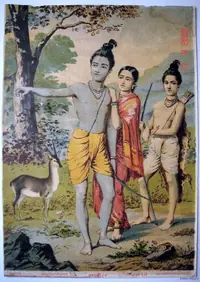
Rama went to Sita to say goodbye. She refused to stay behind. A wife, she told him, shares her husband’s fortune. She would walk ahead of him in the forest, clearing the thorns from his path. Without him, even heaven would mean nothing to her. When Rama tried to talk her out of it, she would not be moved, and he agreed to take her.
Lakshmana, too, would not stay. Rama asked him to remain and care for their mothers, but Lakshmana said Bharata would look after them. He would walk ahead of Rama, bow in hand, find food and keep watch. Rama was pleased, and agreed.
Bark garments
In the palace, before the whole court, Rama asked only for bark clothes, a digging tool and a basket. Kaikeyi brought the bark garments herself. Rama and Lakshmana took off their fine clothes and put them on.
Sita, still in silk, did not know how to wear bark and stood ashamed. Rama tied it over her silk himself, and the women of the palace wept. Vasishtha rebuked Kaikeyi sharply: the boons named Rama alone, not Sita, and Sita should go with every comfort. But Sita did not turn back from her choice.
Out of Ayodhya
The three touched the king’s feet and bowed to the mothers. Sumitra kissed Lakshmana’s forehead. Serve your brother faithfully, she told him: think of Rama as your father, of Sita as your mother, and of the forest as Ayodhya. Go, go.
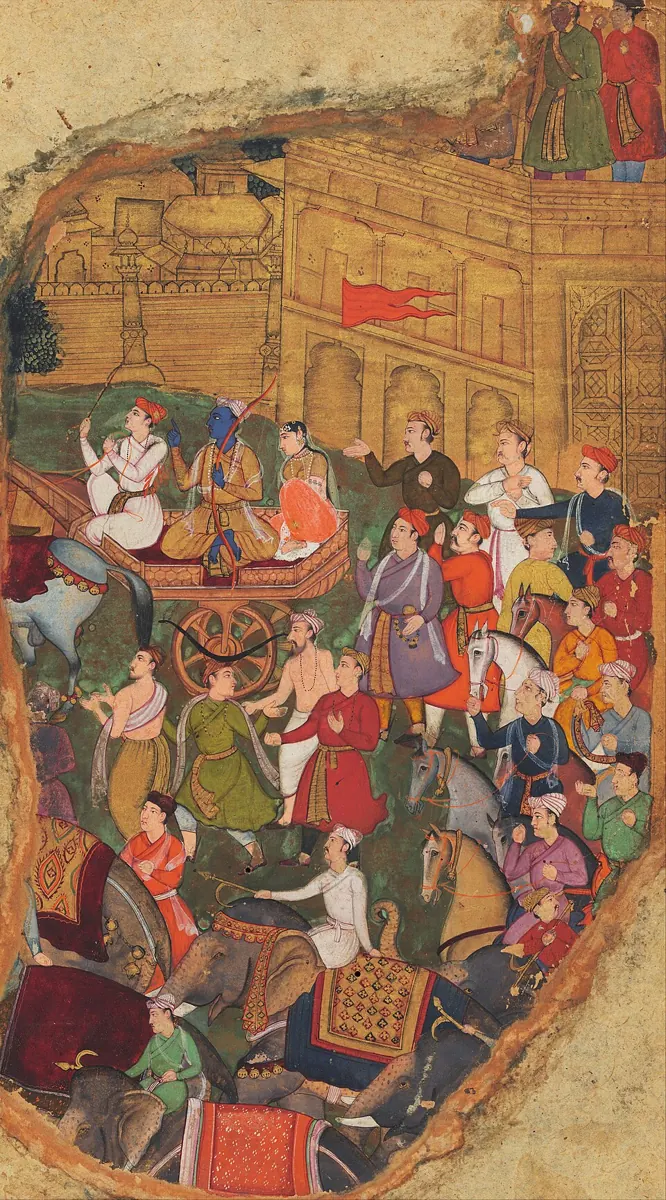
Sumantra drove the chariot out through streets of weeping people. Old and young ran after it, begging him to slow down so they could see Rama’s face. The king came out of the palace, with Kausalya following on foot. “Stop!” cried the king. “Go on,” said Rama, and told Sumantra to say, if the king asked, that he had not heard. Drawing out the parting, he said, would only prolong the pain. The chariot sped away, and Dasharatha stood in the dust, gazing after his son.
End of chapter 9.
In this chapter
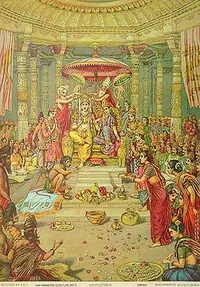 Person or deityRama
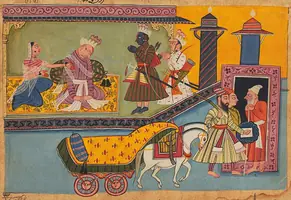 Person or deityKaikeyi
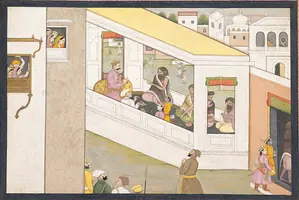 Person or deityDasharatha
 Person or deityBharata
 Person or deityKausalya
 Person or deityLakshmana
 Person or deitySita
- Person or deitySumitra
- Person or deityVasishtha
- Person or deityShatrughna
 PlaceAyodhya
Also named in this chapter
- Vishnu
- The god to whom Kausalya was praying for her son on the morning of the crowning.
- Sumantra
- King Dasharatha's charioteer, who drives Rama, Sita and Lakshmana out of the city.
Keep exploring
 QuestionWhy did Rama go into exile?
 QuestionWhy did Sita and Lakshmana go with Rama to the forest?
- QuestionWhat does dharma mean in the Ramayana?
Sources
- Valmiki Ramayana, Ayodhya Kanda 2.18.1–41 · Verified
- Valmiki Ramayana, Ayodhya Kanda 2.19.1–40 · Verified
- Valmiki Ramayana, Ayodhya Kanda 2.20.14–55; 2.21.1–63 · Verified
- Valmiki Ramayana, Ayodhya Kanda 2.24.9–14, 32–38; 2.25.2–47 · Verified
- Valmiki Ramayana, Ayodhya Kanda 2.27.4–20; 2.30.10–42; 2.31.1–26 · Verified
- Valmiki Ramayana, Ayodhya Kanda 2.37.1–37 · Verified
- Valmiki Ramayana, Ayodhya Kanda 2.40.1–51 · Verified