The Ramayana · Book 3, Aranya Kanda
Sita is taken
Chapter 18 of 41 · 4 min read · as told in the Valmiki Ramayana, Aranya Kanda
A guest at the door
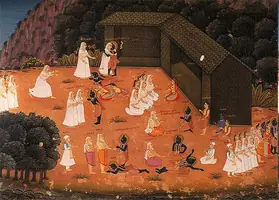
With Rama and Lakshmana both gone, Ravana came to the hut dressed as a wandering holy man. He asked Sita who she was, and why she lived in this dangerous forest.
Sita hesitated, but a guest must not be turned away. She invited him to rest and told him her story. She was the daughter of King Janaka of Mithila, and Rama’s wife. For twelve years they had lived happily in Ayodhya. Then, when King Dasharatha was about to crown Rama, Queen Kaikeyi had claimed her two boons, and Rama had come to the forest without a word of complaint, with Lakshmana and with her. Rama would be back soon, she said. And who was he?
The visitor dropped his pretence. I am Ravana, he said, king of the rakshasas, feared by gods and asuras alike. Since seeing you I take no joy in my own queens. Come to Lanka and be my chief queen, with gardens and five thousand maids.
Sita’s anger flashed. She belonged to Rama, steady as a mountain, deep as the ocean. Wanting her, she told Ravana, was like a jackal wanting a lioness, like trying to grasp the sun or pull a lion’s teeth. Rama and Ravana were as different as gold and lead, as sandalwood and mud, as a swan and a vulture. Then, having spoken so fiercely, she trembled like a plantain tree in the wind.
Into the sky
Ravana’s eyes turned red. He threw off his disguise and stood before her in his true form, huge and terrible, dressed in red, bow in hand. Forget this man, he told her: an exile who gave up his kingdom and will not live long. Then he seized Sita, and a golden chariot drawn by donkeys appeared. He put her in it and rose into the sky.
Sita cried out for Rama. She called to Lakshmana. She called to the flowering trees, to the mountains and to the Godavari river, to the spirits of the forest and to every bird and animal: tell Rama that Ravana has taken me. Rama would come for her, she said, even if Death himself had carried her off.
Then she saw Jatayu, the old vulture, sitting in a tree, and called to him to see what was happening and tell Rama and Lakshmana everything.
Jatayu’s fight
Jatayu rose against Ravana. The battle in the air was like storm clouds crashing together. Jatayu shook off Ravana’s arrows, broke his bow and tore his armour. He killed the donkeys, smashed the chariot and struck down the charioteer, and Ravana fell to the ground, still holding Sita.
You are walking into the noose of death, Jatayu warned him. The two sons of Raghu will never forgive this. This is a thief’s way, not a warrior’s. Remember Khara. Again and again he tore at Ravana, and even cut away some of his many arms, but new ones grew in their place.
At last Ravana set Sita down, drew his sword, and cut off Jatayu’s wings and feet. The old bird fell. Sita ran to him and held him, weeping. Then Ravana seized her again and flew on.
Ornaments on the mountain
As they passed over the forests, Sita saw five vanaras sitting on a mountaintop. Unseen by Ravana, she slipped off her silk upper cloth and her ornaments and let them fall among them, hoping they would somehow reach Rama.
Ravana flew on over rivers and lakes and across the ocean, and the sages and celestial beings watching said: Ravana, this is your end. He carried Sita into his palace in Lanka. He set fierce guards over her and ordered that she be given whatever she wished and that no one speak harshly to her. He sent eight rakshasas to Janasthana to watch Rama and report everything.
A blade of grass
When Ravana pressed her again, Sita, worn with grief but unafraid, placed a blade of grass between herself and him, and answered.
Rama is my husband and my god, she said, renowned in the three worlds. He will come with Lakshmana and take your life, as he took Khara’s. No god or demon can save you from him. Bind me or bury me, but I will never bring shame on my name.
Ravana gave her twelve months to change her mind, and ordered his rakshasis to break her will with threats and with coaxing. They took her to the Ashoka grove, full of fruit trees, flowers and birds. There, surrounded by fearsome guards like a doe among tigresses, Sita thought of Rama and fainted with grief.
End of chapter 18.
In this chapter
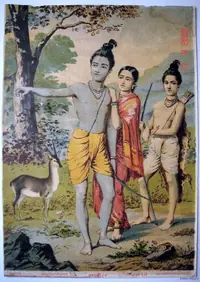 Person or deitySita
- Person or deityRavana
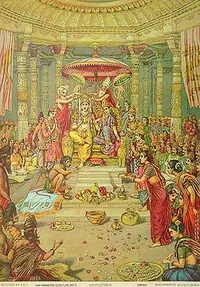 Person or deityRama
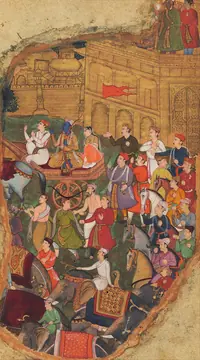 Person or deityLakshmana
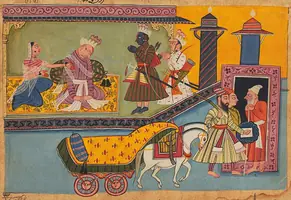 Person or deityKaikeyi
 Person or deityDasharatha
 Person or deityBharata
 Person or deityJanaka
 PlaceLanka
 PlaceAyodhya
Also named in this chapter
- Jatayu
- The great vulture, King Dasharatha's friend, who fights Ravana to save Sita.
- Khara
- Shurpanakha's brother, killed by Rama at Janasthana; Jatayu and Sita both remind Ravana of him.
- Raghu
- An ancestor of Rama's family; Jatayu calls Rama and Lakshmana the sons of Raghu.
Keep exploring
Sources
- Valmiki Ramayana, Aranya Kanda 3.47.1–50 · Verified
- Valmiki Ramayana, Aranya Kanda 3.49.1–41 · Verified
- Valmiki Ramayana, Aranya Kanda 3.51.1–46 · Verified
- Valmiki Ramayana, Aranya Kanda 3.54.1–28 · Verified
- Valmiki Ramayana, Aranya Kanda 3.56.1–36 · Verified