The Ramayana · Book 2, Ayodhya Kanda
Kaikeyi's two boons
Chapter 8 of 41 · 4 min read · as told in the Valmiki Ramayana, Ayodhya Kanda
Manthara’s warning
Manthara threw the ornament to the ground. Kaikeyi was a fool to rejoice, she said: she was standing in an ocean of sorrow and could not see it.
Kaikeyi did not give way at first. She praised Rama as truthful, pure and grateful, the eldest son and rightly the heir. He would care for his brothers like a father. Rama, she said, was as dear to her as Bharata, even dearer, because he served her more than he served his own mother. If the kingdom was Rama’s, it was Bharata’s too.
Manthara sighed and pressed on. Not every son can rule, she said. Rama would be king, then Rama’s son, and Bharata would be cut off from the royal line. Worse, a king with a rival brother might send him away, or harm him. Bharata had been sent to his uncle’s home as a boy, while Lakshmana stayed at Rama’s side. Kausalya, whom Kaikeyi had once slighted out of pride, would take her revenge. Kaikeyi would end up serving her co-wife like a maid.
Two old promises
Slowly, Kaikeyi’s face changed, flushed with anger. How, she asked, could Bharata have the kingdom instead of Rama?
Manthara reminded her of something long past. Once, in a war between the gods and the asuras, Dasharatha had gone to help Indra against the asura Shambara, and had taken Kaikeyi with him. The king was badly wounded, and Kaikeyi carried him, unconscious, out of the battle and saved his life. In gratitude he granted her two boons, to claim whenever she wished.
Now was the time, Manthara said. Ask for Bharata to be crowned, and for Rama to live in the forest for fourteen years. By the time Rama returned, Bharata would be firmly rooted. She told Kaikeyi how to do it: go to the chamber of anger, take off her jewels, lie on the bare floor in soiled clothes, and refuse to look at the king. He could not bear to see her unhappy. And she must not be bought off with gold and gems.
Kaikeyi praised Manthara’s counsel and promised her rich rewards. Then she went into the chamber of anger, took off her necklace and her ornaments, and lay on the ground. Either Bharata would have the kingdom, she said, or she would die.
The king in the dark room
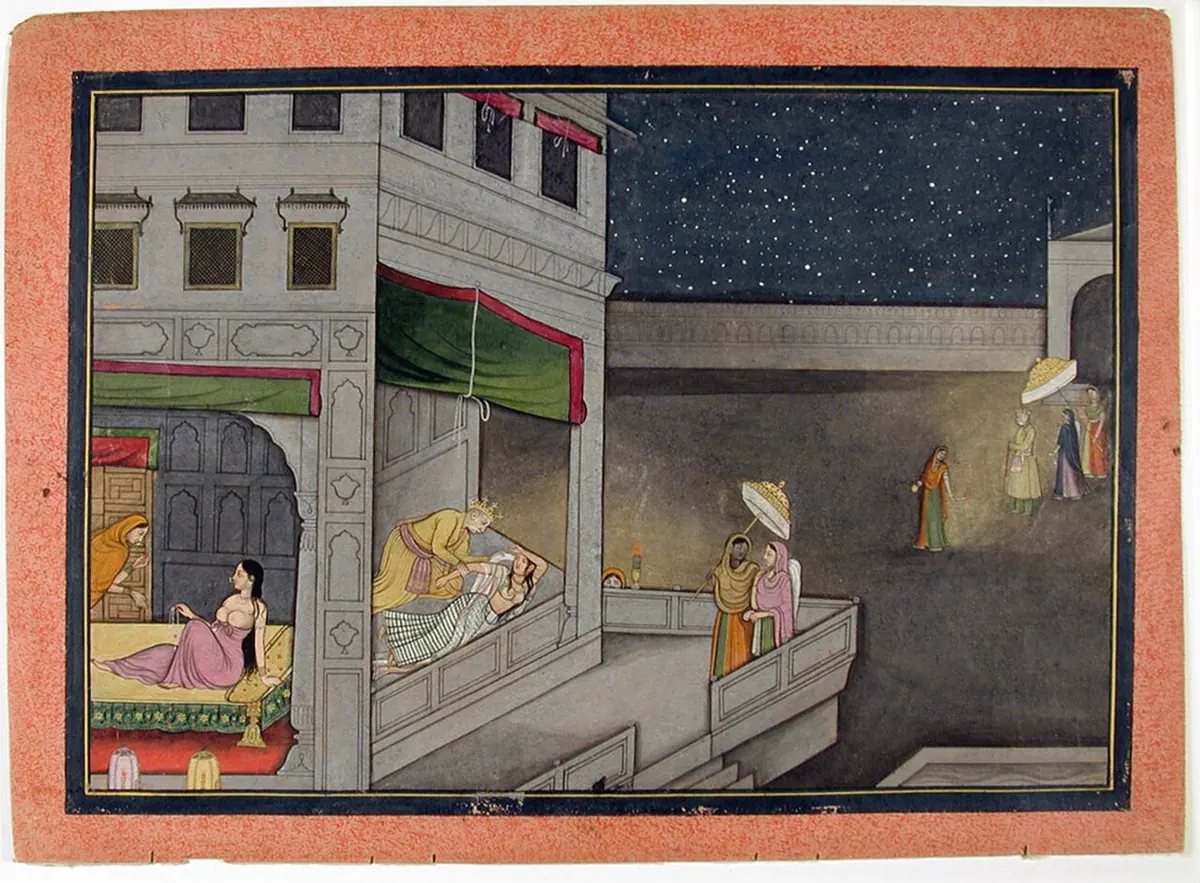
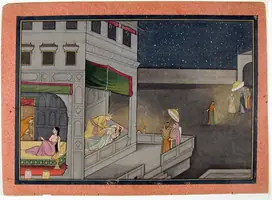
Dasharatha came to Kaikeyi’s palace, eager to share the good news. Her rooms were full of music, flowering trees and singing birds, but she was not there. A doorkeeper told him the queen had gone to the chamber of anger.
He found her lying on the floor and knelt beside her, stroking her as an elephant comforts its wounded mate. Had someone insulted her? Was she ill? He would send physicians. Whoever she wanted rewarded would be rewarded, whoever she wanted punished would be punished. He swore it on his good deeds. Everything a chariot wheel could reach was his, he said, and it was hers to ask for.
Kaikeyi then named her boons. Let Bharata be crowned, and let Rama go to live in the Dandaka forest as an ascetic.
The longest night
The king could not believe what he heard. Was it a dream? He sat trembling on the bare ground like a deer before a tigress, cried out, and fainted.
When he came to, he pleaded. What had Rama ever done to her? Rama honoured her like a son, more than Bharata did. He would give up anything, even his own life, sooner than give up Rama. He folded his hands and bowed at her feet. Bharata himself, he said, would never accept a kingdom that set Rama aside.
Kaikeyi only hardened. If he went back on his word, she said, how could he call himself righteous? She named King Shaibya, who gave his own flesh to a hawk, and King Alarka, who gave away his eyes, to keep their promises. Even the ocean keeps to its shore. If Rama was crowned, she would drink poison in front of him.
Dasharatha called Rama’s name and fell like a felled tree. Through the night he begged, then raged, then begged again. He asked the night not to end, so that he would not have to see the morning. When he touched her feet, she drew them away.
Morning comes
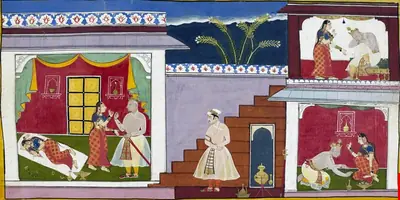
At dawn, Vasishtha arrived at the palace with his pupils and everything for the crowning: Ganga water in golden jars, the throne, the umbrella, the royal elephant. The city outside was garlanded and fragrant with incense. Vasishtha asked Sumantra, the king’s charioteer, to tell the king that all was ready.
Sumantra went in, praising the king and urging him to rise, as he did every morning. His words only deepened the king’s pain. Dasharatha could not speak. It was Kaikeyi who answered. The king had been awake all night with excitement, she said, and now he was asleep. Go and bring Rama.
Sumantra, believing Rama was being called to be crowned, hurried out gladly.
End of chapter 8.
In this chapter
 Person or deityKaikeyi
 Person or deityManthara
 Person or deityDasharatha
 Person or deityRama
 Person or deityBharata
 Person or deityLakshmana
 Person or deityShatrughna
- Person or deityKausalya
- Person or deityVasishtha
 PlaceAyodhya
Also named in this chapter
- Shambara
- An asura who challenged Indra in the war in which Dasharatha was wounded.
- Indra
- King of the gods, whom Dasharatha went to help in a war against the asuras.
- Shaibya
- A king who gave his own flesh to a hawk to keep his word; Kaikeyi names him as an example.
- Alarka
- A king who gave away his eyes to keep a promise; Kaikeyi names him too.
- Sumantra
- King Dasharatha's charioteer and minister, sent at dawn to bring Rama.
Keep exploring
 QuestionWhat were Kaikeyi's two boons?
- QuestionWho was Kaikeyi, and why did she ask for Rama's exile?
 QuestionWhy did King Dasharatha keep a promise that broke his heart?
Sources
- Valmiki Ramayana, Ayodhya Kanda 2.8.1–39 · Verified
- Valmiki Ramayana, Ayodhya Kanda 2.9.1–66 · Verified
- Valmiki Ramayana, Ayodhya Kanda 2.10.1–40 · Verified
- Valmiki Ramayana, Ayodhya Kanda 2.11.25–26 · Verified
- Valmiki Ramayana, Ayodhya Kanda 2.12.1–114 · Verified
- Valmiki Ramayana, Ayodhya Kanda 2.13.1–26; 2.14.1–69 · Verified