The Ramayana · Book 1, Bala Kanda
A king's wish for sons
Chapter 2 of 41 · 3 min read · as told in the Valmiki Ramayana, Bala Kanda
A king without a son
King Dasharatha of Ayodhya was mighty, righteous and given to austerity. Yet one sorrow stayed with him. He had no son to carry on his line.
Thinking it over, he resolved to perform the horse sacrifice, the ashvamedha, for the sake of sons. He sent his minister Sumantra to bring his teachers and priests: Suyajna, Vamadeva, Jabali, Kashyapa and the family priest, Vasishtha.
He told them plainly that without a son he could find no happiness, and asked them how the rite should be performed according to scripture. Vasishtha and the others approved. Gather what is needed, they said, and release the sacrificial horse. Your righteous wish will bring you the sons you long for.
The king, his eyes bright with joy, gave his orders. The sacrificial ground was to be made ready on the northern bank of the Sarayu river, and the horse released under capable guard. Every rule must be followed, he warned his ministers, for learned brahmarakshasas watch for any flaw, and a sacrifice done wrongly destroys the one who performs it.
Then he went to his queens and told them to begin the vows of the sacrifice. Their faces brightened, the epic says, like lotuses opening after the winter.
The rite for sons
When the horse sacrifice was done, the sage Rishyashringa, learned in the Vedas, began one more rite for the king: a sacrifice for the birth of sons, with mantras from the Atharva tradition. He made his offerings into the sacred fire.
Gods, gandharvas, siddhas and great sages gathered to receive their share of the offerings.
The gods’ complaint
Gathered there, the gods brought a grave matter to Brahma. Ravana, king of the rakshasas, had won a boon from Brahma himself, and now he tormented the three worlds. He harassed sages, gandharvas and brahmins, and he wanted to attack Indra, king of the gods. Because of the boon, the gods could neither restrain him nor punish him. They asked Brahma to find a way to end this.
Brahma reflected, and said that there was a way. When Ravana asked for his boon, he had asked to be safe from gods, gandharvas, yakshas, danavas and rakshasas. Out of contempt, he had not even mentioned human beings. So a human being could kill him.
Vishnu agrees
At that moment Vishnu arrived, bearing his conch, discus and mace. The gods bowed to him, praised him and made their request. Become the son of King Dasharatha of Ayodhya, they said. Be born to his three queens in four forms, and as a man, slay Ravana, whom the gods cannot defeat. You are the refuge of us all.
“Cast off your fear,” Vishnu told them. He would kill Ravana, with his kin and allies, and then rule the human world for a very long time. He considered where on earth he should be born, and, dividing himself into four, he chose King Dasharatha as his father.
A gift from the fire
Then, out of the sacrificial fire, a radiant being rose up, of immense splendour and strength. He was dark, dressed in red, with a voice like a drum. In his arms he carried a large golden vessel with a silver lid, full of divine payasa, a sweet dish cooked in milk.
He had been sent by Prajapati, the lord of creatures, he told the king. Give this to your worthy queens, he said, and through them you will have sons. The king took the vessel with great reverence and walked around the being in honour. He was as glad, the epic says, as a poor man who suddenly finds wealth. Then the being vanished.
Dasharatha went into the palace and divided the payasa. He gave half to Kausalya. Of what remained, he gave half to Sumitra. Of what was left, he gave half to Kaikeyi. Then, after a moment’s thought, he gave the last portion to Sumitra as well.
The three queens felt honoured and full of joy. They ate their portions, and before long all three were expecting children. Seeing this, the king’s heart was at peace at last.
End of chapter 2.
In this chapter
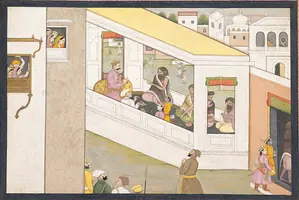 Person or deityDasharatha
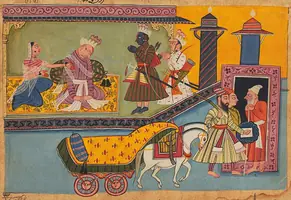 Person or deityKaikeyi
- Person or deityRavana
 PlaceAyodhya
- Person or deityVasishtha
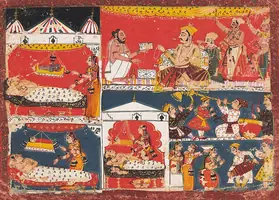 Person or deityKausalya
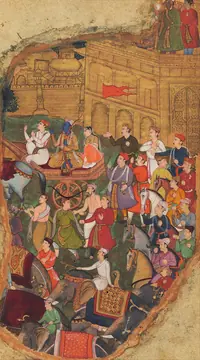 Person or deitySumitra
Also named in this chapter
- Sumantra
- Dasharatha's minister, sent to bring the priests.
- Suyajna, Vamadeva, Jabali, Kashyapa
- Teachers and priests whom Dasharatha consults about the sacrifice.
- Rishyashringa
- The sage, learned in the Vedas, who performs the rite for sons.
- Brahma
- The god whose boon protects Ravana from everyone except humans.
- Indra
- King of the gods, whom Ravana wanted to attack.
- Vishnu
- The god who agrees to be born as Dasharatha's sons, in four forms, to end Ravana.
- Prajapati
- The lord of creatures, who sends the radiant being with the payasa.
Sources
- Valmiki Ramayana, Bala Kanda 1.8.1–24 · Verified
- Valmiki Ramayana, Bala Kanda 1.15.1–33 · Verified
- Valmiki Ramayana, Bala Kanda 1.16.8–32 · Verified