The Ramayana · Book 7, Uttara Kanda
Hanuman's childhood
Chapter 39 of 41 · 3 min read · as told in the Valmiki Ramayana, Uttara Kanda
Many scholars see this last book as a later addition to the epic.
Rama’s question
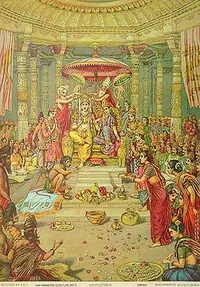
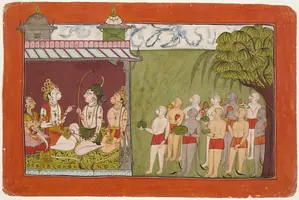
After Rama became king, the sage Agastya and many other sages came to Ayodhya, and Rama asked them about the past. One question had puzzled him. Hanuman is so strong, he said. Why did he not help Sugriva when Vali drove him out? Why did he wait for me?
Because of a curse, Agastya answered. Hanuman did not know his own strength. Let me tell you how it happened.
A child who leapt for the sun
On Mount Sumeru lived the vanara chief Kesari, and there his wife Anjana bore a son to Vayu, the Wind god.
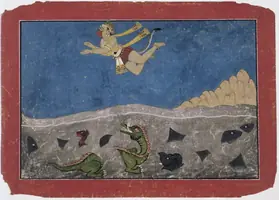
One morning the baby was hungry. He saw the sun rising, red as a ripe fruit, and leapt up into the sky to catch it. Surya, the Sun, did not burn him: he saw that it was only a child who did not know what he was doing.
That same day Rahu, who seizes the sun at an eclipse, came for the sun too, and found a child in his way. He went to Indra, king of the gods, to complain. Indra rode out on his white elephant Airavata, and the child, still hungry, leapt at the elephant, thinking it was another fruit.
Indra loosed his thunderbolt. It struck the child, who fell onto a mountain and broke his jaw.
The Wind withdraws
Vayu was furious. He lifted his son and carried him into a cave, and withdrew himself from the world. Without the wind, no creature anywhere could breathe. Prayers and rites stopped, and the three worlds suffered.
The gods went to Brahma, the creator, and Brahma went with them to the cave. There he saw the child lying still, shining in the darkness, and was moved with pity.
The gifts of the gods
Brahma touched the child, and he came back to life, like a seed that has been watered. Vayu was content, and the breath of life returned to every creature.
Then the gods gave the child their gifts. Indra said: because the thunderbolt struck his jaw, he will be called Hanuman, and my thunderbolt will never harm him again. The Sun gave him a share of his own radiance and the gift of eloquence once he had learned the scriptures. Varuna, Yama, Kubera and Shiva each promised that their weapons would never hurt him; Yama added that no illness would touch him. Vishvakarma promised that no weapon he had made would harm him. And Brahma said that no weapon of his would harm him either, that he would be invincible, and that one day he would help to destroy Ravana.
The sages’ curse
Full of these gifts, young Hanuman became very mischievous. He ran wild through the hermitages of the forest sages, scattering and breaking the things they used for their rites, and would not stop.
At last the sages of the families of Bhrigu and Angiras laid a curse on him. For a long time, they said, you will not know your own strength, until someone reminds you of it.
That is why, Agastya told Rama, Hanuman did not help Sugriva against Vali. He did not know what he could do. Only years later, on the shore of the southern sea, did old Jambavan remind him.
End of chapter 39.
In this chapter

Also named in this chapter
- Agastya
- A great sage, who tells Rama these stories after his return to Ayodhya.
- Vali
- Sugriva's elder brother, king of Kishkindha.
- Kesari
- A vanara chief, Anjana's husband, in whose home Hanuman is born.
- Anjana
- Hanuman's mother.
- Vayu
- The Wind god, Hanuman's father.
- Surya
- The Sun god.
- Rahu
- The being who seizes the sun and moon at an eclipse.
- Indra
- King of the gods, whose thunderbolt strikes the child Hanuman.
- Airavata
- Indra's white elephant.
- Brahma
- The creator god, who brings the child back to life.
- Varuna, Yama
- The god of the waters and the god of death, among the gods who bless Hanuman.
- Kubera
- The god of wealth, among the gods who bless Hanuman.
- Shiva
- One of the three great gods, among those who bless Hanuman.
- Vishvakarma
- The divine craftsman, who promises that no weapon he made will harm Hanuman.
- Jambavan
- The wise elder of the vanara army, king of the bears.
- Bhrigu, Angiras
- Ancient sages, from whose families come the ascetics Hanuman troubles.
Keep exploring
Sources
- Valmiki Ramayana (tr. Hari Prasad Shastri), Uttara Kanda sarga 35 · Verified
- Valmiki Ramayana (tr. Hari Prasad Shastri), Uttara Kanda sarga 36 · Verified
- Valmiki Ramayana, Kishkindha Kanda 4.66.1–38 · Verified