The Ramayana · Book 1, Bala Kanda
Vishvamitra asks for Rama
Chapter 4 of 41 · 4 min read · as told in the Valmiki Ramayana, Bala Kanda
The sage’s request
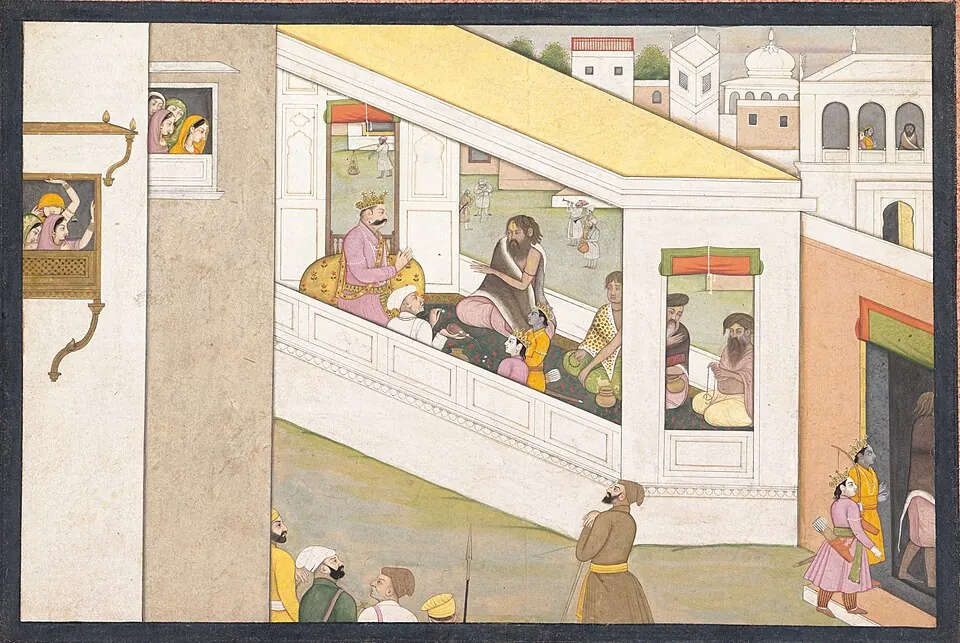
Vishvamitra was pleased with the king’s welcome, and told him why he had come. He was keeping a strict vow for a sacrifice, he said, and two rakshasas who could take any form they liked were ruining it. Their names were Maricha and Subahu. Each time the rite was nearly complete, they drenched the altar with blood and flesh. He could not curse them, because no curse may be spoken during such a vow. So he had left, worn out and discouraged.
“Give me your eldest son, Rama,” he said. Protected by the sage and by his own splendour, Rama could destroy them, and no one else could. Vasishtha and the other sages knew Rama’s worth as well as he did. “Don’t let a father’s attachment stand in the way. I need him for ten nights only.”
A father refuses
The words struck Dasharatha so hard that for a moment he lost his senses. When he could speak, he pleaded.
Rama is not yet sixteen, he said. He has never fought, and rakshasas fight by trickery. Take my army instead. I will come myself, bow in hand, and guard your sacrifice for as long as I live. I am sixty thousand years old, and I won this son only after great sorrow. I cannot bear to be parted from him for a moment.
He asked who these rakshasas were. Vishvamitra told him that they acted for Ravana, king of the rakshasas, who held a boon from Brahma and tormented the three worlds. At that name Dasharatha’s courage failed. Not even the gods can stand against Ravana in battle, he said. “I will not give you my son.”
Vasishtha’s counsel
Vishvamitra’s anger flared like a sacrificial fire fed with butter. The king had made a promise, he said, and was now going back on it, which was unworthy of his family. If so, he would leave just as he had come. The earth shook at his anger, and the gods were afraid.
Then Vasishtha spoke to the king. You are known in all three worlds as a righteous man, he said. Do not abandon dharma now. A broken promise ruins the merit of every sacrifice and every gift. With Vishvamitra beside him, Rama would be as safe as nectar guarded by fire. No one knew the divine weapons as Vishvamitra did. He could deal with the rakshasas himself. He was asking for Rama for Rama’s own good.
Dasharatha’s heart was eased, and he agreed.
Setting out
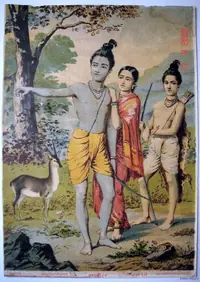
Rama’s parents and Vasishtha blessed him. The king kissed his son’s head and placed him in Vishvamitra’s care. As they left, a gentle breeze blew and flowers fell from the sky. Vishvamitra walked ahead, Rama followed with his bow in hand, and Lakshmana walked behind them.
After a little more than half a yojana along the southern bank of the Sarayu, the sage stopped. “Take water in your hands, my child,” he told Rama, “and receive the teachings called Bala and Atibala.” With them Rama would feel neither tiredness nor fever, hunger nor thirst, and no rakshasa could harm him even while he slept. Rama purified himself and received them with a glad face. That night the three slept on grass by the river, and it felt pleasant, the epic says, because of the sage’s kind words.
Tataka
On their way they came to a forest haunted by Tataka, a yaksha’s daughter of great strength who was skilled in sorcery, and Vishvamitra told Rama to kill her.
Rama joined his palms. His father, he said, had told him in Ayodhya, before the elders, to do whatever the sage asked. He would do it without doubt, for the good of the people and the land.
He twanged his bowstring. The sound filled the forest, and Tataka came rushing at them in a rage. Still Rama hesitated. She was a woman, and he meant only to stop her, not to kill her. She raised a cloud of dust and rained stones on the brothers. Rama cut off her hands with his arrows, and Lakshmana cut off her ears and the tip of her nose. Then she made herself invisible and kept up the hail of stones.
“Stop showing pity,” Vishvamitra called. She was a destroyer of sacrifices, he said, and she must be killed before dusk, when rakshasas grow stronger. When she charged at them again, Rama struck her in the chest with an arrow, and she fell.
The gods, led by Indra, cried “Well done!” and asked Vishvamitra to give Rama the divine weapons. The sage kissed Rama’s head. That night they rested in the forest, which had become lovely again, freed from its curse.
End of chapter 4.
In this chapter
 Person or deityDasharatha
 Person or deityRama
 Person or deityLakshmana
- Person or deityRavana
 PlaceAyodhya
- Person or deityVishvamitra
- Person or deityVasishtha
 Person or deityMaricha
Also named in this chapter
- Subahu
- A rakshasa who, with Maricha, keeps spoiling Vishvamitra's sacrifice, urged on by Ravana.
- Brahma
- The god whose boon Ravana holds.
- Tataka
- A yaksha's daughter of great strength, skilled in sorcery, who haunts the forest.
- Indra
- King of the gods, who leads them in praising Rama.
Sources
- Valmiki Ramayana, Bala Kanda 1.19.1–21 · Verified
- Valmiki Ramayana, Bala Kanda 1.20.1–27 · Verified
- Valmiki Ramayana, Bala Kanda 1.21.1–21 · Verified
- Valmiki Ramayana, Bala Kanda 1.22.1–23 · Verified
- Valmiki Ramayana, Bala Kanda 1.26.1–36 · Verified