The Ramayana · Book 1, Bala Kanda
Four princes are born
Chapter 3 of 41 · 3 min read · as told in the Valmiki Ramayana, Bala Kanda
The waiting
The great sacrifice came to an end. The gods received their shares and returned to their homes, the visiting kings went back to their own cities, and Dasharatha entered Ayodhya again with his queens. The sage Rishyashringa left too. And the king waited, his mind at ease, in the hope of sons.
Rama is born
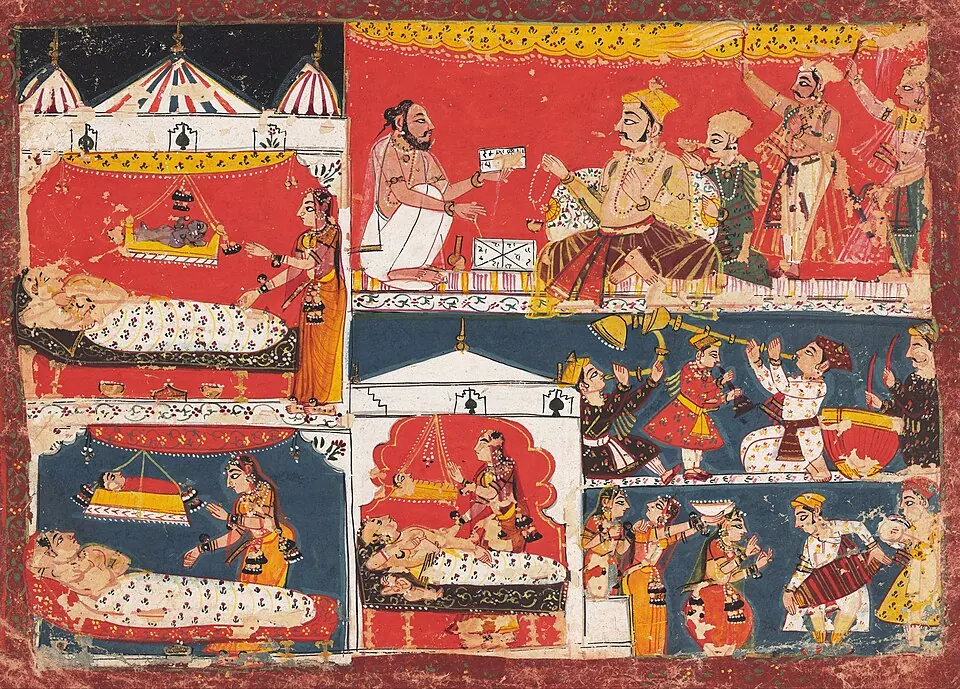
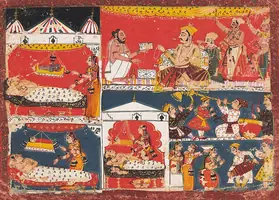
Six seasons passed. Then, in the month of Chaitra, on the ninth day of the bright half of the moon, Kausalya gave birth to Rama.
The epic marks the moment with care. The star Punarvasu was in the ascendant, five planets stood in exaltation and the sign of Karkata was rising. It speaks of the child as a part of Vishnu himself, and says Kausalya shone with her son as Aditi, mother of the gods, shone with Indra.
Many Hindus still celebrate Rama’s birth on this day, the ninth of the bright half of Chaitra, as Rama Navami.
Three brothers
Kaikeyi gave birth to Bharata, under the star Pushya. Sumitra gave birth to twins, Lakshmana and Shatrughna, under the star Ashlesha.
Ayodhya held a great festival. Gandharvas sang, apsaras danced, the drums of the gods sounded and flowers fell from the sky. The streets filled with crowds, singers and musicians, and the king gave generously to bards and to brahmins.
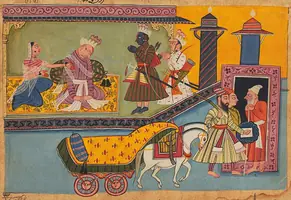
On the eleventh day, the naming ceremony was held. The family priest, Vasishtha, named the eldest Rama, Kaikeyi’s son Bharata, and Sumitra’s sons Lakshmana and Shatrughna.
Growing up
All four brothers grew up learned in the Vedas, brave and devoted to the good of others. Among them Rama stood out, a joy to his father and loved by everyone. He mastered riding elephants and horses, driving a chariot and, above all, the bow, and he served his parents with care.
From childhood, Lakshmana was devoted to his elder brother. He did everything that pleased Rama, the epic says, as if he were Rama’s own breath of life moving outside his body. Rama could not sleep without Lakshmana near, or enjoy fine food without sharing it with him. When Rama rode out hunting, Lakshmana followed with his bow to guard him.
In the same way, Shatrughna was dearer than life to Bharata, and Bharata to him.
Dasharatha delighted in his four sons as Brahma delights in the gods. They studied the Vedas, served their father and mastered archery. In time, the king began to talk with his priests and family about their marriages.
A visitor at the gate
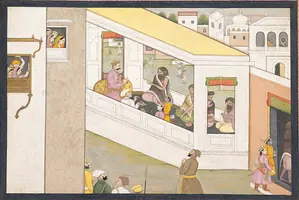
While the king sat in council, a visitor came to the palace gate. “Tell the king,” he said, “that Kaushika, son of Gadhi, has come.” It was the great sage Vishvamitra. The attendants hurried in with the news.
Dasharatha went out joyfully to meet him, as Indra goes out to welcome Brahma, and offered him water in welcome. Vishvamitra asked after the king’s city, his treasury, his family and his friends. He greeted Vasishtha and the other sages, and they all went in and took their seats.
The king could hardly contain his joy. Vishvamitra had once been a king, and by his own austerities had risen to be a brahmarshi, a sage of the highest rank. His visit, Dasharatha said, was like tasting nectar, like rain falling on parched land. Seeing him was as purifying as a pilgrimage.
“Tell me why you have come,” said the king. “You are like a god to me. Whatever you wish, I will do it in full.”
He did not yet know what the sage was going to ask for.
End of chapter 3.
In this chapter
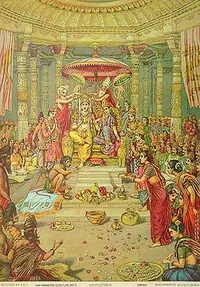 Person or deityRama
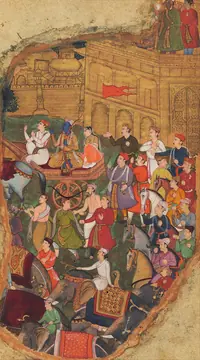 Person or deityLakshmana
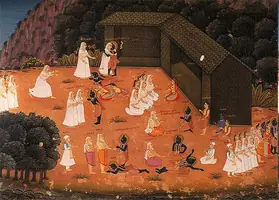 Person or deityBharata
 Person or deityDasharatha
 Person or deityKaikeyi
 PlaceAyodhya
- Person or deityVishvamitra
- Person or deityVasishtha
 Person or deityKausalya
- Person or deitySumitra
- Person or deityShatrughna
Also named in this chapter
- Rishyashringa
- The sage who performed the rite for sons.
- Vishnu
- The epic speaks of the newborn Rama as a part of Vishnu.
- Aditi
- Mother of the gods. Kausalya with her newborn son is compared to Aditi with Indra.
- Indra
- King of the gods, son of Aditi.
- Brahma
- Dasharatha delights in his sons as Brahma delights in the gods.
Keep exploring
Sources
- Valmiki Ramayana, Bala Kanda 1.18.1–15 · Verified
- Valmiki Ramayana, Bala Kanda 1.18.16–36 · Verified
- Valmiki Ramayana, Bala Kanda 1.18.37–58 · Verified