The Ramayana · Book 7, Uttara Kanda
Sita in Valmiki's ashram
Chapter 40 of 41 · 3 min read · as told in the Valmiki Ramayana, Uttara Kanda
Many scholars see this last book as a later addition to the epic.
What the people said
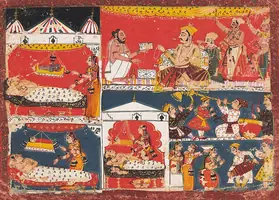
Rama ruled Ayodhya, and the city was at peace. One evening he asked his companion Bhadra a question. What do people say about me, he asked, and about Sita and my family? Tell me, so that I can put right whatever is wrong.
Bhadra told him. The people praised the bridge across the sea and the victory over Ravana. But they also said that Rama had taken back a wife who had lived in Ravana’s house. What a king does, they said, his people will follow. The others there confirmed it. It was true.
Rama’s decision
What happens next is one of the most painful passages in the whole epic, and it has been questioned and read in many different ways.
Rama called his brothers, Lakshmana, Bharata and Shatrughna. He told them what the people were saying. He knew that Sita was pure, he said; the gods themselves had declared it. But he feared dishonour more than death. He told Lakshmana to take Sita the next morning, with Sumantra driving the chariot, to the hermitage of the sage Valmiki across the Ganga, and to leave her there. Sita had once said she wished to visit the hermitages by the river; that would be the reason given. Do not argue with me, he said. Then he went to his rooms, weeping.
The journey
Sita was happy to be going. She packed jewels and fine clothes to give to the wives of the sages. But on the way she saw bad omens and felt uneasy, and she prayed for the queens and for everyone’s wellbeing.
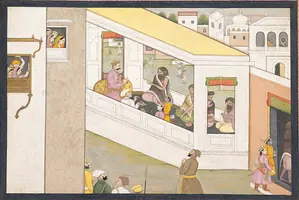
When they reached the Ganga, Lakshmana broke down and wept. They crossed the river by boat, and on the far bank he folded his hands and told her. The king has heard people speaking against you, he said. Though you are blameless in my eyes, he has given you up. Go to the sage Valmiki, my father’s friend. You will be safe with him.
Sita’s message
Sita fell to the ground. When she could speak again, she wept for her fate. But she would not end her life, she said, for she was carrying Rama’s children, and his line must go on.
Tell the queens I bow to them, she said to Lakshmana. Tell the king that I am pure, and that he has given me up for fear of dishonour. Let him care for his people as he cares for his brothers, and keep his good name. And she asked Lakshmana to see for himself, before he went, that she was carrying a child.
Lakshmana bowed to the ground and walked around her in respect. I have never looked at your face, he said, only at your feet. He crossed the river and drove away, looking back again and again at Sita, who stood weeping on the far bank.
Under Valmiki’s protection
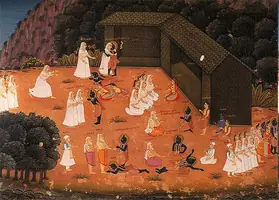
The young sons of the sages found her and ran to tell Valmiki. The sage already knew who she was. He came to the river and spoke gently to her. I know that you are pure, he said. You are under my protection now. Do not grieve.
Sita bowed at his feet and went with him. Valmiki placed her in the care of the women ascetics who lived near his hermitage. She is innocent, he told them, and her husband has given her up. Protect her and honour her.
Kusha and Lava
Some time later, Rama’s youngest brother Shatrughna stopped for a night at Valmiki’s hermitage on his way to a war. That night, Sita gave birth to twin sons.
The young ascetics brought the news to Valmiki at midnight. The sage came and performed a rite of protection for the babies with blades of kusha grass. He named the elder Kusha and the younger Lava, and said those names would be famous.
Shatrughna was overjoyed. He went to Sita and greeted her. Be happy, Mother, he said. In the morning he went on his way, and the boys grew up in the hermitage, in the care of their mother and of Valmiki.
End of chapter 40.
In this chapter
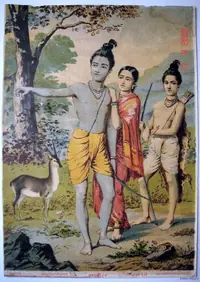 Person or deitySita
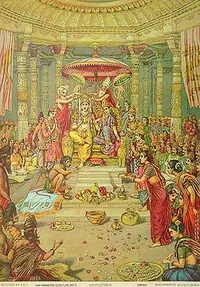 Person or deityRama
 Person or deityLakshmana
 Person or deityBharata
 Person or deityShatrughna
 Person or deityDasharatha
- Person or deityRavana
 PlaceAyodhya
Also named in this chapter
- Bhadra
- One of Rama's companions, who tells him what people are saying.
- Sumantra
- The royal charioteer of Ayodhya.
- Valmiki
- The sage who composed the Ramayana, a friend of King Dasharatha.
- Kusha, Lava
- The twin sons of Rama and Sita, born in Valmiki's hermitage.
Sources
- Valmiki Ramayana (tr. Hari Prasad Shastri), Uttara Kanda sargas 43–44 · Verified
- Valmiki Ramayana (tr. Hari Prasad Shastri), Uttara Kanda sarga 45 · Verified
- Valmiki Ramayana (tr. Hari Prasad Shastri), Uttara Kanda sargas 46–47 · Verified
- Valmiki Ramayana (tr. Hari Prasad Shastri), Uttara Kanda sarga 48 · Verified
- Valmiki Ramayana (tr. Hari Prasad Shastri), Uttara Kanda sarga 49 · Verified
- Valmiki Ramayana (tr. Hari Prasad Shastri), Uttara Kanda sarga 66 · Verified