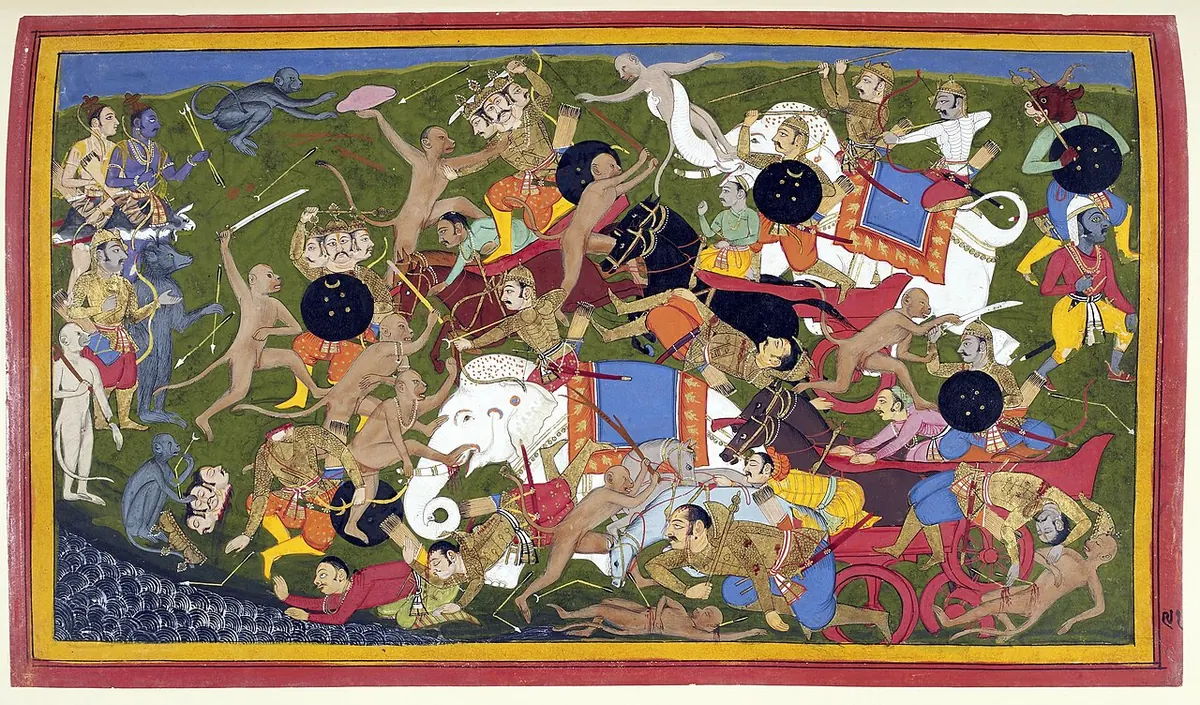
Story
The war in Lanka and Rama's return
Rama's army builds a bridge across the sea to Lanka, Rama kills Ravana with an arrow of Brahma, and he flies home to Ayodhya, where his brother Bharata hands back the kingdom and Rama is crowned.
Read the 5-minute story5 min read · told as scenes, from the Valmiki Ramayana, Yuddha Kanda
- The ocean god points to NalaNala, son of the divine craftsman Vishvakarma, can build a bridge.
- The vanaras build the bridge in five daysTrees and rocks span a hundred yojanas, and the army crosses to Lanka.
- Rama kills the demon king RavanaAn arrow first made by Brahma strikes Ravana's chest.
- Rama flies home in the Pushpaka chariotThe aerial chariot Ravana had taken from Kubera carries Rama, Sita and Lakshmana.
- Rama's brother Bharata returns the kingdomHe places Rama's sandals, kept on the throne for fourteen years, at Rama's feet.
- Rama is crowned in AyodhyaThe family priest Vasishtha places the crown on his head.
Understand more
Simple
Once Hanuman had found Sita, Rama led the vanara army to the sea. The ocean god told them that Nala, son of the divine craftsman, could build a bridge, and the army crossed to Lanka on it.
After a long war, Rama killed Ravana with a blazing arrow made by the god Brahma.
Rama, Sita and Lakshmana flew back to Ayodhya. His brother Bharata, who had ruled in Rama's name, came out to meet him and returned the kingdom. Rama was crowned king.
Detailed
Where the story is told
This is the Yuddha Kanda, the Book of War: the sixth of the seven books of the Valmiki Ramayana. It begins once Hanuman has brought back news of Sita, and ends with Rama crowned in Ayodhya. Explore next: The Ramayana in seven books
What the Valmiki Ramayana draws out
Many hands. The bridge to Lanka is not Rama’s work alone. The ocean god names Nala, a vanara who was the son of the divine craftsman Vishvakarma, as its builder, and the vanaras carry trees and rocks until it reaches the far shore. Explore next: Lanka
A weapon given, not made. The arrow that kills Ravana is one presided over by Brahma, given to Rama by the sage Agastya and first made for Indra. Rama’s charioteer Matali reminds him of it at the height of the battle.
A kingdom held in trust. For fourteen years Bharata refused the throne and ruled from Nandigrama with Rama’s sandals in Rama’s place. When Rama comes home in the Pushpaka, the aerial chariot Ravana had taken from Kubera, Bharata places the sandals at his feet and returns the kingdom. Explore next: Why did Bharata refuse to become king?
The epic describes Rama’s reign as a time without disease, fear or theft, when rain fell on time and trees bore fruit.
Where the story lives on
The festival of Dussehra celebrates Rama’s victory over Ravana. Explore next: Dussehra
In North India, Diwali celebrates his homecoming to Ayodhya. Explore next: Diwali
Keep exploring
 StoryHanuman's search for Sita
 PlaceLanka
 PlaceAyodhya
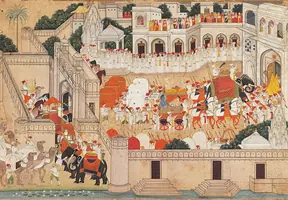 QuestionWhy did Bharata refuse to become king?
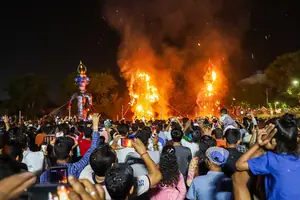 TraditionDussehra
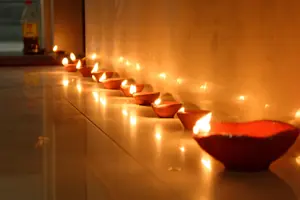 TraditionDiwali
- StoryThe Ramayana in seven books
Also named on this page
- Rama
- Rama is the central figure of the Ramayana, the eldest son of King Dasharatha of Ayodhya, and is worshipped by Hindus as the seventh avatar of Vishnu.
- Sita
- Sita is worshipped as an incarnation of the goddess Lakshmi and stands at the heart of the Ramayana as Rama's wife.
- Hanuman
- Hanuman is a vanara, son of the wind god, who served Rama with complete devotion.
- Bharata
- Bharata was Rama's younger brother, the son of King Dasharatha and Queen Kaikeyi.
- Lakshmana
- Lakshmana was Rama's younger brother, the son of King Dasharatha and Queen Sumitra.
- Ravana
- Ravana was the ten-headed king of the rakshasas who ruled Lanka.
- Vasishtha
- Vasishtha is the family priest of Ayodhya in the Valmiki Ramayana.
- Nala
- A vanara, son of the divine craftsman Vishvakarma, who built the bridge to Lanka.
- Vishvakarma
- The divine craftsman, father of Nala.
- Matali
- Rama's charioteer in the battle with Ravana.
- Agastya
- A sage who gave Rama the arrow made by Brahma.
- Brahma
- The god who made the arrow with which Rama killed Ravana.
- Indra
- The god for whom the arrow that killed Ravana was first made.
- Kubera
- From whom Ravana had taken the aerial chariot Pushpaka.
Sources
- Valmiki Ramayana, Yuddha Kanda 6.22.44–85 · Verified
- Valmiki Ramayana, Yuddha Kanda sarga 108 · Verified
- Valmiki Ramayana, Yuddha Kanda 6.127.16–61 · Verified
- Valmiki Ramayana, Yuddha Kanda 6.128.2–106 · Verified
- Valmiki Ramayana, Ayodhya Kanda 2.112.10–26; sarga 115 · Verified