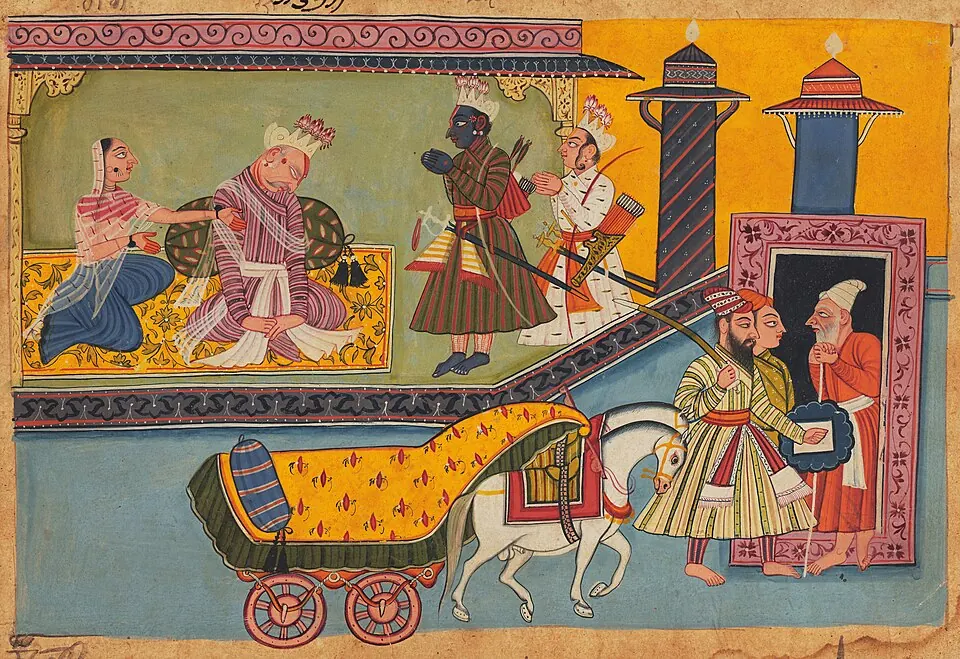
Person or deity
Kaikeyi
Kaikeyi was one of King Dasharatha's three queens, a princess of Kekaya and the mother of Bharata. In the Valmiki Ramayana she loved Rama, until her maid Manthara turned her fear for her own son against him and she claimed the two boons that sent Rama into exile.
- Family
- In her story
Kaikeyi: Princess of Kekaya and one of Dasharatha's queens
Tap a name to see who they are.
Understand more
Simple
Kaikeyi came from the royal house of Kekaya. She was one of King Dasharatha's queens, and her son was Bharata.
Long before, she had saved the wounded king in battle, and he had promised her two boons. When Rama was to be made heir, she was at first delighted. Her maid Manthara then convinced her that Bharata was in danger, and she used the boons to make Bharata heir and send Rama to the forest.
Her plan failed in the way that mattered most to her, because Bharata refused the throne. Later retellings, such as Tulsidas's Ramcharitmanas, see her as part of a divine plan and less to blame.
Detailed
A queen from Kekaya
Kaikeyi came from the royal house of Kekaya, whose king was Bharata’s maternal uncle. She was one of the three queens of King Dasharatha of Ayodhya, and the mother of Bharata. Explore next: Dasharatha
Two boons
Years before, when Dasharatha lay wounded and unconscious in a battle against the demon Shambara, Kaikeyi carried him from the field and protected him. In gratitude he promised her two boons, and she said she would ask for them when she needed them. Explore next: What were Kaikeyi’s two boons?
From joy to fear
When her maid Manthara brought news that Rama was to be made heir, Kaikeyi was delighted and gave her an ornament, saying Rama was as dear to her as her own son. Manthara warned that Rama’s mother Kausalya would rise, Kaikeyi would serve her like a maid, and Bharata might be sent away or worse. Afraid for her son, Kaikeyi claimed her boons: Bharata as heir, and Rama to the forest for fourteen years. Explore next: Who was Kaikeyi, and why did she ask for Rama’s exile?
What she won, and lost
Her own son rejected what she had done. Bharata blamed her for his father’s death and Rama’s exile, and refused the throne. Rama himself later asked Bharata not to hold bitterness towards her. Explore next: Bharata
How other tellings see her
In Tulsidas’s Ramcharitmanas, the gods pray to the goddess Saraswati, who turns Manthara’s mind. The exile then serves a divine purpose, and Kaikeyi appears less to blame. Explore next: Why are there many Ramayanas?
Where Kaikeyi appears in the Ramayana
Five-minute chapters from the Valmiki Ramayana. More are being added book by book.
Start here: The Ramayana in seven books
Book 1 · Bala Kanda
Book 2 · Ayodhya Kanda
- 7The crowning that wasn't
- 8Kaikeyi's two boons
- 9Rama accepts
- 10Across the Ganga to Chitrakuta
- 11A father's grief
- 12Bharata refuses the throne
- 13The sandals on the throne
Book 3 · Aranya Kanda
Book 6 · Yuddha Kanda
Keep exploring
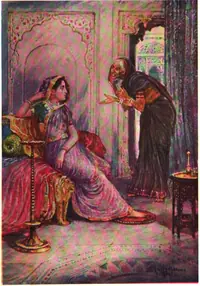 QuestionWho was Kaikeyi, and why did she ask for Rama's exile?
 QuestionWhat were Kaikeyi's two boons?
 QuestionWhy did King Dasharatha keep a promise that broke his heart?
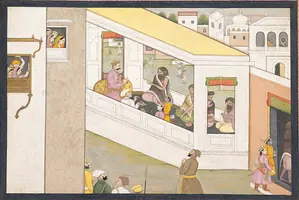 Person or deityDasharatha
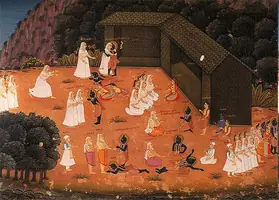 Person or deityBharata
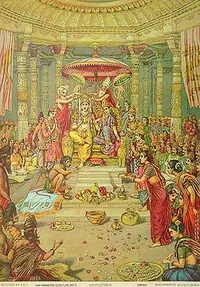 Person or deityRama
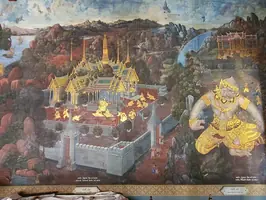 QuestionWhy are there so many versions of the Ramayana?
Also named on this page
- Ayodhya
- In the Ramayana, Ayodhya is the capital of the kingdom of Kosala, where Rama is born and later crowned.
- Lakshmana
- Lakshmana was Rama's younger brother, the son of King Dasharatha and Queen Sumitra.
- Kausalya
- Kausalya is King Dasharatha's senior queen and the mother of Rama in the Valmiki Ramayana.
- Manthara
- Manthara is Queen Kaikeyi's maid in the Valmiki Ramayana, with her since her birth.
- Shambara
- A demon. Dasharatha was wounded fighting him, and Kaikeyi saved his life.
- Tulsidas
- Poet of the Ramcharitmanas, a later retelling of the Rama story.
- Saraswati
- A goddess. In Tulsidas's Ramcharitmanas the gods pray to her, and she turns Manthara's mind.
Sources
- Valmiki Ramayana, Ayodhya Kanda 2.1.46 · Verified
- Valmiki Ramayana, Ayodhya Kanda 2.7.32; 2.8.9–39 · Verified
- Valmiki Ramayana, Ayodhya Kanda 2.9.11–21; 2.11.25–26 · Verified
- Valmiki Ramayana, Ayodhya Kanda sarga 73; 2.112.18–19 · Verified
- Ramcharitmanas (Tulsidas), Ayodhya Kand doha 11–12 · Verified