Question
Why are there so many versions of the Ramayana?
The story of Rama spread across languages, regions and centuries, and each retelling shaped it for its own audience and devotion. Valmiki's Sanskrit epic is the oldest surviving telling, but poets in Tamil, Bengali, Awadhi and across Southeast Asia created their own.
- Valmiki Ramayana (Sanskrit)The oldest surviving telling; probably not before 300 BCE.
- Iramavataram, by Kampan (Tamil)Kampan lived about 1180–1250.
- Krittibas's Ramayana (Bengali)
- Ramcharitmanas, by Tulsidas (Awadhi)Tulsidas lived about 1543–1623.
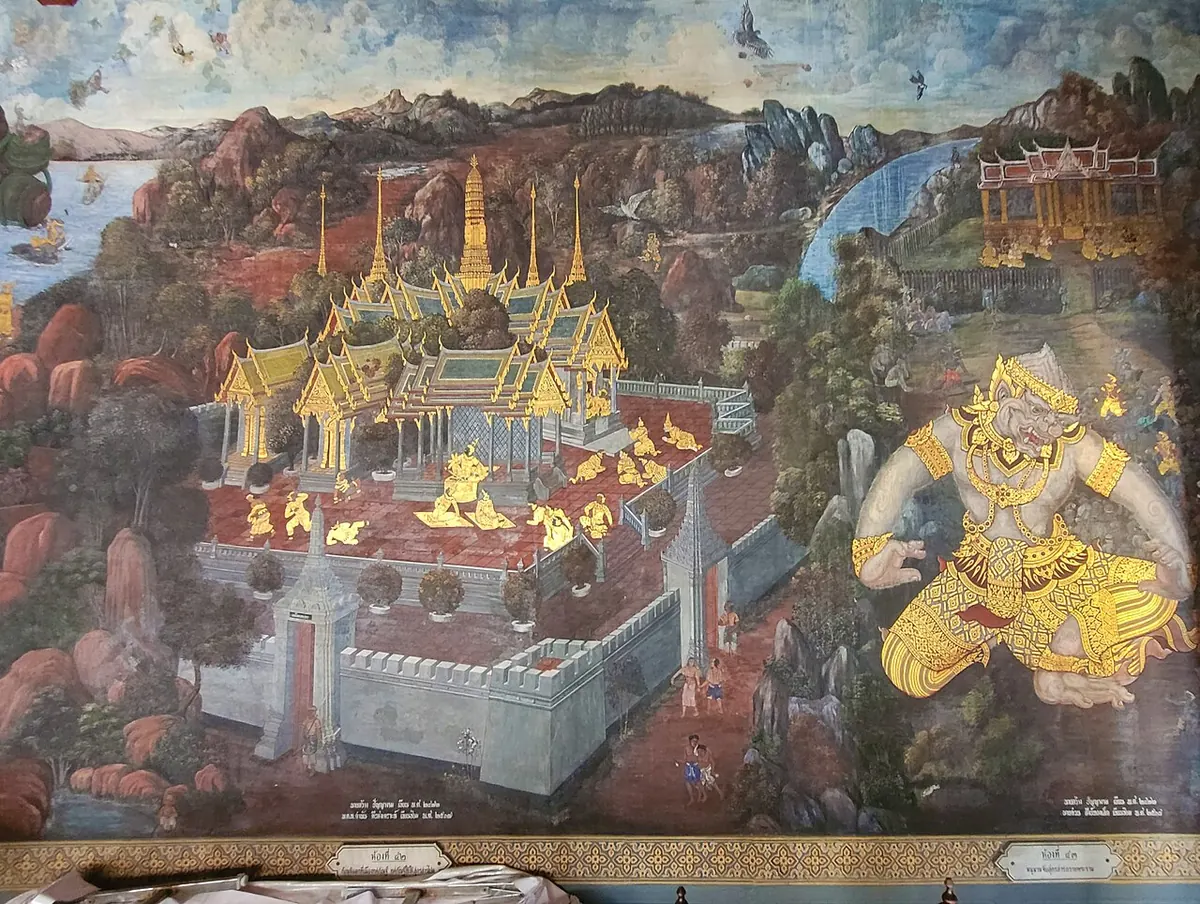
- Ramakien (Thailand) and other Southeast Asian tellings
Understand more
Simple
The Ramayana was first passed on by word of mouth and only written down much later. As it travelled, poets retold it in their own languages and for their own listeners.
Some retellings stress Rama as a perfect king and man. Others, like Tulsidas's Ramcharitmanas, are songs of devotion to Rama as God. The story also travelled to Thailand, Cambodia and Indonesia, where it took local forms. None of these is simply a copy; each is a telling in its own right.
Detailed
A story that travelled
The Ramayana began as an oral poem and was written down much later. Over the centuries it spread through India and beyond, into Cambodia, Indonesia and Thailand, where Thailand’s Ramakien became the basis of the classical khon dance-drama.
Retold, not copied
Each poet told the story for their own audience:
- Kampan’s Tamil Iramavataram is based on Valmiki but much longer, about 40,000 lines. It draws on Tamil poetry and devotion and presents Rama above all as an incarnation of Vishnu, an object of intense devotion.
- Tulsidas’s Ramcharitmanas, in Awadhi, is a song of bhakti, loving devotion, to Rama. It draws mainly on the Adhyatma Ramayana, which itself goes back to Valmiki.
- Krittibas’s Bengali Ramayana is another of the great regional retellings.
Why it matters
Because the tellings differ, the same event can be told in different ways. Rama’s exile is a good example: Valmiki and Tulsidas explain Manthara’s role differently. Explore next: Why did Rama go into exile? Respecting the Ramayana means respecting that variety, rather than treating one version as the only true one.
Read it in the Ramayana
Five-minute chapters from the Valmiki Ramayana. More are being added book by book.
Start here: The Ramayana in seven books
Book 1 · Bala Kanda
Keep exploring
 QuestionWhat is the Ramayana, and who wrote it?
 QuestionWhy did Rama go into exile?
- StoryThe Ramayana in seven books
 StoryShiva's bow and the wedding of Rama and Sita
Also named on this page
- Rama
- Rama is the central figure of the Ramayana, the eldest son of King Dasharatha of Ayodhya, and is worshipped by Hindus as the seventh avatar of Vishnu.
- Manthara
- Manthara is Queen Kaikeyi's maid in the Valmiki Ramayana, with her since her birth.
- Valmiki
- The sage-poet of the Sanskrit Ramayana, the oldest surviving telling.
- Kampan
- Tamil poet of the Iramavataram, who lived about 1180 to 1250.
- Krittibas
- Poet of a Bengali Ramayana, one of the great regional retellings.
- Tulsidas
- Poet of the Ramcharitmanas in Awadhi, who lived about 1543 to 1623.
- Vishnu
- Kampan's telling presents Rama above all as his incarnation.
Sources
- Encyclopaedia Britannica, "Ramayana" · Verified
- Encyclopaedia Britannica, "Kampan" · Verified
- Encyclopaedia Britannica, "Tulsidas" · Verified