The Ramayana · Book 3, Aranya Kanda
Shabari's welcome
Chapter 19 of 41 · 4 min read · as told in the Valmiki Ramayana, Aranya Kanda
The empty hut
Rama was hurrying back through the forest, full of foreboding, when he saw Lakshmana coming towards him alone. Where is Sita? he cried. Why have you left her? The cry they had heard must have been the rakshasa’s trick, and now she was alone.
They ran to the hut. It was empty. The deerskins and grass mats lay scattered, and the forest itself seemed to grieve, its flowers withered.
Perhaps she had gone to gather flowers, Rama thought, or to fetch water from the river. He ran from tree to tree, from hill to hill, from river to river, calling her name. He asked the kadamba tree, the ashoka, the bilva: have you seen her? He asked a deer, an elephant, a tiger. Sometimes he imagined she was hiding among the trees, teasing him; sometimes he feared the rakshasas had killed her. He searched everywhere and would not give up hope.
Jatayu’s last words
In his grief, anger rose in Rama. Lakshmana calmed him: the wise stay steady in trouble. Let us search the forest carefully. Rama listened, and they went on, bows ready.
They found Jatayu lying in his blood, huge as a fallen mountain peak. At first Rama thought he was a rakshasa who had devoured Sita. But the old bird spoke in a faint voice. Ravana had taken her, he said. He had fought Ravana, broken his chariot and his bow, and Ravana had cut off his wings. Do not kill me, he said.
Rama threw down his bow and held the dying bird, weeping. Jatayu told them Ravana had flown south with Sita, and that Rama would win her back. He named Ravana’s father, Vishravas, and then he died, as Rama begged him to say more.
Rama mourned Jatayu as he would have mourned his own father. Even among birds and animals, he said, there are brave and good souls. Jatayu deserved the same honour as King Dasharatha. With Lakshmana he built a pyre, performed the funeral rites, and offered water for him at the Godavari, praying that he reach the highest worlds.
Kabandha
The brothers pressed on through dense forest. Suddenly a huge creature blocked their path: Kabandha, headless, with a single eye and a mouth in his belly, and arms a yojana long. He seized them both. Lakshmana begged Rama to escape and save Sita. Rama told him not to despair, and the brothers cut off the giant’s arms.
Kabandha fell, and asked who they were. When he heard Rama’s name, he rejoiced. Long ago, he said, he had been a shining son of Danu, but a sage’s curse and a blow from Indra had left him in this form. Only Rama could free him. Burn my body, he asked, and I will tell you who can help you.
They burned his body on a pyre. Kabandha rose from the fire, shining, in a chariot drawn by swans. Go to Sugriva, he told Rama, the vanara who lives on Mount Rishyamuka by Lake Pampa. His brother Vali has driven him out. Make him your friend, with fire as witness. His vanaras will search every mountain and river until they find Sita.
Shabari
On the western shore of Lake Pampa the brothers came to a hermitage among the trees. An aged woman ascetic lived there, Shabari, with matted hair and bark clothes. When she saw them she rose, folded her hands, and touched their feet. She gave them water to wash their feet and to drink, as one welcomes an honoured guest.
Rama asked gently about her austerities. Today they are complete, she told him, because I have seen you. Long ago, when Rama first came to Chitrakuta, the sages she served had gone up to heaven. Before they left they had told her: Rama will come to this hermitage with Lakshmana, and you must welcome him. So she had waited, and gathered for him the fruits and roots that grow on the shores of Pampa.
Many people know this moment from a later, much-loved telling, in which Shabari tastes each berry first and keeps only the sweetest for Rama. Valmiki does not tell that detail. It comes from later devotional tellings, among them Priyadas’s commentary on the Bhaktamal, written around 1712.
She showed them the Matanga forest where her teachers had lived: the ford where they had bathed, the altars still glowing, the bark clothes they had hung on the trees, which had never dried, and the flowers of their worship, which had never withered. Then she asked Rama’s leave to join them.
Rama, full of wonder, said: you have honoured me with devotion. Go as you wish. Shabari offered herself into the sacred fire and rose from it, radiant as a flame, to the world of the great sages.
On to Pampa
Rama felt that his bad fortune was passing. He and Lakshmana went on to the beautiful Lake Pampa, bright with lotuses, with Mount Rishyamuka rising on its bank. There lived Sugriva, the son of the Sun. Our search for Sita depends on him, Rama said, and they went to find him.
End of chapter 19.
In this chapter
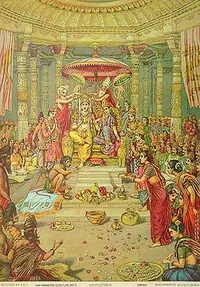 Person or deityRama
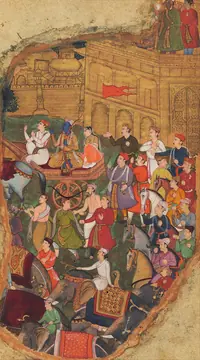 Person or deityLakshmana
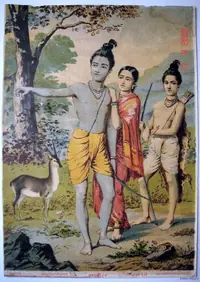 Person or deitySita
- Person or deityRavana
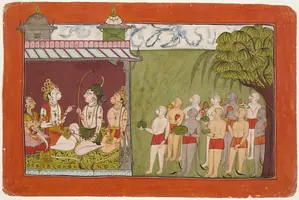 Person or deitySugriva
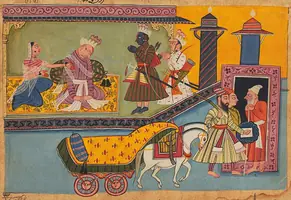 Person or deityKaikeyi
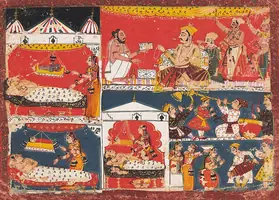 Person or deityKausalya
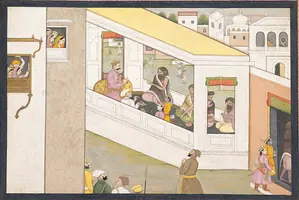 Person or deityDasharatha
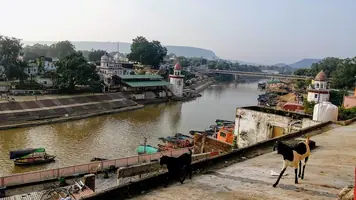 PlaceChitrakuta
Also named in this chapter
- Jatayu
- The great vulture, King Dasharatha's friend, who dies after fighting Ravana for Sita.
- Kabandha
- A son of Danu, cursed into a headless form, freed by Rama, who sends him to Sugriva.
- Shabari
- An aged woman ascetic at Lake Pampa who waited many years to welcome Rama.
- Vali
- Sugriva's elder brother, a vanara king, who has driven Sugriva out.
- Danu
- The mother of the danavas; Kabandha was once her son.
- Indra
- King of the gods, whose thunderbolt left Kabandha in his headless form.
- Vishravas
- Ravana's father, whom the dying Jatayu names.
- Matanga
- The sage whose forest hermitage Shabari served in, by Lake Pampa.
Sources
- Valmiki Ramayana, Aranya Kanda 3.58.1–19; 3.60.1–38 · Verified
- Valmiki Ramayana, Aranya Kanda 3.67.1–29; 3.68.1–38 · Verified
- Valmiki Ramayana, Aranya Kanda 3.69.26–51; 3.71.1–33; 3.72.1–27 · Verified
- Valmiki Ramayana, Aranya Kanda 3.74.1–35 · Verified
- Valmiki Ramayana, Aranya Kanda 3.75.1–30 · Verified
- Philip Lutgendorf, Dining Out at Lake Pampa: The Shabari Episode in Multiple Ramayanas · Verified