The Ramayana · Book 6, Yuddha Kanda
Sita's ordeal by fire
Chapter 36 of 41 · 4 min read · as told in the Valmiki Ramayana, Yuddha Kanda
“Who will be angry with servants?”
Hanuman went into the Ashoka grove and bowed to Sita. Rama has won, he told her. Ravana is dead. Sita was so overjoyed that for a while she could not speak.
Then Hanuman looked at the rakshasi guards who had threatened her for so long. Let me punish them, he said. Sita would not allow it. They only did what their king told them to do, she said. Who will be angry with servants who act under orders? Hanuman said her words were more precious than diamonds. Then Sita gave him her message for Rama: I long to see my husband.
Before everyone
Vibhishana brought Sita to Rama. A great crowd of vanaras, bears and rakshasas had gathered, and the guards began to push them back. Rama stopped them. Let them see her, he said.
Sita came before him at last, after so long.
Rama’s words
What happened next is one of the most painful moments in the whole epic, and Valmiki tells it plainly.
Rama spoke the anger he had kept hidden. He had fought this war, he said, to wipe out the insult to his name and his family, not for her sake. She had lived a long time in another man’s house, and no man of honour would take her back. She was free to go wherever she wished, and he named those she might turn to, his brothers among them. Valmiki gives Rama’s words in full, and they are harder still.
Sita’s eyes filled with tears.
Sita answers
Then Sita answered him. I am not what you imagine, she said. Judge me by my own conduct. When I was carried away I had no power to stop it, but my heart was always yours. If you were going to reject me, why did you send Hanuman to me? I could have given up my life then.
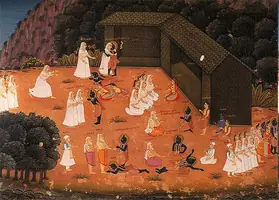
She turned to Lakshmana. Build a fire for me, she said. It is the only answer left.
Lakshmana looked at Rama in anger. But Rama said nothing, and Lakshmana, reading his brother’s face, built the fire.
Sita walked around Rama in respect, folded her hands, and prayed. If my heart has never turned away from Rama, she said, may Agni, the fire who sees all things, protect me on every side. And she stepped into the flames. A great cry went up from everyone watching.
The fire gives her back
Then the gods came down to Rama in their shining chariots: Brahma, Indra, Shiva and the others. How can you stand by while Sita enters the fire? they asked. Do you not know who you are? Rama answered: I think of myself as a man, Rama, son of Dasharatha. Then tell me who I am. You are Narayana himself, said Brahma, and Sita is Lakshmi.
The flames parted, and Agni, the god of fire, rose out of the pyre in his own form, holding Sita in his arms. She was unharmed, her clothes and garlands just as before. Here is your Sita, Agni said to Rama. There is no fault in her, not in word, nor in thought, nor even in a glance.
Rama’s eyes filled with tears. I knew her heart was mine alone, he said, and that Ravana could not even come near her, for she was protected by her own radiance. But if I had taken her back without this, people would have said that Rama was a fool ruled by desire. I let her enter the fire so that the three worlds would believe. She is as much a part of me as light is of the sun. And Rama took Sita back.
How this moment should be read has been asked by devotees, poets and scholars for centuries, and they have answered it in many different ways. Some later tellings, among them the Adhyatma Ramayana and Tulsidas’s Ramcharitmanas, say that the Sita whom Ravana carried off was only a shadow, and that Agni had kept the real Sita safe until this moment. Valmiki does not tell it that way.
A father’s blessing
Then, in a shining chariot in the sky, King Dasharatha appeared. Rama and Lakshmana bowed to their father, and he took Rama on his lap and embraced him. Seeing you safe, he said, my sorrow is gone.
Rama asked one thing of him: to forgive Kaikeyi and Bharata. Dasharatha blessed Lakshmana for his loyal service. And he spoke gently to Sita. Do not hold on to resentment over what has happened, he told her. Then he rose and returned to the world of Indra.
End of chapter 36.
In this chapter
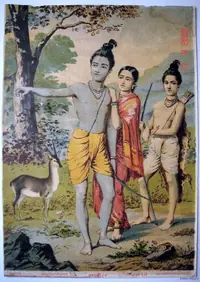 Person or deitySita
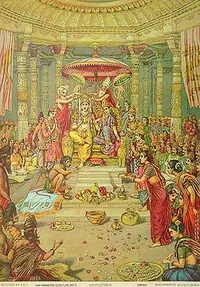 Person or deityRama
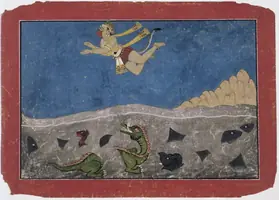 Person or deityHanuman
 Person or deityLakshmana
 Person or deityVibhishana
 Person or deityDasharatha
 Person or deityKaikeyi
 Person or deityBharata
- Person or deityRavana
Also named in this chapter
- Agni
- The god of fire, witness of all that people do, who returns Sita from the flames.
- Brahma
- The creator god, who tells Rama who he truly is.
- Narayana
- A name of Vishnu, the preserver.
- Lakshmi
- The goddess of fortune, Vishnu's consort.
- Indra
- King of the gods, to whose world Dasharatha returns.
- Shiva
- One of the great gods, among those who come to Rama.
- Tulsidas
- A sixteenth-century poet-saint who retold the Ramayana in Awadhi as the Ramcharitmanas.
Sources
- Valmiki Ramayana, Yuddha Kanda sarga 113 · Verified
- Valmiki Ramayana, Yuddha Kanda sarga 117 (vedapath numbering) · Verified
- Valmiki Ramayana, Yuddha Kanda 6.118.1–25 (vedapath numbering) · Verified
- Valmiki Ramayana, Yuddha Kanda 6.119.6–28 (vedapath numbering) · Verified
- Valmiki Ramayana, Yuddha Kanda sarga 120 (vedapath numbering) · Verified
- Valmiki Ramayana, Yuddha Kanda 6.121.11–22 (vedapath numbering) · Verified
- Valmiki Ramayana, Yuddha Kanda 6.122.7–39 (vedapath numbering) · Verified
- Wikipedia, "Maya Sita" (citing Wendy Doniger, "The Shadow Sita and the Phantom Helen", 1999, and others) · Verified