Person or deity
Hanuman
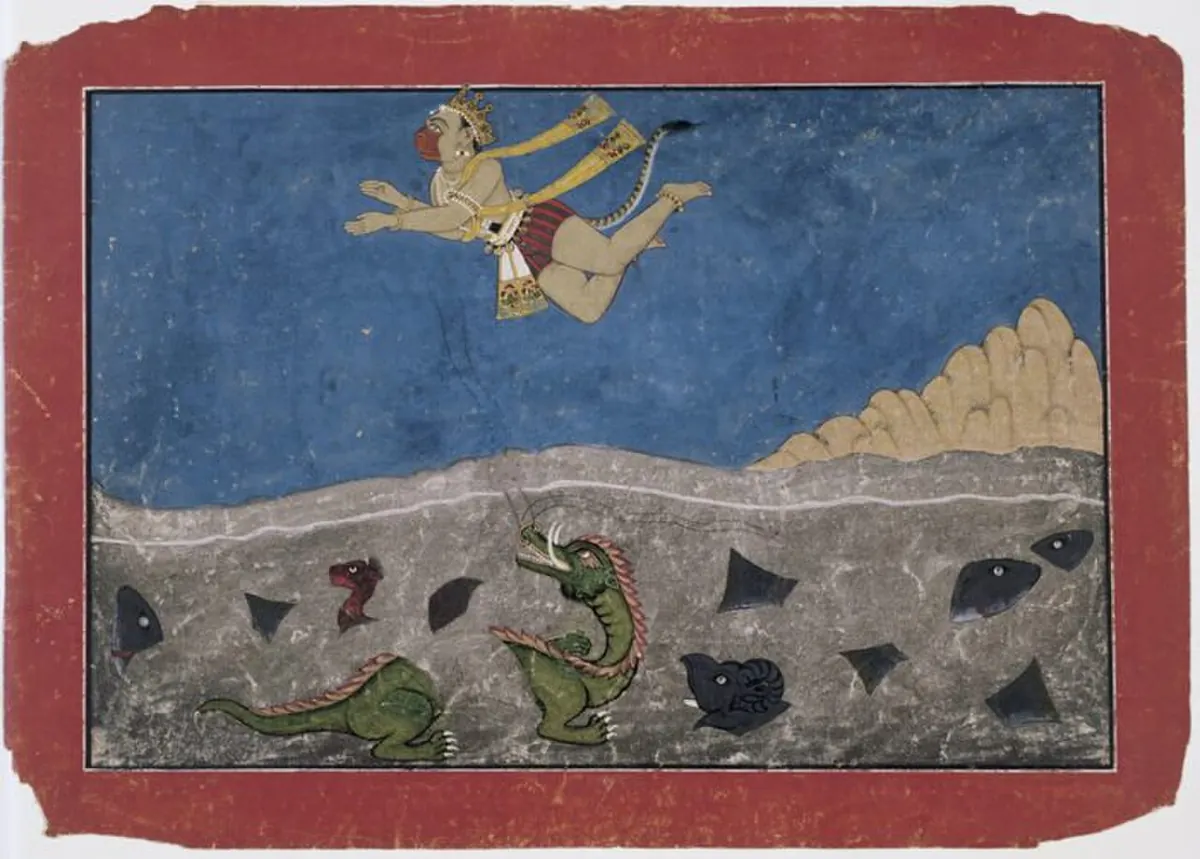
Hanuman is a vanara, son of the wind god, who served Rama with complete devotion. He found Sita in Lanka, and Hindus worship him in his own shrines and in Rama's temples as a model of bhakti, loving devotion.
Divine origin
Traditions differ, so each view is shown with its source.
Family and companions
- Father
- Served
- In his story
Hanuman: A vanara of great power; a model of devotion
Tap a name to see who they are.
Understand more
Simple
Hanuman is a vanara, one of the monkey people of the Ramayana. He is the son of the wind god, and has wondrous powers, such as flying and growing to an enormous size.
He was minister to the vanara prince Sugriva, and brought Sugriva and Rama together as allies. He then crossed the sea to find Sita, and later flew to the Himalayas for a mountain of healing herbs for Rama's wounded army.
Hindus worship Hanuman for his devotion to Rama, in his own shrines and in Rama's temples. He is popular far beyond India too.
Detailed
Who he is
Hanuman is a vanara, one of the monkey people of the Ramayana, and a commander in the vanara army. Britannica describes him as the son of the wind god and a nymph (in Sanskrit, an apsara, a celestial woman). He has wondrous powers: he can fly and can make himself enormous.
How he met Rama
Hanuman was minister to Sugriva, an exiled vanara prince. Sent to find out who two armed strangers were, he came to Rama and Lakshmana in disguise, and Rama was struck by how well he spoke. Hanuman then kindled a sacred fire before which Rama and Sugriva swore friendship. Explore next: Who is Hanuman, and why did he help Rama?
What he did
He crossed the sea to Lanka in a single leap, found Sita in the Ashoka grove and gave her Rama’s ring. When his tail was set on fire, he used it to burn the city. Later he flew to the Himalayas and brought back a whole mountain of healing herbs for Rama’s wounded army. Explore next: Hanuman’s search for Sita
Hanuman in worship
Hanuman is worshipped in shrines of his own and alongside Rama in Rama’s temples, and is upheld as a model for all human devotion (bhakti). His story still shapes festivals: in Kullu, in Himachal Pradesh, Dussehra ends with a bonfire representing Hanuman burning Lanka. He is also a popular figure among Buddhists in Central, Southeast and East Asia. Explore next: Dussehra
Where Hanuman appears in the Ramayana
Five-minute chapters from the Valmiki Ramayana. More are being added book by book.
Start here: The Ramayana in seven books
Book 1 · Bala Kanda
Book 4 · Kishkindha Kanda
- 20Hanuman meets Rama
- 21Sugriva and Vali
- 22The rains, and a promise remembered
- 23The search parties set out
- 24Sampati and the ocean shore
Book 5 · Sundara Kanda
Book 6 · Yuddha Kanda
- 29Vibhishana seeks refuge
- 30The bridge to Lanka
- 31The first battles
- 32Kumbhakarna wakes
- 33The mountain of herbs
- 34Indrajit's last battle
- 35Rama and Ravana
- 36Sita's ordeal by fire
- 37The return to Ayodhya
Book 7 · Uttara Kanda
Keep exploring
 QuestionWho is Hanuman, and why did he help Rama?
 StoryHanuman's search for Sita
 Person or deityRama
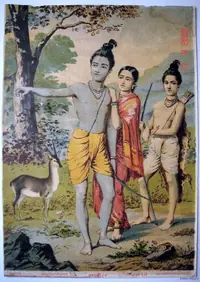 Person or deitySita
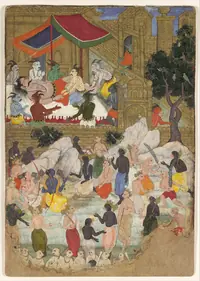 PlaceLanka
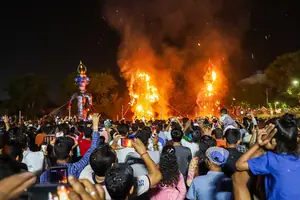 TraditionDussehra
Also named on this page
- Lakshmana
- Lakshmana was Rama's younger brother, the son of King Dasharatha and Queen Sumitra.
- Ravana
- Ravana was the ten-headed king of the rakshasas who ruled Lanka.
- Sugriva
- Sugriva is the vanara prince who became Rama's sworn ally in the Valmiki Ramayana.
- Shiva
- One of the three great gods; in the Shiva Purana, Hanuman is a form of Shiva.
- Vayu
- The wind god, Hanuman's father in the Valmiki Ramayana.
Sources
- Encyclopaedia Britannica, "Hanuman" · Verified
- Valmiki Ramayana, Kishkindha Kanda 4.3.1–35; 4.5.12–31 · Verified
- Valmiki Ramayana, Sundara Kanda sarga 15; 5.36.2–4; sarga 54 · Verified
- Encyclopaedia Britannica, "Dussehra and Vijayadashami" · Verified
- Valmiki Ramayana, Bala Kanda 1.17.1–3, 1.17.9, 1.17.15 · Verified
- Shiva Purana, Shatarudra Samhita, chapter 20 20.4–9, 20.37 · Verified