Question
Who is Hanuman, and why did he help Rama?
Hanuman is a vanara, son of the wind god and minister to the vanara prince Sugriva. He helped Rama because Rama and Sugriva became sworn allies, and he became Rama's most devoted servant, remembered by Hindus as a model of devotion.
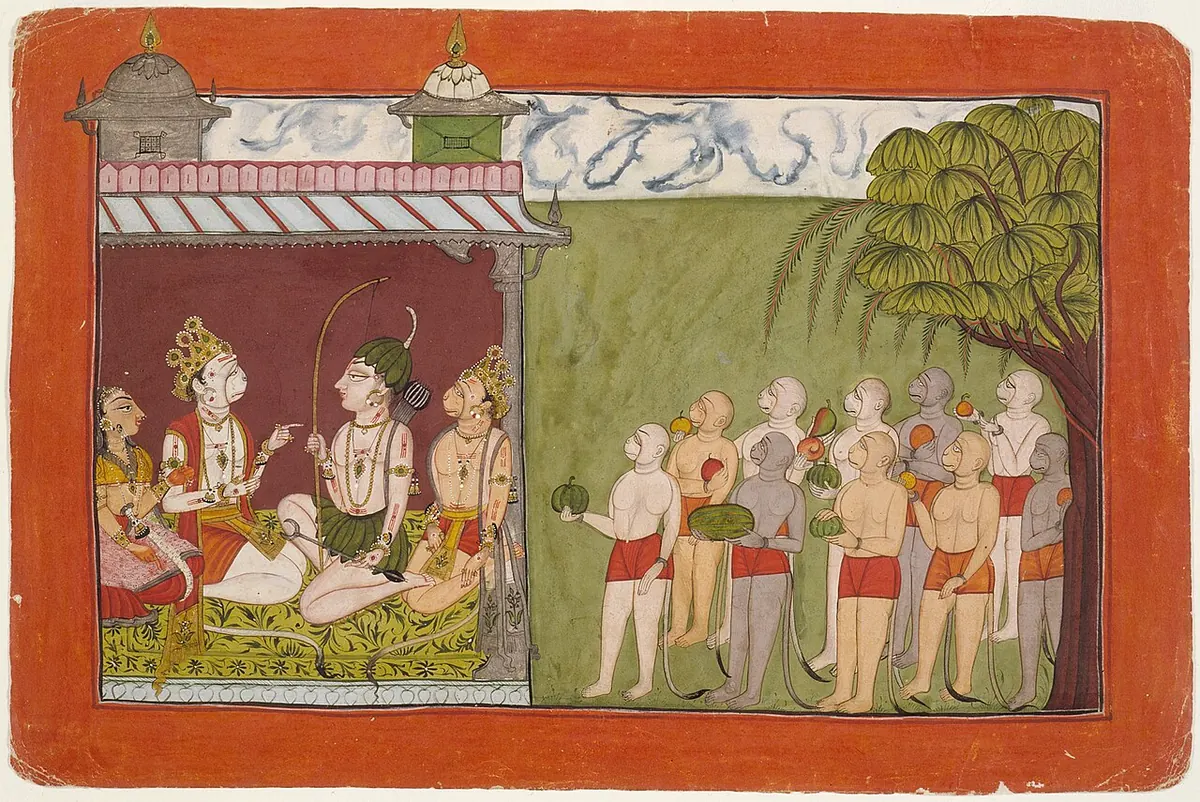
- An exiled vanara prince sends HanumanSugriva sends his minister to meet Rama and Lakshmana; Hanuman comes disguised as a mendicant.
- Rama and Sugriva swear friendshipHanuman kindles a fire; Rama and Sugriva circle it as witness.
- Each promises to help the otherRama will face Sugriva's brother Vali; Sugriva will help recover Rama's wife Sita.
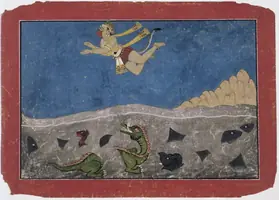
- Hanuman leaps across the seaHanuman crosses the sea to Lanka in search of Sita.
Understand more
Simple
While searching for Sita, Rama and Lakshmana met Hanuman. He came to them in disguise, sent by Sugriva, an exiled vanara prince. Hanuman was the son of the wind god and could change his shape and move at great speed.
Hanuman brought Rama and Sugriva together. They swore friendship before a sacred fire. Rama promised to help Sugriva against his brother Vali, and Sugriva promised to help find Sita. Hanuman then leapt across the sea to Lanka and found her.
Detailed
The first meeting
Sugriva, a vanara prince driven out by his brother Vali, sees two armed strangers and sends his minister Hanuman to find out who they are. Hanuman puts aside his own form and comes as a mendicant. He introduces himself as the son of the wind god and Sugriva’s minister. Rama is struck by how well he speaks and praises his learning and his clear, measured words.
Why he helped
Hanuman brings Rama and Sugriva together. He kindles a sacred fire, and the two circle it as witness to their friendship. Rama vows to deal with Vali, who has taken Sugriva’s wife and kingdom; Sugriva promises to make every effort so that Rama gets Sita back. From then on Hanuman serves Rama’s cause as his own.
What he did
Hanuman leads the search for Sita, crossing the sea to Lanka in a single leap. When his tail is set on fire there, he uses it to burn the city. Later he flies to the Himalayas and brings back a mountain of healing herbs for Rama’s wounded army.
Hanuman in devotion
Beyond the epic, Hanuman is worshipped in his own shrines and in Rama’s temples, and is upheld as a model of bhakti, loving devotion. That place in worship comes from living tradition, not from the epic alone. Explore next: What is the Ramayana, and who wrote it?
Read it in the Ramayana
Five-minute chapters from the Valmiki Ramayana. More are being added book by book.
Book 4 · Kishkindha Kanda
Book 5 · Sundara Kanda
Book 7 · Uttara Kanda
Keep exploring
 QuestionWhy did Ravana take Sita?
 QuestionWhat is the Ramayana, and who wrote it?
 Person or deityHanuman
 StoryHanuman's search for Sita
Also named on this page
- Rama
- Rama is the central figure of the Ramayana, the eldest son of King Dasharatha of Ayodhya, and is worshipped by Hindus as the seventh avatar of Vishnu.
- Sita
- Sita is worshipped as an incarnation of the goddess Lakshmi and stands at the heart of the Ramayana as Rama's wife.
- Lanka
- Lanka is Ravana's island fortress across the sea, where he held Sita captive.
- Lakshmana
- Lakshmana was Rama's younger brother, the son of King Dasharatha and Queen Sumitra.
- Sugriva
- Sugriva is the vanara prince who became Rama's sworn ally in the Valmiki Ramayana.
- Vali
- Sugriva's brother, who had driven him out.
- Tara
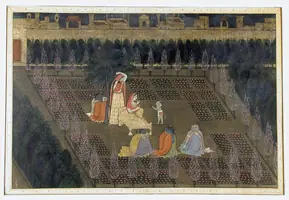
- In the painting above, she sits with Sugriva in the palace of Kishkindha.
Sources
- Valmiki Ramayana, Kishkindha Kanda 4.3.1–35 · Verified
- Valmiki Ramayana, Kishkindha Kanda 4.5.12–31 · Verified
- Valmiki Ramayana, Kishkindha Kanda 4.7.3–4 · Verified
- Encyclopaedia Britannica, "Hanuman" · Verified