The Ramayana · Book 6, Yuddha Kanda
The bridge to Lanka
Chapter 30 of 41 · 3 min read · as told in the Valmiki Ramayana, Yuddha Kanda
Three nights on the shore
Rama had done as Vibhishana advised. He lay on a bed of sacred grass on the shore, facing the ocean, with folded hands, and waited for the Ocean to answer him. One night passed, then a second, then a third. The waves came and went, and the Ocean did not appear.
Rama’s anger
Then Rama’s patience ended. When the good are gentle with those who do not deserve it, he told Lakshmana, their gentleness is taken for weakness. Bring my bow and arrows. He drew it and sent arrow after arrow blazing into the water. The sea boiled and heaved, and its great creatures were thrown about in pain. Rama set another arrow to his bow, ready to dry up the ocean altogether.
Lakshmana sprang forward and caught hold of the bow. Enough, he said. Come back to yourself.
The Ocean rises
Then, out of the middle of the water, the Ocean himself rose, shining like a mountain at sunrise, adorned with jewels and surrounded by his rivers. He came before Rama with joined palms.
Every element keeps its own nature, he said, and mine is to be deep and hard to cross. I cannot change that, not out of desire, fear or anger. But I will help you. Build a bridge, and I will hold it up, and my crocodiles will not attack the army as it crosses.
The arrow on Rama’s bow could not be taken back. Send it north, said the Ocean, to Drumakulya, where wicked beings trouble my waters. Rama loosed it, and where it struck, the land dried and became the desert of Maru. Rama blessed that land, and it became rich in herbs and fruit and good for cattle.
Nala’s bridge
There is a vanara in your army named Nala, the Ocean went on, son of Vishvakarma, the craftsman of the gods. He has his father’s skill. Let him build it.
Nala bowed to Rama. It is true, he said; my father gave me this gift, and I will build it with his skill. Let the vanaras bring me what I need.
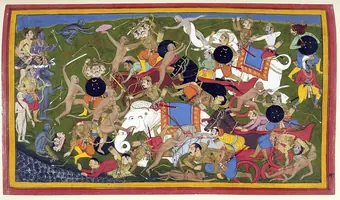
So the vanaras went into the forests in their thousands. They pulled up trees and broke off rocks and whole mountain tops, and carried them to the shore. Some held cords a hundred yojanas long to keep the line straight. Nala laid them in the sea, and the Ocean held them up.
On the first day the bridge reached fourteen yojanas out from the shore. On the second day it reached twenty more, and then twenty-one, and twenty-two, and on the fifth day twenty-three, until it touched the far side: a hundred yojanas long and ten wide. The gods and sages gathered in the sky to see it.
Two much-loved details of this moment, the little squirrel who helped carry sand and the stones that floated because Rama’s name was written on them, come from later retellings and folk tradition. Valmiki does not tell them.
Across the sea
Sugriva asked Rama to ride across on Hanuman’s shoulders, and Lakshmana on Angada’s. Rama went at the front of the army, and behind him came a roaring flood of vanaras and bears. Some ran along the bridge, some took great leaps, and some flew through the sky like Garuda. On the far shore Sugriva camped the army in a place with plenty of fruit, roots and water.
The war was about to begin.
End of chapter 30.
In this chapter
 Person or deityRama
 Person or deityLakshmana
 Person or deityVibhishana
 Person or deitySugriva
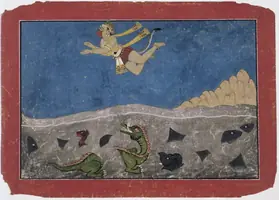 Person or deityHanuman
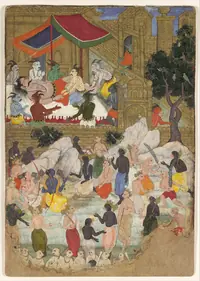 PlaceLanka
Also named in this chapter
- Angada
- Vali's son, a vanara prince, who carries Lakshmana across.
- Garuda
- The great eagle who carries Vishnu, to whom the flying vanaras are compared.
- Nala
- A vanara, son of the divine craftsman Vishvakarma, who built the bridge.
- Vishvakarma
- The divine craftsman of the gods, Nala's father.
Sources
- Valmiki Ramayana, Yuddha Kanda sarga 21 · Verified
- Valmiki Ramayana, Yuddha Kanda sarga 22 · Verified