The Ramayana · Book 5, Sundara Kanda
Lanka burns
Chapter 28 of 41 · 4 min read · as told in the Valmiki Ramayana, Sundara Kanda
The messenger makes himself known
Hanuman had found Sita, but his work was not yet finished. A good messenger, he reasoned, may do more than he was sent for, as long as it never harms his main task. He wanted to see Ravana’s strength for himself, and to let Ravana know that Rama’s friends had found his city. So he began to tear up the Ashoka grove.
The guards ran to Ravana, and Ravana sent warriors against the vanara. Hanuman fought them all off. Then Ravana sent his young son Aksha, in a chariot drawn by eight horses. Hanuman admired the prince’s courage and skill and did not want to kill him. But an enemy left unchecked grows like a spreading fire, he decided, and Aksha fell.
Bound before Ravana
Now Ravana sent his eldest son, Indrajit, the greatest of his warriors. Neither could get the better of the other, until Indrajit loosed the Brahma weapon and Hanuman fell, bound by its power. He could have freed himself, but out of respect for Brahma he let it hold him. And he was glad: this way he would be taken to Ravana.
The rakshasas tied him with ropes and dragged him to the palace. There sat Ravana on his throne among his ministers, blazing with power. Even Hanuman was struck by his splendour. If wrongdoing were not so strong in him, Hanuman thought, this king of the rakshasas could have been a protector of the gods themselves.
Hanuman spoke calmly. I am the messenger of Sugriva, king of the vanaras, he said, and of Rama. He told the whole story: Rama’s exile, Sita’s loss, the alliance with Sugriva, and the search. Taking another man’s wife is against dharma, he said. No one in the three worlds can stand against Rama’s arrows. Give Sita back, and save yourself, your family and your city.
A tail on fire
Ravana, furious, ordered him killed. But his brother Vibhishana stood up. A messenger must never be killed, he said, whatever he has done. Punish him some other way.
So Ravana chose humiliation instead. The tail is a vanara’s pride, he said. Set it on fire, and parade him through the streets. The rakshasas wrapped Hanuman’s tail in cloth soaked in oil and set it alight, and led him through the city.
In the grove, Sita heard what was happening. She prayed to Agni, the god of fire: if I have been true, be cool to Hanuman. The flames on his tail burned bright, but Hanuman felt no pain, only a coolness, and he knew it was by Sita’s grace.
Lanka in flames
Hanuman shrank, slipped out of his ropes, and grew again. He leapt to the rooftops and ran from house to house with his blazing tail, setting the mansions of Ravana’s great warriors alight one by one, and at last Ravana’s own palace. But he passed by Vibhishana’s house and left it untouched. The wind fanned the flames until fire surrounded the whole city, and the rakshasas fled in terror.
Then a terrible thought stopped him. If all of Lanka was burning, had Sita burned too? What have I done? he cried, and for a moment he was ready to give up his life. Then he heard the Charanas, celestial beings in the sky, marvelling that the whole city had burned and yet Sita was unharmed. He went back to the grove and saw her with his own eyes. Only then did he turn for home.
Home with the news
Hanuman leapt back across the ocean. On Mount Mahendra the vanaras heard him roaring as he came, and knew from the sound that he had succeeded. They crowded round him with fruit and roots. Hanuman bowed to Jambavan and Angada, and said simply: Sita has been seen.
On their way back to Kishkindha, the vanaras celebrated in Sugriva’s own honey garden, Madhuvana, eating the fruit and drinking the honey, and chasing off the keepers. Their keeper, Dadhimukha, hurried to Sugriva to complain. But Sugriva was glad. They would never have done this, he told Rama, unless Hanuman had found Sita.
The jewel
Hanuman came before Rama and told him everything. Sita was alive, held in Ravana’s grove, refusing Ravana, wearing her hair in a single braid. She had a month left. Then he gave Rama the crest jewel.
Rama pressed it to his heart and wept. Her father, King Janaka, had given her this jewel at their wedding, and it had shone in her hair. Tell me again what she said, he asked Hanuman. Tell me again and again. I cannot live a moment longer without her. Take me to the place where you saw her.
End of chapter 28.
In this chapter
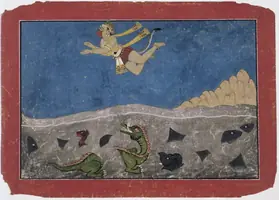 Person or deityHanuman
- Person or deityRavana
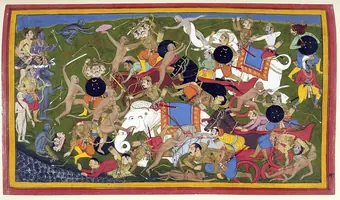 Person or deityVibhishana
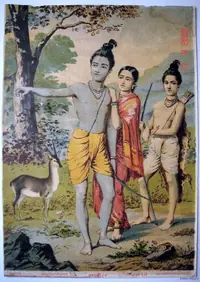 Person or deitySita
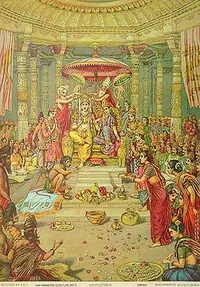 Person or deityRama
 Person or deityLakshmana
 Person or deitySugriva
 Person or deityJanaka
 PlaceLanka
Also named in this chapter
- Aksha
- Ravana's young son, who attacks Hanuman in the grove.
- Indrajit
- Ravana's eldest son, a great warrior, who binds Hanuman with the Brahma weapon.
- Brahma
- The creator god, whose weapon Hanuman honours by letting it bind him.
- Agni
- The god of fire, to whom Sita prays to keep Hanuman from harm.
- Angada, Jambavan
- Leaders of the search party, waiting for Hanuman on Mount Mahendra.
- Dadhimukha
- The vanara who keeps Sugriva's honey garden, Madhuvana.
Keep exploring
Sources
- Valmiki Ramayana, Sundara Kanda sarga 41 · Verified
- Valmiki Ramayana, Sundara Kanda sarga 47 · Verified
- Valmiki Ramayana, Sundara Kanda sarga 48 · Verified
- Valmiki Ramayana, Sundara Kanda 5.49.17–18 · Verified
- Valmiki Ramayana, Sundara Kanda 5.51.1–46 · Verified
- Valmiki Ramayana, Sundara Kanda 5.53.6–42 · Verified
- Valmiki Ramayana, Sundara Kanda 5.54.1–47; sarga 55 · Verified
- Valmiki Ramayana, Sundara Kanda sarga 57; 5.62.1–40; 5.63.17–28 · Verified
- Valmiki Ramayana, Sundara Kanda sarga 65; 5.66.1–15 · Verified