Person or deity
Vasishtha
Vasishtha is the family priest of Ayodhya in the Valmiki Ramayana. He names the four princes, counsels King Dasharatha to keep his word, conducts the weddings at Mithila, and crowns Rama king when he returns from exile.
- He approves the sacrifice for sonsWith the other priests, when King Dasharatha has no son.
- He names the four princesRama, Bharata, Lakshmana and Shatrughna, on the eleventh day.
- He counsels the king to keep his wordRama goes with Vishvamitra, as safe "as nectar guarded by fire".
- He conducts the weddings at MithilaHe prepares the altar and lights the sacred fire.
- He sends for BharataAfter Dasharatha's death, messengers ride to Kekaya.
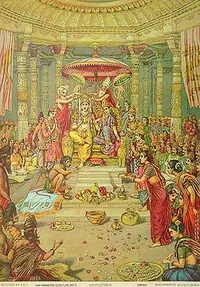
- He crowns RamaThe sages consecrate Rama, and Vasishtha places the crown.
Understand more
Simple
Vasishtha is the purohita, the family priest, of King Dasharatha's royal house. He supports the king's great sacrifice for sons and names the four princes on the eleventh day after their birth.
When the king will not let Rama go with the sage Vishvamitra, Vasishtha reminds him that a broken promise ruins all merit. Later he conducts the four weddings at Mithila.
After the king's death he sends messengers to bring Bharata home, and at the end of the exile he leads the sages who consecrate Rama and places the crown on his head.
Detailed
The family priest
In the Valmiki Ramayana, Vasishtha is the purohita of Ayodhya, the priest of King Dasharatha’s royal house. When the king, still without a son, resolves on a great sacrifice, Vasishtha and the other priests approve it. When the four princes are born, it is Vasishtha who names them on the eleventh day: Rama, Bharata, Lakshmana and Shatrughna. Explore next: Dasharatha
Keeping a king’s word
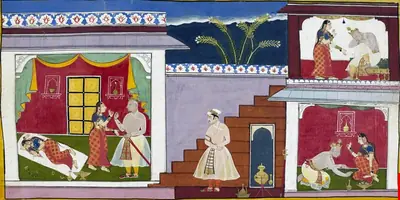
When the sage Vishvamitra asks for Rama to guard his sacrifice, the king refuses. Vasishtha counsels him: a king known for righteousness must not abandon dharma, and a broken promise ruins the merit of every sacrifice and gift. With Vishvamitra beside him, he says, Rama will be as safe as nectar guarded by fire. The king lets Rama go. Explore next: Vishvamitra
The weddings at Mithila
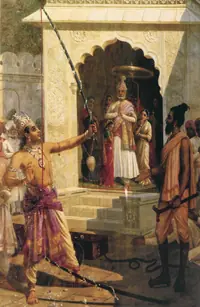
When Rama breaks Shiva’s bow, Dasharatha travels to Mithila with the sages, led by Vasishtha. On the wedding day Vasishtha prepares the altar and lights the sacred fire, and the four brothers are married. Explore next: Shiva’s bow and the wedding of Rama and Sita
After the king’s death
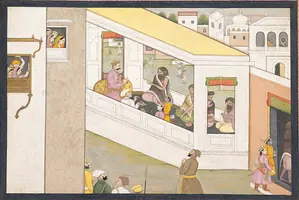
Once Rama has gone into exile and Dasharatha has died of grief, Vasishtha sends swift messengers to Kekaya to bring Bharata home. He tells them not to reveal what has happened. Explore next: Bharata
The crowning
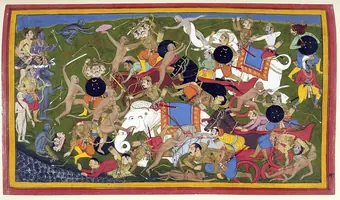
When Rama returns after fourteen years, the sages led by Vasishtha consecrate him with water brought from the four oceans and five hundred rivers, and Vasishtha places the crown on his head. Explore next: The war in Lanka and Rama’s return
Where Vasishtha appears in the Ramayana
Five-minute chapters from the Valmiki Ramayana. More are being added book by book.
Book 1 · Bala Kanda
Book 2 · Ayodhya Kanda
- 7The crowning that wasn't
- 8Kaikeyi's two boons
- 9Rama accepts
- 12Bharata refuses the throne
- 13The sandals on the throne
Book 6 · Yuddha Kanda
Book 7 · Uttara Kanda
Keep exploring
 Person or deityDasharatha
 Person or deityRama
- Person or deityVishvamitra
 Person or deityBharata
 StoryShiva's bow and the wedding of Rama and Sita
 StoryThe war in Lanka and Rama's return
 QuestionWhy did King Dasharatha keep a promise that broke his heart?
Also named on this page
- Ayodhya
- In the Ramayana, Ayodhya is the capital of the kingdom of Kosala, where Rama is born and later crowned.
- Sita
- Sita is worshipped as an incarnation of the goddess Lakshmi and stands at the heart of the Ramayana as Rama's wife.
- Lanka
- Lanka is Ravana's island fortress across the sea, where he held Sita captive.
- Lakshmana
- Lakshmana was Rama's younger brother, the son of King Dasharatha and Queen Sumitra.
- Shatrughna
- Shatrughna is the youngest of King Dasharatha's four sons in the Valmiki Ramayana, Sumitra's son and Lakshmana's twin.
Sources
- Valmiki Ramayana, Bala Kanda 1.8.1–24 · Verified
- Valmiki Ramayana, Bala Kanda 1.18.16–36 · Verified
- Valmiki Ramayana, Bala Kanda 1.21.1–21 · Verified
- Valmiki Ramayana, Bala Kanda sargas 69, 73 · Verified
- Valmiki Ramayana, Ayodhya Kanda 2.68.1–11 · Verified
- Valmiki Ramayana, Yuddha Kanda 6.128.2–106 · Verified