The Ramayana · Book 7, Uttara Kanda
Lava, Kusha and the earth
Chapter 41 of 41 · 3 min read · as told in the Valmiki Ramayana, Uttara Kanda
Many scholars see this last book as a later addition to the epic.
The horse sacrifice
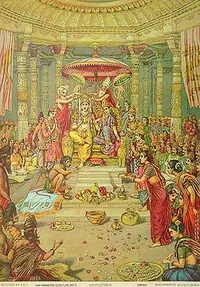
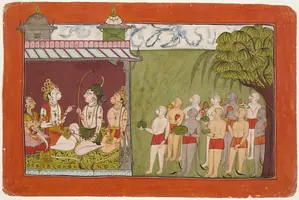
Years passed. Rama decided to perform the great horse sacrifice, the Ashvamedha, in the Naimisha forest beside the river Gomati. He invited sages from everywhere, Sugriva and the vanaras, Vibhishana and the rakshasas, and kings from far and wide. For the rite he had a golden statue of his queen brought, to stand in Sita’s place. For a whole year the sacrifice went on, and everyone who asked for anything was given it.
Two young singers
The sage Valmiki came to the sacrifice too, with his disciples, and among them were two boys, Kusha and Lava. Valmiki had taught them the poem he had composed, the Ramayana. Go and sing it, he told them, wherever people gather, and above all at the gate of Rama’s own pavilion. Sing twenty chapters a day. Ask for nothing. And if the king asks whose pupils you are, tell him: Valmiki’s.
The boys sang, and Rama heard them. He had never heard such a poem. He called the sages, kings and musicians to listen, and everyone who heard was spellbound. They look just like Rama, people whispered.
Rama ordered that the boys be given gold. They would not take it. What use is gold, they asked, to people who live in the forest on fruits and roots? Who made this poem? Rama asked. Our teacher Valmiki, they said. It tells the whole story of your life.
Rama knows them
Day after day Rama listened, until he understood: these were his and Sita’s sons. He sent a message to Valmiki. If Sita is without blame, he said, let her come before this assembly and declare it.
Valmiki’s oath
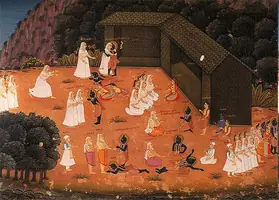
The next morning a vast crowd gathered: sages, kings, vanaras and rakshasas, and people of every kind. They stood in silence. Then Valmiki came, and Sita walked behind him with her head bowed and her hands joined, weeping. A cry went up from the crowd.
Valmiki spoke to Rama. Sita was left near my hermitage, he said, because of what people said. These twins are your sons. I have never in my life told a lie. If Sita has done any wrong, may I lose the fruit of all my years of penance. She is pure.
“Let the Earth receive me”
Rama answered before everyone. I always knew Sita was innocent, he said. It was for fear of the people that I sent her away. Kusha and Lava are my sons. I wish to be reconciled with Sita here, before you all.
But Sita, her eyes cast down and her hands joined, spoke her own oath. If I have never thought of anyone but Rama, she said, let the Earth goddess receive me.
As she spoke, a shining throne rose out of the earth, borne up on the heads of great serpents. The Earth goddess took Sita in her arms and seated her on it, and as flowers fell from the sky, Sita went down into the earth. The gods cried out in praise of her, and the whole world trembled.
Rama’s grief
Rama was overcome. In grief and anger he called on the Earth to give Sita back. Then Brahma came, with all the gods. Remember who you are, he said gently. You are Vishnu. Sita has gone to the world below, and you will be together again in heaven.
Rama took his sons with him, and that night he grieved for Sita.
This is one of the hardest moments in the whole epic, and it has been read, questioned and retold in many ways. The Uttara Kanda goes on to tell of Rama’s long reign and how, at last, he and his brothers left the world. Those parts are not yet on this path.
End of chapter 41.
In this chapter
 Person or deityRama
 Person or deitySita
 Person or deityLakshmana
 Person or deityBharata
 Person or deityShatrughna
 Person or deitySugriva
 Person or deityVibhishana
- Person or deityVasishtha
Also named in this chapter
- Kusha, Lava
- The twin sons of Rama and Sita, raised in Valmiki's hermitage.
- Valmiki
- The sage who composed the Ramayana and protected Sita.
- Brahma
- The creator god, who comforts Rama.
- Vishnu
- The preserver god, of whom Rama is an avatar.
Sources
- Valmiki Ramayana (tr. Hari Prasad Shastri), Uttara Kanda sargas 91–92 · Verified
- Valmiki Ramayana (tr. Hari Prasad Shastri), Uttara Kanda sargas 93–94 · Verified
- Valmiki Ramayana (tr. Hari Prasad Shastri), Uttara Kanda sargas 95–96 · Verified
- Valmiki Ramayana (tr. Hari Prasad Shastri), Uttara Kanda sarga 97 · Verified
- Valmiki Ramayana (tr. Hari Prasad Shastri), Uttara Kanda sarga 98 · Verified