5-minute story
The war in Lanka and Rama's return
5 min read · as told in the Valmiki Ramayana, Yuddha Kanda
A brother at the gate
Hanuman had come back from Lanka with Sita’s jewel and news of where she was held. Rama gathered the vanara army and marched to the shore of the southern sea.
There, a stranger came to them from across the water. It was Vibhishana, Ravana’s own younger brother. Ravana had spoken to him harshly and treated him like a servant, and Vibhishana had left behind his family and his home to come to Rama for refuge.
Sugriva did not trust him. A brother of Ravana, he warned, could only be a spy, and should be seized, or even killed.
Rama listened, and then answered. Quarrels inside a family are common, he said, and Vibhishana’s break with his brother might be exactly what it seemed. Someone who comes in friendship must not be turned away, whatever his faults. He spoke of the dove in the old story, who gave shelter even to its enemy. And he made a vow: whoever comes to him even once, saying “I am yours”, he will protect from every danger.
Sugriva was moved, and agreed. Rama went to meet Vibhishana as a friend.
A bridge across the sea
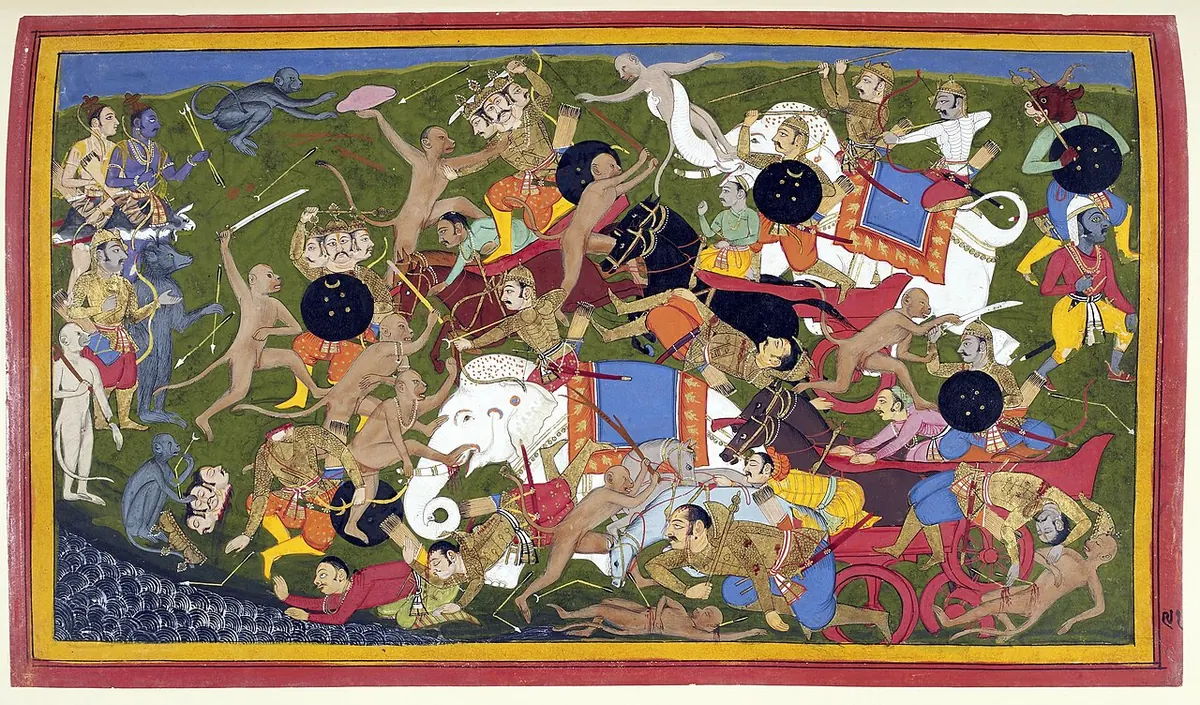
Now the ocean lay between the army and Lanka. The ocean would not open a path for them. In anger, Rama took up his bow and set a mighty arrow to it, and the sky, the earth and the mountains trembled.
Then the ocean itself rose from the waves, adorned and surrounded by its rivers, and came before Rama with joined palms. It could not change its own nature, it said, but it would help them cross. There was a vanara in the army named Nala, son of the divine craftsman Vishvakarma, who could build a bridge that the ocean would hold up.
The vanaras set to work in their thousands. They tore up trees and carried rocks and mountain peaks to the shore. Day by day the bridge grew: fourteen yojanas on the first day, twenty on the second, then twenty-one, then twenty-two, until on the fifth day it touched the far shore, a hundred yojanas long and ten wide. Gods and sages watched in wonder as the army crossed to Lanka. Explore next: Lanka
The mountain of herbs
The war was long and hard. One day Ravana’s son Indrajit unleashed a weapon of Brahma that struck down Rama and Lakshmana and laid low a great part of the army.
Among the fallen, the wise elder Jambavan, wounded and barely able to see, asked for Hanuman. As long as Hanuman lived, he said, the army was not lost. He told Hanuman to fly across the sea to the Himalayas, to a mountain where four healing herbs grew, and to bring them back quickly.
Hanuman grew to an enormous size and leapt into the sky, flying so fast that the rakshasas below shook with fear. When he reached the mountain, the herbs hid themselves from him. So he tore off the whole peak, with its trees and its elephants, and carried it back through the sky.
As he came near the battlefield, the fragrance of the herbs reached the fallen. Rama and Lakshmana rose, healed of their wounds, and the vanaras stood up as if waking from sleep. Explore next: Hanuman
Brahma’s arrow
At last Rama faced Ravana himself. His charioteer Matali reminded him of a weapon he had not yet used: an arrow made by Brahma for the god Indra, which the sage Agastya had given to Rama. The epic says the wind lived in its feathers, fire and the sun in its tip, and the weight of mountains in its body.
Rama blessed the arrow, drew his bow and let it fly. It struck Ravana in the chest, and Ravana fell from his chariot. The arrow returned to Rama’s quiver. The gods rejoiced, heavenly drums sounded, and flowers fell on Rama’s chariot. The surviving rakshasas fled back into the city, and the vanaras cheered.
Then, as the sky cleared and the wind blew gently, Rama turned to the friends who had stood with him, Sugriva, Angada and Vibhishana, and granted what each of them wished. Explore next: Ravana
Good news runs ahead
Before he reached Ayodhya, Rama sent Hanuman ahead to find Bharata and tell him that Rama was coming home, with Sita and Lakshmana beside him. Bharata was overjoyed. He showered Hanuman with gifts: a hundred thousand cows and more than a hundred villages.
The road home
Rama, Sita and Lakshmana flew home in the Pushpaka, the aerial chariot Ravana had once taken from Kubera. On the way they stopped at the hermitage of the sage Bharadvaja, who told Rama that Bharata was waiting for him, with Rama’s sandals placed before him. When the sage offered a boon, Rama asked that the trees on the road to Ayodhya bear sweet fruit out of season, and they did.
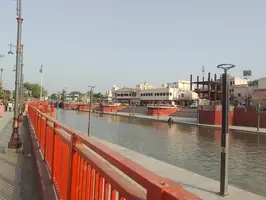
Bharata came out from Nandigrama to meet him, carrying the sandals he had kept on the throne for fourteen years. He placed them at Rama’s feet and gave back the kingdom he had held in trust. Explore next: Bharata
The crowning
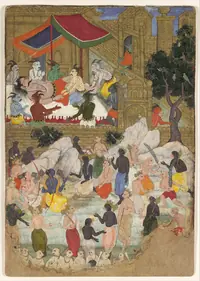
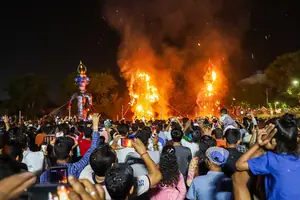
The sages, led by Vasishtha, consecrated Rama with water brought from the four oceans and five hundred rivers, and Vasishtha placed the crown on his head. The epic describes the years that followed as a time without disease, fear or theft, when rain fell on time and the trees bore fruit. Explore next: Diwali
Meet the people and places in this story
Also named in this story
- Rama
- Rama is the central figure of the Ramayana, the eldest son of King Dasharatha of Ayodhya, and is worshipped by Hindus as the seventh avatar of Vishnu.
- Sita
- Sita is worshipped as an incarnation of the goddess Lakshmi and stands at the heart of the Ramayana as Rama's wife.
- Hanuman
- Hanuman is a vanara, son of the wind god, who served Rama with complete devotion.
- Bharata
- Bharata was Rama's younger brother, the son of King Dasharatha and Queen Kaikeyi.
- Lakshmana
- Lakshmana was Rama's younger brother, the son of King Dasharatha and Queen Sumitra.
- Ravana
- Ravana was the ten-headed king of the rakshasas who ruled Lanka.
- Vasishtha
- Vasishtha is the family priest of Ayodhya in the Valmiki Ramayana.
- Sugriva
- Sugriva is the vanara prince who became Rama's sworn ally in the Valmiki Ramayana.
- Vibhishana
- Vibhishana is Ravana's brother in the Valmiki Ramayana.
- Angada
- A vanara prince who stood with Rama.
- Nala
- A vanara, son of the divine craftsman Vishvakarma, who built the bridge to Lanka.
- Vishvakarma
- The divine craftsman, father of Nala.
- Indrajit
- Ravana's son, who struck down Rama and Lakshmana with a weapon of Brahma.
- Jambavan
- The wise elder of the vanara army.
- Matali
- Rama's charioteer in the battle with Ravana.
- Brahma
- The god who made the arrow with which Rama killed Ravana.
- Indra
- The god for whom the arrow that killed Ravana was first made.
- Agastya
- A sage who gave Rama the arrow made by Brahma.
- Kubera
- From whom Ravana had once taken the aerial chariot Pushpaka.
- Bharadvaja
- A sage who told Rama, on the way home, that Bharata was waiting for him.
Sources
- Valmiki Ramayana, Yuddha Kanda 6.17.1–17 · Verified
- Valmiki Ramayana, Yuddha Kanda 6.18.18–38 · Verified
- Valmiki Ramayana, Yuddha Kanda sarga 22 · Verified
- Valmiki Ramayana, Yuddha Kanda sarga 74 · Verified
- Valmiki Ramayana, Yuddha Kanda sarga 108 · Verified
- Valmiki Ramayana, Yuddha Kanda sarga 127 · Verified
- Valmiki Ramayana, Yuddha Kanda sarga 128 (vedapath numbering) · Verified
- Valmiki Ramayana, Yuddha Kanda 6.127.16–61 · Verified
- Valmiki Ramayana, Yuddha Kanda 6.128.2–106 · Verified
- Valmiki Ramayana, Yuddha Kanda 6.22.44–85 · Verified
- Valmiki Ramayana, Yuddha Kanda sarga 108 · Verified
- Valmiki Ramayana, Yuddha Kanda 6.127.16–61 · Verified
- Valmiki Ramayana, Yuddha Kanda 6.128.2–106 · Verified
- Valmiki Ramayana, Ayodhya Kanda 2.112.10–26; sarga 115 · Verified