Story
The Ramayana in seven books
The Valmiki Ramayana tells Rama's story in seven books, called kandas, from his birth in Ayodhya to his exile, Sita's capture, her rescue from Lanka and his return as king.
Read the 5-minute story5 min read · told as scenes, from the Valmiki Ramayana, all seven books
- 1. Bala Kanda, the Book of YouthRama is born in Ayodhya and wins Sita by stringing Shiva's bow.
- 2. Ayodhya Kanda, the Book of AyodhyaQueen Kaikeyi's boons send Rama into fourteen years of exile.
- 3. Aranya Kanda, the Book of the ForestThe demon king Ravana carries Sita off to Lanka.
- 4. Kishkindha Kanda, the Book of the Monkey KingdomRama and the vanara prince Sugriva swear friendship.
- 5. Sundara Kanda, the Book of BeautySugriva's minister Hanuman crosses the sea and finds Sita.
- 6. Yuddha Kanda, the Book of WarRama defeats Ravana, returns to Ayodhya and is crowned.
- 7. Uttara Kanda, the Book of Further EventsSita's banishment and her sons; some scholars see this book as a later addition.
Understand more
Simple
The Ramayana is traditionally credited to the poet Valmiki and was composed in Sanskrit. It is divided into seven books, called kandas.
The first books tell of Rama's birth and his marriage to Sita, then his fourteen years of exile in the forest. In the forest, the demon king Ravana carries Sita off to Lanka.
With the help of Sugriva and Hanuman, Rama finds Sita, crosses the sea, defeats Ravana and returns home to be crowned. The last book tells what happened afterwards, and some scholars think it was added later.
Detailed
Where the story is told
The Ramayana is traditionally credited to the poet Valmiki and was composed in Sanskrit. Its current text has about 24,000 couplets, divided into seven books called kandas. Explore next: What is the Ramayana, and who wrote it?
The seven books at a glance
- Bala Kanda, the Book of Youth: Rama’s birth, and his marriage to Sita. Explore next: Shiva’s bow and the wedding of Rama and Sita
- Ayodhya Kanda: Kaikeyi’s two boons, and Rama’s exile.
- Aranya Kanda, the Book of the Forest: Ravana carries Sita off to Lanka.
- Kishkindha Kanda: Rama’s alliance with Sugriva, and Hanuman.
- Sundara Kanda, the Book of Beauty: Hanuman finds Sita. Explore next: Hanuman’s search for Sita
- Yuddha Kanda, the Book of War: the war, Ravana’s death and Rama’s crowning. Explore next: The war in Lanka and Rama’s return
- Uttara Kanda, the Book of Further Events: an epilogue, in which Sita is sent to the forest and gives birth to their two sons at Valmiki’s hermitage.
Questions about the text
Some scholars consider the Uttara Kanda a later addition to the poem. And many later retellings, in other languages and traditions, tell parts of the story differently. Explore next: Why are there so many versions of the Ramayana?
Read it in the Ramayana
Five-minute chapters from the Valmiki Ramayana. More are being added book by book.
Start here: The Ramayana in seven books
Book 1 · Bala Kanda
Keep exploring
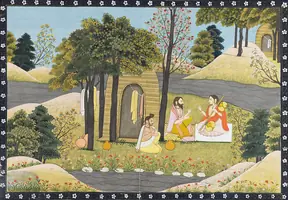 QuestionWhat is the Ramayana, and who wrote it?
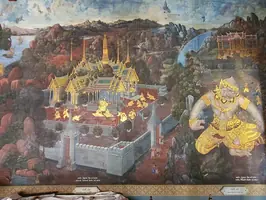 QuestionWhy are there so many versions of the Ramayana?
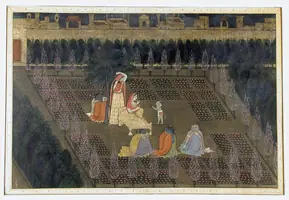 StoryHanuman's search for Sita
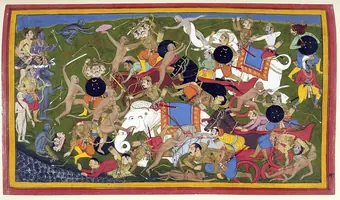 StoryThe war in Lanka and Rama's return
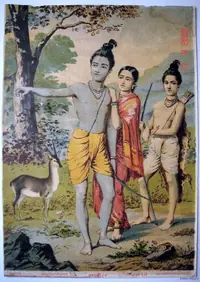
 Person or deityRama
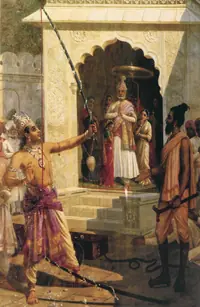
 Person or deitySita
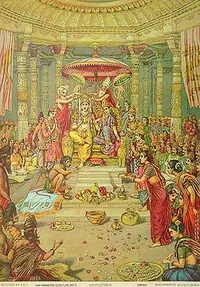
 StoryShiva's bow and the wedding of Rama and Sita
Also named on this page
- Ayodhya
- In the Ramayana, Ayodhya is the capital of the kingdom of Kosala, where Rama is born and later crowned.
- Hanuman
- Hanuman is a vanara, son of the wind god, who served Rama with complete devotion.
- Lanka
- Lanka is Ravana's island fortress across the sea, where he held Sita captive.
- Kaikeyi
- Kaikeyi was one of King Dasharatha's three queens, a princess of Kekaya and the mother of Bharata.
- Ravana
- Ravana was the ten-headed king of the rakshasas who ruled Lanka.
- Sugriva
- Sugriva is the vanara prince who became Rama's sworn ally in the Valmiki Ramayana.
- Valmiki
- The poet to whom the Ramayana is traditionally credited.
- Shiva
- The god whose great bow Rama strung and broke.
Sources
- Encyclopaedia Britannica, "Ramayana" · Verified
- Valmiki Ramayana, Bala Kanda 1.18.8–14; 1.66.13–26 · Verified
- Valmiki Ramayana, Ayodhya Kanda 2.11.25–26 · Verified
- Valmiki Ramayana, Ayodhya Kanda sargas 30–31 · Verified
- Encyclopaedia Britannica, "Sita" · Verified
- Valmiki Ramayana, Aranya Kanda 3.49.16–23 · Verified
- Valmiki Ramayana, Kishkindha Kanda 4.5.12–31 · Verified
- Valmiki Ramayana, Sundara Kanda sarga 15 · Verified
- Valmiki Ramayana, Yuddha Kanda sargas 22, 108 and 128 · Verified