Question
What is the Ramayana, and who wrote it?
The Ramayana is an epic poem in Sanskrit, about 24,000 couplets long, telling the story of Rama, prince of Ayodhya. Hindu tradition attributes it to the sage Valmiki.
- Bala KandaBook of youth
- Ayodhya KandaBook of Ayodhya
- Aranya KandaBook of the forest
- Kishkindha KandaBook of the vanara kingdom
- Sundara KandaBook of beauty
- Yuddha KandaBook of war
- Uttara KandaBook of later events
Understand more
Simple
The Ramayana tells how Prince Rama is exiled, how his wife Sita is taken by Ravana, king of Lanka, and how Rama wins her back with the help of allies such as Hanuman.
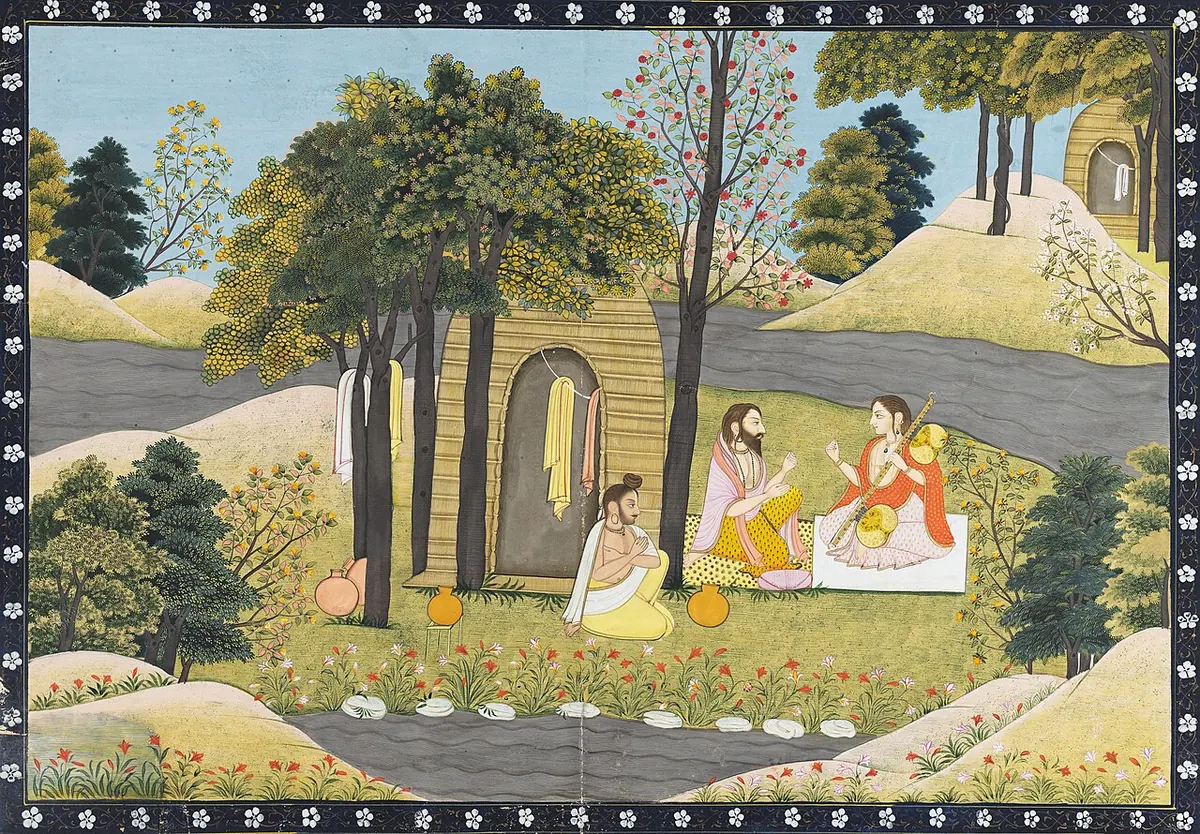
Tradition says it was composed by the sage Valmiki. The epic itself tells how it began. Valmiki saw a hunter kill one of a pair of birds, and his grief poured out in a new kind of verse. The god Brahma then told him to tell Rama's story in that metre.
Detailed
The poem
The Ramayana is a Sanskrit epic of about 24,000 couplets in its present form, divided into seven books called kandas. It follows Rama from his youth, through his exile and the war to rescue Sita, to the events after his return.
Who wrote it
Hindu tradition attributes the poem to the sage Valmiki. Little is known of him as a historical person; a popular tradition says he was once a thief named Ratnakara before becoming a sage.
How the poem says it began
In the Bala Kanda, Valmiki sees a pair of krauncha birds. A hunter kills the male, and the female cries out for her mate. Moved by grief, Valmiki curses the hunter, and his words come out as a perfectly measured verse, the first shloka. The god Brahma tells him to tell the story of Rama in this new metre.
When it was composed
This is a question of history, separate from faith. Encyclopaedia Britannica dates the poem to probably not before 300 BCE. It was passed on orally and written down much later, which may have led to additions and deletions; some scholars consider the seventh book, the Uttara Kanda, a later addition.
One story, many tellings
Valmiki’s is the oldest surviving telling, but far from the only one. Explore next: Why are there so many versions of the Ramayana?
Read it in the Ramayana
Five-minute chapters from the Valmiki Ramayana. More are being added book by book.
Start here: The Ramayana in seven books
Book 1 · Bala Kanda
Keep exploring
- QuestionWhat does dharma mean in the Ramayana?
 QuestionWhy are there so many versions of the Ramayana?
- StoryThe Ramayana in seven books
Also named on this page
- Rama
- Rama is the central figure of the Ramayana, the eldest son of King Dasharatha of Ayodhya, and is worshipped by Hindus as the seventh avatar of Vishnu.
- Ayodhya
- In the Ramayana, Ayodhya is the capital of the kingdom of Kosala, where Rama is born and later crowned.
- Sita
- Sita is worshipped as an incarnation of the goddess Lakshmi and stands at the heart of the Ramayana as Rama's wife.
- Hanuman
- Hanuman is a vanara, son of the wind god, who served Rama with complete devotion.
- Lanka
- Lanka is Ravana's island fortress across the sea, where he held Sita captive.
- Ravana
- Ravana was the ten-headed king of the rakshasas who ruled Lanka.
- Narada
- A sage who tells Valmiki the story of Rama (Bala Kanda).
- Brahma
- The god who tells Valmiki to tell Rama's story in the new metre.
- Ratnakara
- In a popular tradition, Valmiki's name as a thief, before he became a sage.
Sources
- Encyclopaedia Britannica, "Ramayana" · Verified
- Valmiki Ramayana, Bala Kanda 1.2.9–31 · Verified