Question
What does dharma mean in the Ramayana?
Dharma means right conduct, the duty that fits a person's place and relationships. The Ramayana shows it through people's choices more than definitions, and even one of Ravana's allies calls Rama "dharma in bodily form".
- The epic opens with a questionValmiki asks who in the world knows dharma. The answer is Rama.
- Rama keeps his father's wordEven at the cost of the throne.
- Rama's brother Bharata refuses the throneHe sees it as Rama's and rules only in his name.
- Rama's wife and brother choose to go with himSita shares his fate; Lakshmana serves him.
- An enemy calls Rama "dharma in bodily form"Maricha, a demon, warns Ravana with these words.
Understand more
Simple
Dharma is a hard word to translate. It covers duty, right conduct, truthfulness and doing what your role asks of you, as a child, a sibling, a spouse or a ruler.
The Ramayana teaches it through choices. Rama keeps his father's word even though it costs him the throne. Bharata refuses a crown that isn't rightfully his. Lakshmana gives up comfort to serve his brother. The poem opens with a search for a person who truly knows dharma, and the answer is Rama.
Detailed
A word without an easy translation
Dharma is often translated as duty, righteousness or right conduct. In the Ramayana it is less a rule book than a way of acting well in one’s relationships and role. What follows is a widely shared reading of the epic, drawn from the episodes below; it is interpretation, not a definition the text gives.
Where the epic starts
The poem opens with Valmiki asking the sage Narada a question: who in the world today is virtuous, brave, knows dharma, is grateful, truthful in speech and firm in his vows? Narada’s answer is Rama, and the whole epic follows from it.
Dharma in action
- Rama keeps his father’s promise even when it costs him the kingdom, and refuses to come back early because that would make his father’s word false. Explore next: Why did King Dasharatha keep a promise that broke his heart?
- Bharata turns down a throne he sees as Rama’s and rules only as his stand-in. Explore next: Why did Bharata refuse to become king?
- Sita says a wife shares her husband’s fate, and Lakshmana asks to serve his brother in the forest.
Even an enemy says it
Maricha, the demon who later becomes the golden deer, warns Ravana against Rama with a famous line: rāmo vigrahavān dharmaḥ, “Rama is dharma in bodily form.”
Hard cases
The epic does not make dharma simple. Dasharatha is torn between his promise and his love for his son, and later readers have long debated some of Rama’s own choices. Those debates belong to commentary and tradition, and differ between them.
Read it in the Ramayana
Five-minute chapters from the Valmiki Ramayana. More are being added book by book.
Book 2 · Ayodhya Kanda
Keep exploring
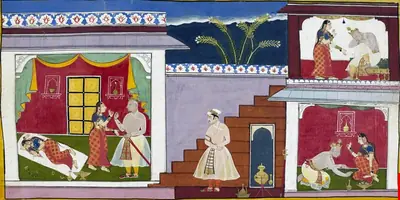
 QuestionWhy did Rama go into exile?
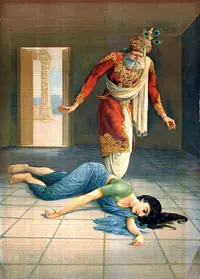
 QuestionWhy did King Dasharatha keep a promise that broke his heart?
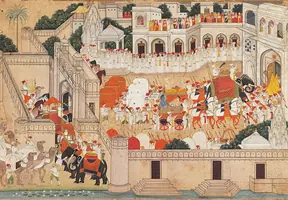 QuestionWhy did Bharata refuse to become king?
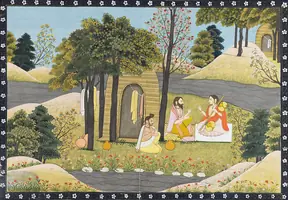 QuestionWhat is the Ramayana, and who wrote it?
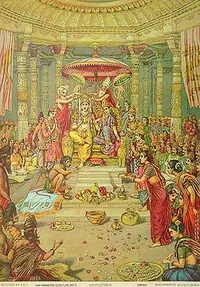 Person or deityRama
 Person or deityBharata
Also named on this page
- Sita
- Sita is worshipped as an incarnation of the goddess Lakshmi and stands at the heart of the Ramayana as Rama's wife.
- Dasharatha
- Dasharatha was the king of Ayodhya and the father of Rama, Bharata, Lakshmana and Shatrughna.
- Lakshmana
- Lakshmana was Rama's younger brother, the son of King Dasharatha and Queen Sumitra.
- Ravana
- Ravana was the ten-headed king of the rakshasas who ruled Lanka.
- Maricha
- Maricha is the rakshasa who became the deer that drew Rama away from Sita in the Valmiki Ramayana.
- Valmiki
- The sage-poet to whom Hindu tradition attributes the Ramayana.
- Narada
- A sage. When Valmiki asks who in the world is truly virtuous, Narada answers: Rama.
Sources
- Valmiki Ramayana, Bala Kanda 1.1.2 · Verified
- Valmiki Ramayana, Aranya Kanda 3.37.13 · Verified
- Valmiki Ramayana, Ayodhya Kanda 2.112.18–19; 2.73.25–27; 2.27.4–8; 2.31.22–26 · Verified