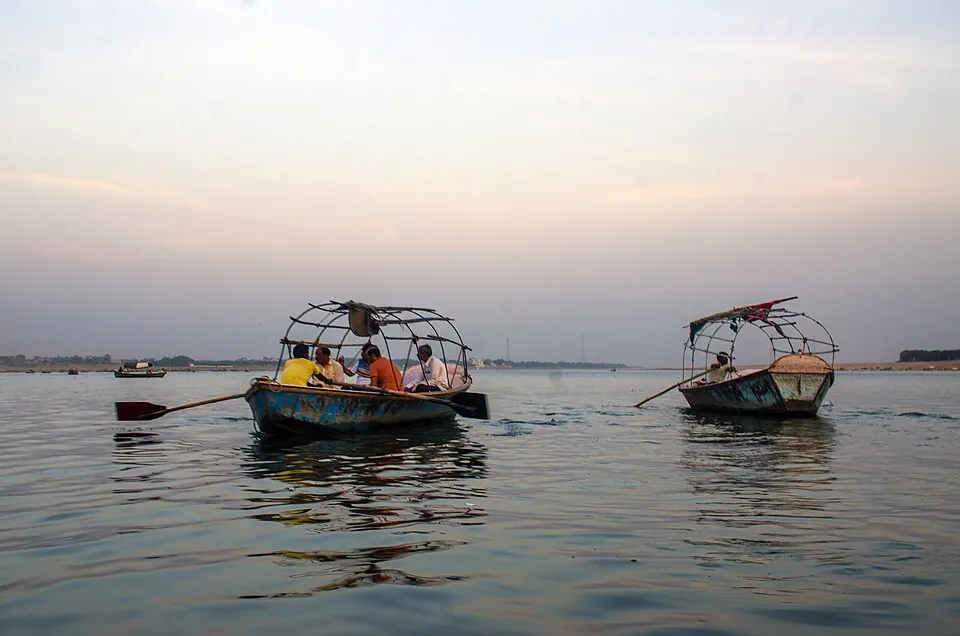
Place
Prayagraj
Prayaga, where the rivers Ganga and Yamuna meet, is where Rama, Sita and Lakshmana stayed with the sage Bharadvaja at the start of their exile, and where Rama stopped again on his way home. Today it is the city of Prayagraj in Uttar Pradesh, one of the four homes of the Kumbh Mela.
- In the epic: Rama comes to BharadvajaThe sage offers them a home at the meeting of the rivers, then sends them to the quieter Chitrakuta.
- In the epic: Bharata's visitFollowing Rama, Bharata stops here, and the sage feasts his whole army.
- In the epic: Rama's returnAfter fourteen years Rama stops again, and the road to Ayodhya bursts into fruit.
- Today: PrayagrajA city in Uttar Pradesh, called Allahabad from 1583 until 2018.
- Today: the Kumbh MelaPilgrims bathe where the rivers meet. Tradition links the site to drops of the nectar of immortality.
Understand more
Simple
In the Valmiki Ramayana, Rama, Sita and Lakshmana followed the smoke of sacred fires to the hermitage of the sage Bharadvaja at Prayaga, where the Ganga and Yamuna meet. He welcomed them and sent them on to Chitrakuta.
Rama's brother Bharata stopped there too, on his way to bring Rama home, and the sage feasted his whole army. Fourteen years later Rama stopped again on his journey back to Ayodhya.
Today the place is the city of Prayagraj, called Allahabad from the 16th century until 2018. Every few years it hosts the Kumbh Mela, one of the largest gatherings in the world.
Detailed
Where the rivers meet
In the Valmiki Ramayana, after leaving Ayodhya, Rama, Sita and Lakshmana crossed a great forest towards the meeting of the Ganga and the Yamuna. Near Prayaga they saw the smoke of sacred fires and heard the sound of the two rivers joining, and at sunset they reached the hermitage of the sage Bharadvaja.
Rama told the sage that his father had sent him into exile and that they would live on roots and fruit. Bharadvaja welcomed them and offered them a home there, at the holy meeting of the rivers. Rama gently declined: it was too close to the towns, and people would keep coming to see them. He asked for a quieter place where Sita could live in peace. The sage named Chitrakuta, a holy hill ten krosas away, and they set out at dawn. Explore next: Chitrakuta
Bharata’s visit
Soon afterwards, Rama’s brother Bharata came the same way with an army, on his way to beg Rama to return. Bharadvaja hosted the whole army for a night, and the epic describes a feast so rich that the soldiers felt they were dreaming. Explore next: Why did Bharata refuse the throne?
Rama’s return
Fourteen years later, on his way home from Lanka, Rama stopped at Bharadvaja’s hermitage again. The sage told him that Bharata was waiting for him, with Rama’s sandals placed before him. When Bharadvaja offered a boon, Rama asked that the trees on the road to Ayodhya bear sweet fruit out of season, and the trees along the way burst into fruit and flower. Explore next: Ayodhya
Prayagraj today
What follows is the city’s history and living tradition, which are separate from the epic.
The modern city of Prayagraj, in Uttar Pradesh, stands on the site of ancient Prayag, long a holy city. The Mughal emperor Akbar founded the present city in 1583 and named it Allahabad; in 2018 the state government renamed it Prayagraj.
Prayagraj is one of four places, with Haridwar, Ujjain and Nashik, that take turns to host the Kumbh Mela, where pilgrims bathe in the sacred rivers. Here, tradition holds, three rivers meet: the Ganga, the Yamuna and the Sarasvati. The festival’s story comes from the Puranas: when the gods and demons churned the ocean for the nectar of immortality, drops of it fell at these four places. More than 200 million people came in 2019, and UNESCO added the Kumbh Mela to its list of the world’s intangible cultural heritage in 2017.
Read it in the Ramayana
Five-minute chapters from the Valmiki Ramayana. More are being added book by book.
Book 2 · Ayodhya Kanda
Book 6 · Yuddha Kanda
Keep exploring
 PlaceChitrakuta
 PlaceAyodhya
 QuestionWhy did Bharata refuse to become king?
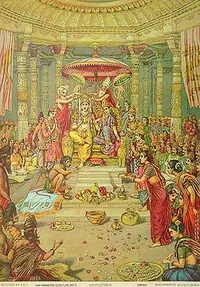 Person or deityRama
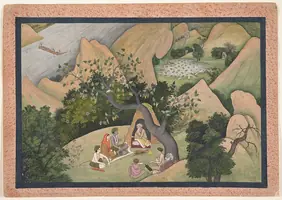 QuestionWhy did Sita and Lakshmana go with Rama to the forest?
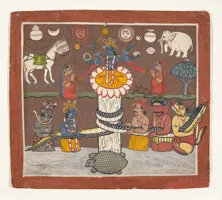 StoryThe churning of the ocean
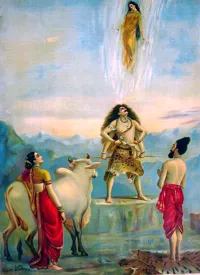 StoryThe descent of the Ganga
Also named on this page
- Sita
- Sita is worshipped as an incarnation of the goddess Lakshmi and stands at the heart of the Ramayana as Rama's wife.
- Lanka
- Lanka is Ravana's island fortress across the sea, where he held Sita captive.
- Bharata
- Bharata was Rama's younger brother, the son of King Dasharatha and Queen Kaikeyi.
- Lakshmana
- Lakshmana was Rama's younger brother, the son of King Dasharatha and Queen Sumitra.
- Bharadvaja
- A sage whose hermitage at Prayaga sheltered Rama, Sita and Lakshmana at the start of the exile.
- Akbar
- The Mughal emperor who founded the present city in 1583 and named it Allahabad.
Sources
- Valmiki Ramayana, Ayodhya Kanda sarga 54 · Verified
- Valmiki Ramayana, Ayodhya Kanda sarga 91 · Verified
- Valmiki Ramayana, Yuddha Kanda sarga 127 · Verified
- Encyclopaedia Britannica, "Prayagraj" · Verified
- Encyclopaedia Britannica, "Kumbh Mela" · Verified
- UNESCO, Intangible Cultural Heritage, "Kumbh Mela" · Verified