Tradition
Holi
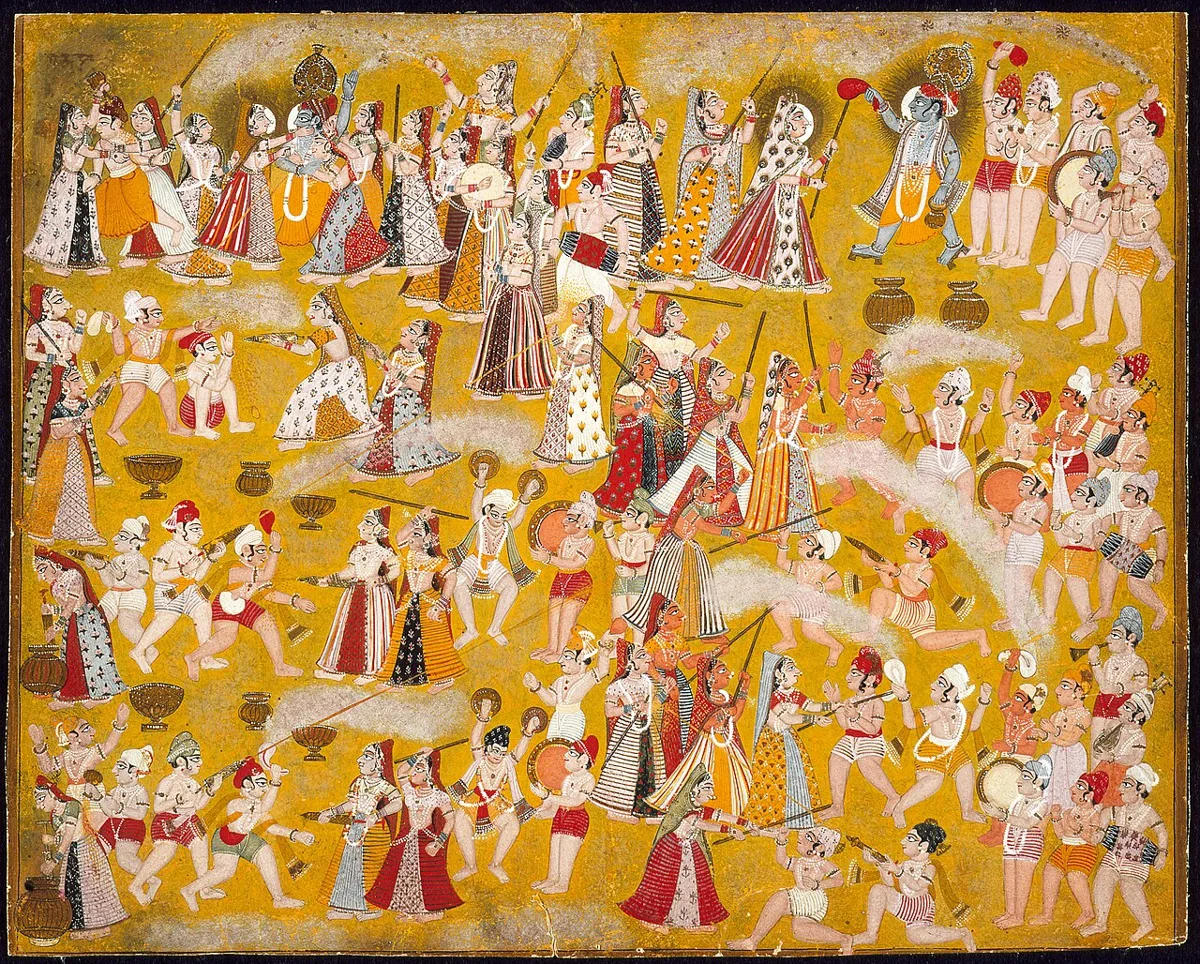
Holi is the spring festival of colours, held on the full moon of Phalguna, in February or March. The night before, bonfires recall how the devotee Prahlada was saved from the fire; the next day, people throw coloured powder and water, as Krishna is said to have played with Radha and the gopis.
- The bonfire, Holika DahanPrahlada, devoted to Vishnu, is saved from the fire; Holika, who was meant to be immune, burns.
- The colours, Krishna and RadhaKrishna's play with Radha and the gopis. Mathura, Vrindavan and Barsana link their Holi to him.
- South India, Kama DahanamShiva burns Kama, the god of love, with his third eye, and later restores him after Rati's penance.
- Bengal and Odisha, Dol PurnimaImages of Radha and Krishna are swung on decorated swings.
- Punjab, Holla MohallaBegun by Guru Gobind Singh, a week of martial arts, music and shared meals from the day after Holi.
Understand more
Simple
Holi is a spring festival held on the full moon of the month of Phalguna, between February and March, in India, Nepal and wherever Indian communities live.
On the night before, Holika Dahan, people light bonfires. They recall how Holika, sister of the demon king Hiranyakashipu, tried to burn the young devotee Prahlada, and burned herself instead.
On the day itself people throw coloured powder and coloured water at each other, share sweets and visit friends and family. Devotees of Krishna see the play of colours as his play with Radha and the gopis.
Detailed
A festival of spring
Holi is a spring festival held on the full moon of the month of Phalguna, which falls between February and March. It is kept across India and in Nepal, and Indian communities have carried it to Britain, the United States, the Caribbean and beyond. It has deep roots: it is mentioned in very old Indian writings, including appendices to the Atharvaveda.
On the day, people throw coloured powder, called gulal, and coloured water, poured from buckets or sprayed from water pistols called pichkaris. Everyday distinctions of status and age are relaxed for a while. The day ends with bathing, clean clothes and visits to friends, teachers and relatives. Traditional colours came from plants such as neem and henna, turmeric and marigold, and indigo, and many people today choose herbal colours. Sweets are shared: gujiya, jalebi and malpua, and in Maharashtra puran poli.
Three stories
Encyclopaedia Britannica names three stories most often told about Holi.
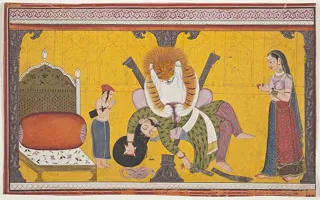
Prahlada and Holika. The demon king Hiranyakashipu had a boon from Brahma that made him almost impossible to kill, and he demanded to be worshipped. His young son Prahlada worshipped Vishnu instead. Hiranyakashipu’s sister Holika, who was said to be immune to fire, took Prahlada onto a burning pyre, but the fire spared Prahlada and burned Holika. Vishnu later came as Narasimha, the man-lion, and killed Hiranyakashipu. The bonfires of Holika Dahan, on the night before Holi, recall this victory of good over evil. Holika is part of the popular telling; she does not appear in the Bhagavata Purana’s account of Prahlada. Explore next: Narasimha and Prahlada
Krishna and Radha. Devotees of Krishna see Holi as his playfulness with the gopis, the cowherd women of Vraja, described in the Bhagavata Purana, the Gitagovinda and the Garga Samhita. One legend tells that the young Krishna was dark and Radha fair, and that his foster mother Yashoda told him he could colour Radha any shade he liked. Mathura, Vrindavan and Barsana still link their Holi to this play.
Shiva and Kama. This story is told mostly in the south. Shiva was lost in deep meditation, and Kama, the god of love, shot an arrow to turn his thoughts to Parvati. Shiva burned Kama to ashes with his third eye. Kama’s wife Rati performed penance, and Shiva brought Kama back, without a body. In Tamil Nadu the festival is called Kaman Pandigai or Kama Dahanam, and songs tell of Rati’s grief. In much of South India, Holi is quieter or not kept at all.
Many ways to keep it
- The Braj region (Mathura, Vrindavan, Barsana): celebrations run for up to 40 days, from Basant Panchami. In Barsana’s Lathmar Holi, women strike at the men with staves while the men defend themselves with shields.
- Bengal and Odisha: Dol Purnima, when images of Radha and Krishna are swung on decorated swings.
- Manipur: Yaoshang, five days of colours, the burning of a thatched hut and the thabal chongba dance by moonlight.
- Maharashtra: Rang Panchami, five days after Holika Dahan, brings coloured powder.
- The Konkan coast and Goa: Shimga or Shigmotsav, up to two weeks of processions.
- Kerala: Manjal Kuli, with temple prayers and turmeric water.
- Punjab: Sikhs keep Holla Mohalla, begun by Guru Gobind Singh, for a week from the day after Holi, with martial arts, music and shared meals.
- The Caribbean: Indo-Caribbean communities call the festival Phagwah.
Keep exploring
Also named on this page
- Krishna
- The god whose play with colours Holi is said to recall.
- Radha
- Krishna's beloved, among the gopis of Vraja.
- Yashoda
- Krishna's foster mother.
- Holika
- Hiranyakashipu's sister, said to be immune to fire.
- Hiranyakashipu
- A demon king who demanded to be worshipped, Prahlada's father.
- Prahlada
- Hiranyakashipu's son, a devotee of Vishnu.
- Brahma
- The creator god, who granted Hiranyakashipu his boon.
- Vishnu
- The god Prahlada worshipped, who came as Narasimha to save him.
- Narasimha
- Vishnu's avatar as a man-lion.
- Shiva
- The god who burned Kama with the fire of his third eye.
- Kama
- The god of love.
- Rati
- Kama's wife, whose prayers won him back.
- Parvati
- The goddess whom Kama hoped to help win Shiva's attention.
- Guru Gobind Singh
- The tenth Sikh Guru, who began Holla Mohalla.
Sources
- Encyclopaedia Britannica, "Holi" · Verified
- Bhagavata Purana, Canto 7, chapter 5 7.5.39–44 · Verified