Story
Narasimha and Prahlada
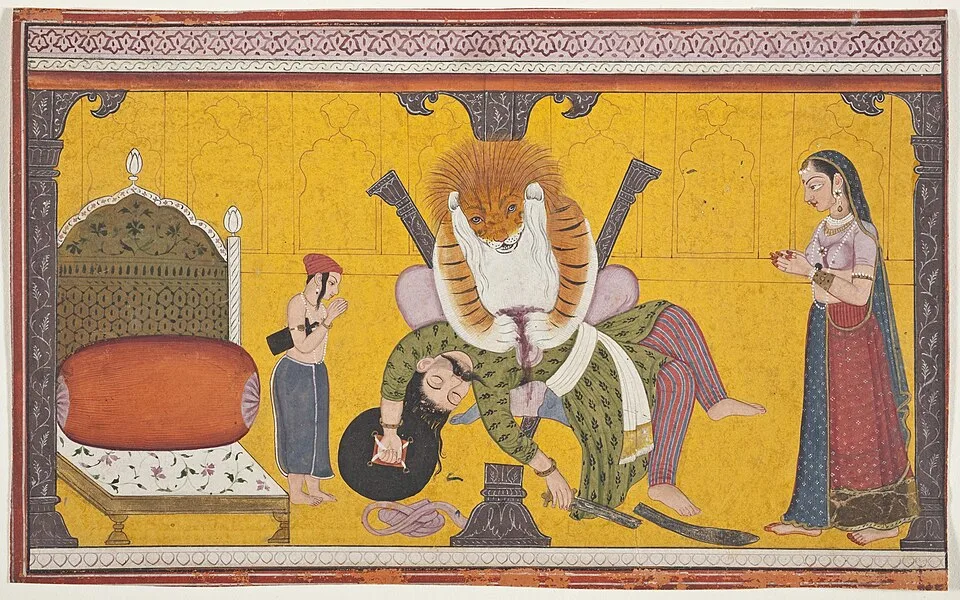
The asura king Hiranyakashipu won a boon that seemed to make him impossible to kill, and turned on his own son Prahlada for worshipping Vishnu. When he struck a pillar and asked where Prahlada's God was, Vishnu burst out of it as Narasimha, neither man nor lion, and ended his rule in a way the boon had not foreseen.
Read the 5-minute story5 min read · told as scenes, from the Bhagavata Purana (Book 7, chapters 2 to 10)
- A vow of revengeAfter Vishnu, as the boar Varaha, kills his brother, Hiranyakashipu swears to destroy him.
- The boonBrahma grants that no man or animal, no weapon, nothing inside or outside, by day or by night, on earth or in the sky, can kill him.
- Prahlada's devotionHis son worships Vishnu, and survives weapons, elephants, snakes, poison, fire and a fall from a hill.
- The pillarHiranyakashipu asks why Prahlada's God is not in the pillar, strikes it, and Narasimha bursts out.
- Neither man nor lionIn the doorway, on his lap, with his nails and no weapon, Narasimha kills him.
- Prahlada becomes kingHe asks only that his father be forgiven, and Narasimha places him on the throne.
Understand more
Simple
Vishnu, as the boar Varaha, had killed Hiranyakashipu's brother. Hiranyakashipu swore revenge and won a boon from Brahma that he could not be killed by any being Brahma had made, by man or animal, inside or outside, by day or by night, on the ground or in the sky, or by any weapon.
His young son Prahlada, taught by Narada before he was born, loved Vishnu above everything. His teachers could not change him, and his father's servants tried to kill him again and again, with weapons, elephants, snakes, poison, fire and a fall from a hill. Nothing harmed him.
At last Hiranyakashipu demanded to know why, if Prahlada's God was everywhere, he was not in the pillar in front of them, and struck it. With a sound that shook the universe, Vishnu came out of the pillar as Narasimha, neither man nor lion.
Narasimha seized him, placed him on his lap in the doorway of the hall, and killed him with his nails. Prahlada asked for nothing for himself, only that his father be forgiven, and Narasimha made him king.
Detailed
Where the story is told
This page follows the Bhagavata Purana, Book 7, chapters 2 to 10. It begins where another story ends: Vishnu, as the boar Varaha, has killed the asura Hiranyaksha, and his brother Hiranyakashipu swears revenge. Explore next: Varaha raises the earth
What the Bhagavata Purana draws out
A boon with gaps. Brahma grants Hiranyakashipu that he will not die at the hands of any being Brahma made, inside or outside, by day or night, on the ground or in the sky, by any weapon, man or animal. Each condition is met and none of them saves him: Narasimha is neither man nor lion, he sits in a doorway, holds Hiranyakashipu on his lap and uses his nails. Britannica adds that it was dusk, neither day nor night.
Learning before birth. Prahlada later tells his schoolfellows that he learned of Vishnu while still in his mother’s womb, when the sage Narada sheltered her in his hermitage and taught her. His teachers at school were Shanda and Amarka, sons of Shukracharya, the asuras’ teacher.
“The Lord is in everything.” Asked by whose power he is so fearless, Prahlada answers that his strength comes from the same place as his father’s: the Lord, who is in everything. It is to prove these words true that Vishnu comes out of the pillar.
A boon refused. Offered anything he wants, Prahlada asks only to stay free of worldly desire, and for his father to be forgiven. Narasimha tells him that his father is already purified, with twenty-one generations of his family.
Where the story lives on
The Bhagavata adds that Hiranyaksha and Hiranyakashipu were born again as Kumbhakarna and the ten-headed Ravana, and were killed by Rama. Explore next: Ravana
Many Hindus also remember Prahlada at Holi. The night before the festival, bonfires recall how Hiranyakashipu’s sister Holika, who could not be burned, took Prahlada into a fire, and the fire spared him and consumed her. This telling is known across India, but it is not part of the Bhagavata Purana.
Vishnu came to the asuras’ kingdom again generations later, as Vamana, the dwarf, in the time of Prahlada’s grandson Bali. Explore next: Vamana and King Bali
Keep exploring
 StoryVamana and King Bali
 StoryJaya and Vijaya, the doorkeepers
- Person or deityRavana
 StoryVaraha raises the earth
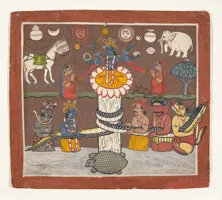 StoryThe churning of the ocean
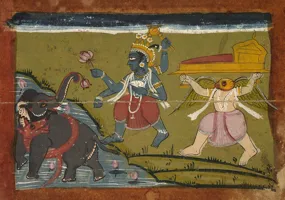 StoryGajendra, the elephant king
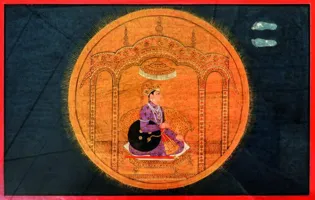 StoryDhruva, the pole star
Also named on this page
- Rama
- Rama is the central figure of the Ramayana, the eldest son of King Dasharatha of Ayodhya, and is worshipped by Hindus as the seventh avatar of Vishnu.
- Narasimha
- Vishnu's form as half man, half lion, who protects his devotee Prahlada.
- Prahlada
- Hiranyakashipu's son, honoured as one of the greatest devotees of Vishnu.
- Hiranyakashipu
- An asura king who won a boon from Brahma and made war on Vishnu.
- Hiranyaksha
- Hiranyakashipu's brother, killed by Vishnu as the boar Varaha.
- Vishnu
- The god who preserves the world; Narasimha is one of his avatars.
- Varaha
- Vishnu's avatar as a boar.
- Brahma
- The creator god, who granted Hiranyakashipu's boon.
- Narada
- The sage who taught Prahlada about Vishnu before he was born.
- Holika
- Hiranyakashipu's sister, who burned in the fire meant for Prahlada.
- Kumbhakarna
- Ravana's brother; in the Bhagavata Purana, Hiranyaksha born again.
- Shanda and Amarka
- Prahlada's teachers, the sons of Shukracharya.
- Shukracharya
- The teacher and priest of the asuras.
Sources
- Bhagavata Purana, Canto 7, chapter 2 7.2.1–9 · Verified
- Bhagavata Purana, Canto 7, chapter 3 7.3.2, 7.3.35–38 · Verified
- Bhagavata Purana, Canto 7, chapter 5 7.5.23–24, 7.5.39–44 · Verified
- Bhagavata Purana, Canto 7, chapter 7 · Verified
- Bhagavata Purana, Canto 7, chapter 8 7.8.6–41 · Verified
- Bhagavata Purana, Canto 7, chapter 9 7.9.1–6 · Verified
- Bhagavata Purana, Canto 7, chapter 10 7.10.7, 7.10.15–24, 7.10.35–37 · Verified
- Encyclopaedia Britannica, "Narasimha" · Verified
- Encyclopaedia Britannica, "Holi" · Verified