Tradition
Pongal
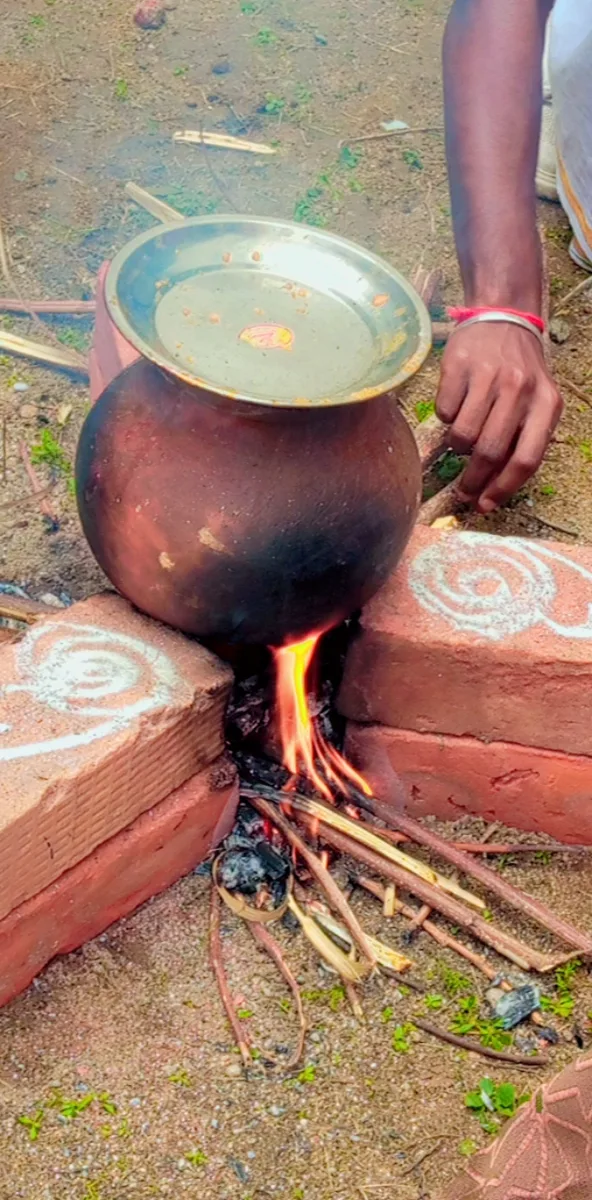
Pongal is the harvest festival of Tamil Nadu, held in mid-January as the sun begins its northward journey. Its name comes from the Tamil for "to boil", after the new rice boiled in milk and offered first to the gods, then to the cattle, then to the family.
- BhogiOld belongings are thrown out and replaced with new ones.
- Thai Pongal, or Surya PongalThe Sun God is worshipped, kolams are drawn at the door, and the new rice is boiled.
- Mattu PongalCattle are decorated and honoured for their work on the farms.
- Kaanum PongalFamilies gather for a large meal, with folk dances such as Mayilattam and Kolattam.
Understand more
Simple
Pongal is a harvest festival of South India, above all of Tamil Nadu, usually held from 13 to 16 January. It thanks the Sun God for the harvest and marks the sun's northward journey, called Uttarayan.
The heart of the festival is a pot of new rice, milk and jaggery boiled until it bubbles over, a sign of plenty. As it boils, people call out "Pongalo Pongal!"
Cattle are honoured too. Their horns are polished and painted, and they are garlanded with flowers, beads and bells, in thanks for their work on the farms.
Detailed
A festival of the harvest
Pongal is a harvest festival held across South India, and above all in Tamil Nadu. It usually falls between 13 and 16 January. Its main day, Thai Pongal, opens the Tamil month of Thai and falls on the same day as Makar Sankranti, the harvest festival kept across India under many regional names.
The festival is dedicated to the Sun God. It marks the sun’s northward journey, Uttarayan, when by the traditional Hindu reckoning the sun enters the sign of Makara (Capricorn). The month before Pongal is thought of as inauspicious and the month after as auspicious.
The rice that boils over
The name Pongal comes from the Tamil word for “to boil” or “to boil over”. New rice is cooked with milk, jaggery and cardamom in a pot, and when it bubbles over, it is a sign of plenty in the year ahead. People call out “Pongalo Pongal!” as it boils. The rice is offered first to the gods, then to the cows, then to the family, together with sugarcane, vegetables and spices. When people visit during the festival, one asks “Has the rice boiled?”, and the answer is “It has boiled.”
The four days
- Bhogi: old belongings are thrown out and replaced with new ones.
- Thai Pongal, or Surya Pongal: the Sun God is worshipped, and kolams, decorative patterns, are drawn at the entrance of homes.
- Mattu Pongal: cattle, which work the farms, are honoured. Their horns are polished and painted, they are garlanded with flowers, beads and bells, taken in procession and left to graze freely.
- Kaanum Pongal: families gather for a large meal, and folk dances such as Mayilattam and Kolattam are performed.
Encyclopaedia Britannica describes Pongal as a three-day festival; Tamil Nadu Tourism counts four days, as above.
Games and fairs
Pongal is also a time for village games, among them jallikattu (a bull-taming contest), climbing a greased pole and breaking a hanging pot while blindfolded, and for fairs selling saris, jewellery, crafts and pottery. Besides Tamil Nadu, it is kept in Karnataka, Andhra Pradesh and Puducherry, and by Tamil communities around the world, especially in Sri Lanka, Malaysia and Singapore. Kerala keeps its own harvest festival, Onam, in August or September. Explore next: Onam
Keep exploring
Also named on this page
- Lanka
- Lanka is Ravana's island fortress across the sea, where he held Sita captive.
- Sun God
- Surya, the sun, thanked at Pongal for the harvest.
Sources
- Encyclopaedia Britannica, "Pongal" · Verified
- Tamil Nadu Tourism, "Pongal Festival" · Verified