Tradition
Maha Shivaratri
Maha Shivaratri, the "great night of Shiva", falls on the fourteenth night of the waning moon in the month of Phalguna or Magha, between January and March. Devotees fast, bathe the Shiva linga with water and milk, and keep watch through the night in prayer.
- Bath and fastA purifying bath, then a fast, often of only fruit, milk and nuts.
- Bilva leaves, flowers and lampsHomes and temples are decorated.
- Bathing the lingaThe abhishekam, with water, milk, honey, yogurt and ghee; bilva leaves and fruit are offered.
- The night vigilThe jagaran, divided into four parts, with prayers and the chant "Om namah Shivaya" in each.
- The next morningThe fast is broken with a simple meal after prayers.
Understand more
Simple
The fourteenth day of the waning moon in every lunar month is sacred to Shiva. When it falls in Magha or, above all, Phalguna, between January and March, it is Maha Shivaratri, the great night of Shiva.
Devotees fast, decorate homes and temples with bilva leaves, flowers and lamps, and bathe the Shiva linga with water, milk, honey, yogurt and ghee. They chant "Om namah Shivaya" and stay awake all night in prayer.
Different texts give different reasons for the night. The Shiva Purana remembers Shiva's marriage to Parvati; the Linga Purana, Shiva appearing as an endless pillar of light. Many also remember how Shiva drank the poison that rose from the churning of the ocean.
Detailed
The great night of Shiva
In every lunar month, the fourteenth day of the dark half, when the moon is waning, is sacred to Shiva. When it falls in the month of Magha, and above all in Phalguna, it is kept as Maha Shivaratri, the great night of Shiva. Magha falls in January and February, and Phalguna in February and March. Devotees believe that worship on this night brings great blessings, both spiritual and worldly.
Why the night is kept
There is no single story behind Maha Shivaratri. The tradition puts devotion first, and different texts and communities remember different reasons:
- Shiva’s marriage to Parvati. The Shiva Purana says the festival celebrates the marriage of Shiva and Parvati.
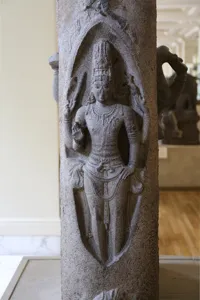
- The pillar of light. The Linga Purana links the night to the moment Shiva appeared as the linga, a column of light without beginning or end, a sign of his formless, infinite nature. The Shiva Purana tells a version of this story too. Explore next: Shiva’s pillar of fire
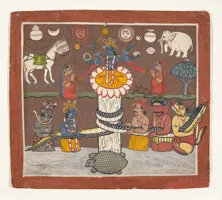
- The poison from the ocean. When the gods and asuras churned the ocean for the nectar of immortality, a deadly poison, halahala, rose first. Shiva drank it to save creation and held it in his throat, which turned blue, and he is called Neelakantha, “the blue-throated one”. Explore next: The churning of the ocean
- The destroyer of the three cities, and the cosmic dancer. The night also honours Shiva as Tripurantaka, who destroyed three moving cities of the asuras with a single arrow, and as Nataraja, whose dance drives the cycles of creation, preservation and destruction.
Keeping the night
Devotees begin with a purifying bath and fast, often eating only fruit, milk and nuts. Homes and temples are decorated with bilva (wood-apple) leaves, flowers and lamps. The central rite is the abhishekam, bathing the Shiva linga with water, milk, honey, yogurt and ghee, and offering bilva leaves and fruit. Devotees chant “Om namah Shivaya” and recite hymns from the Shiva Purana. The heart of the night is the jagaran, the vigil, divided into four parts with prayers in each. The fast is broken the next morning with a simple meal, and the following day brings feasts and fairs.
Across India and beyond
- Varanasi: crowds visit the Kashi Vishwanath Temple and bathe in the Ganga.
- Ujjain: the Mahakaleshwar Temple anoints the deity with sacred ash at dawn.
- Tiruvannamalai, Tamil Nadu: devotees walk barefoot about 14 km around Arunachala Hill.
- Kashmir: Kashmiri Pandits keep the festival as Herath, and share walnuts soaked in water as prasada.
- Gujarat: a five-day fair at Bhavnath Mahadev near the Girnar Hills, and great ceremonies at Somnath.
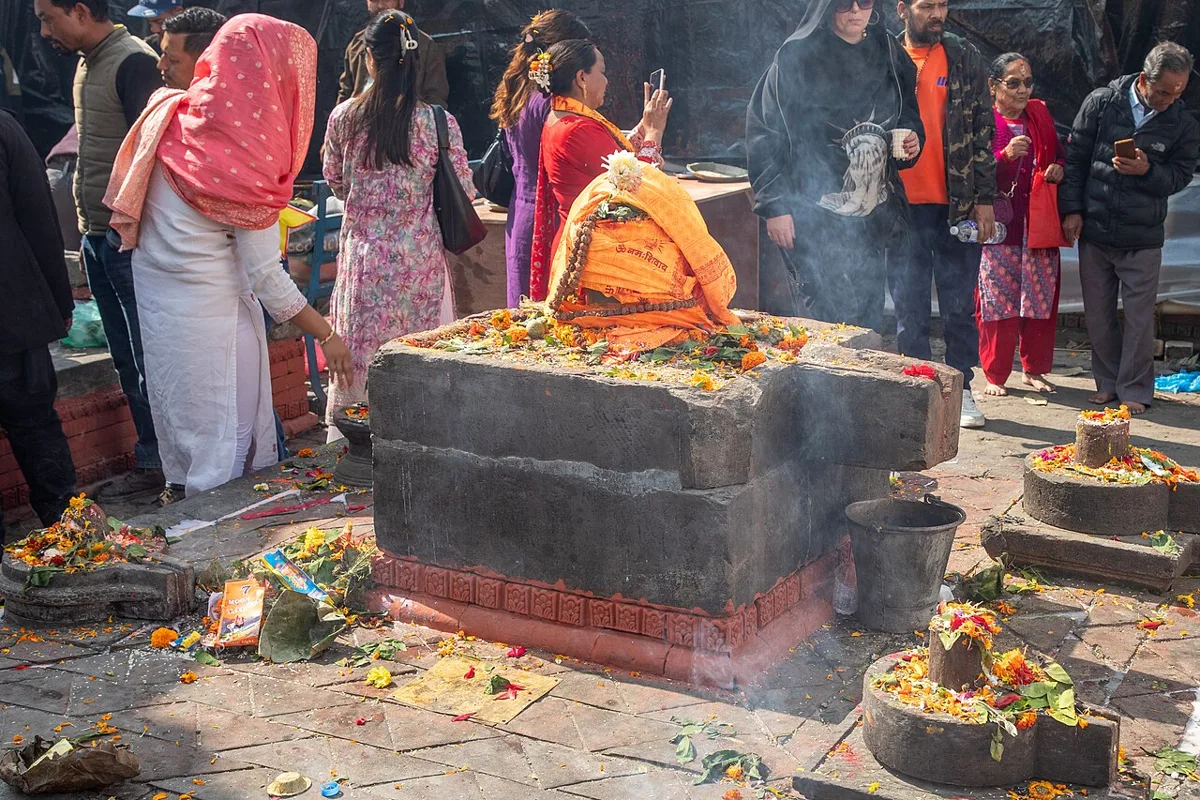
- Nepal: thousands gather at Pashupatinath Temple in Kathmandu, as in the picture above.
- Tamil communities in Malaysia and Singapore, and Hindus in Mauritius, Fiji, Australia and North America, also keep the night.
Keep exploring
 StoryShiva's pillar of fire
 StoryThe churning of the ocean
 StoryThe birth of Ganesha
 TraditionGanesh Chaturthi
 TraditionHoli
Also named on this page
- Shiva
- One of the main Hindu gods, worshipped as supreme by Shaivites.
- Parvati
- The goddess, Shiva's wife.
Sources
- Encyclopaedia Britannica, "Maha Shivaratri" · Verified
- Shiva Purana, Vidyeshvara Samhita, chapter 9 1.9.11–25 · Verified