5-minute story
The descent of the Ganga
5 min read · as told in the Valmiki Ramayana (Bala Kanda), with the Bhagavata Purana
On the river bank
In the Valmiki Ramayana, young Rama and his brother Lakshmana travel with the sage Vishvamitra. After half a day’s walk they reach the Ganga, and camp for the night on her bank. They bathe, make their offerings, and sit down around the sage. Then Rama asks him about the river: how did she come to flow through the three worlds? Vishvamitra begins her story, and it turns out to be the story of Rama’s own family. Explore next: Shiva’s bow and the wedding of Rama and Sita
A king and his sons
Long before Rama, a righteous king called Sagara ruled Ayodhya. For many years he had no children. He had two queens. The elder, Keshini, bore him one son, Asamanja, whose son was Amshuman, a brave prince loved by all. The younger queen, Sumati, bore sixty thousand sons.
The vanished horse
Sagara resolved to perform the great horse sacrifice. But during the sacrifice the horse disappeared. The Bhagavata Purana says it was Indra who stole it.
Sagara sent his sixty thousand sons to find it. They searched the whole earth, and when they could not find it, they began to dig. They dug so deep that they reached the world beneath the earth. There, the Ramayana says, they passed the four great elephants who hold up the world, one in each direction, and walked around each in reverence.
The sage Kapila
At last, digging towards the north-east, they found the horse, grazing peacefully. Beside it sat the sage Kapila, whom the Ramayana calls a form of Vishnu himself.
The sons were sure they had found their thief. Shouting at him to stop, they ran at him with spades and ploughshares, trees and stones. Kapila was filled with wrath. He let out a single sound, “Hum!”, and by his power all sixty thousand were burned to heaps of ash.
The Bhagavata Purana tells this moment differently. It says the fire did not come from Kapila’s eyes, for he was wholly at peace.
What the ashes needed
When his uncles did not come back, Amshuman went after them. He found the horse and the ashes, and bowed before Kapila, who gave him the horse to take back. But the uncles’ souls could only be freed in one way, he learned: by the waters of the Ganga, the river of heaven.
Sagara finished his sacrifice and, in time, left the kingdom to Amshuman. Amshuman spent the rest of his life in austerities, trying to bring the Ganga down to earth. He died without succeeding. His son Dilipa tried too, all his life, and he too died without succeeding.
Bhagiratha
Dilipa’s son Bhagiratha left the kingdom in the care of others and went to Gokarna to perform austerities. There he stood with his arms raised among five fires, and ate only once a month. He kept this up for thousands of years.
At last Brahma, the creator, came to him with the gods and offered him a wish. Bhagiratha asked for two things. Let my ancestors, the sons of Sagara, be freed by the Ganga’s water. And let our family line continue.
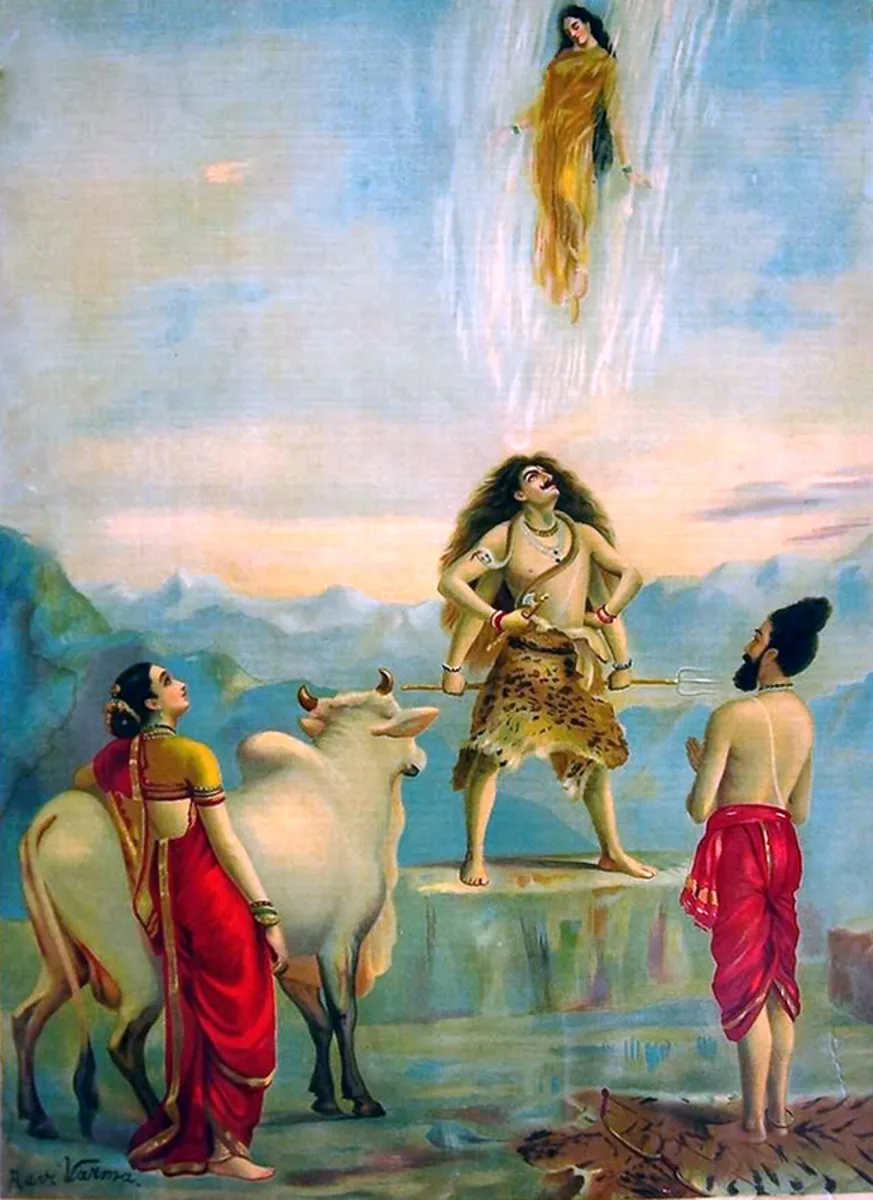
Brahma granted both. But he gave a warning. The Ganga, the eldest daughter of the Himalaya, would fall from heaven with a force that the earth could never bear. Only one being could hold her: Shiva.
The Bhagavata Purana adds that the Ganga herself raised two worries. Who could bear her fall? And if everyone washed their sins away in her, where would she wash those sins away? Bhagiratha answered that the holy people who bathed in her would purify her.
Caught in Shiva’s hair
So Bhagiratha began again. For a year more he prayed to Shiva, and Shiva agreed.
The Ganga fell from the sky, meaning to sweep Shiva down with her into the world below. But Shiva caught her in his matted locks, and she could not get out. For years she wandered there, lost in the tangles of his hair.
Bhagiratha prayed again. Shiva was pleased, and let her out gently towards the lake of Bindusaras. There she divided into seven streams. Three flowed east, three flowed west, and the seventh followed Bhagiratha’s chariot.
Across the land
Wherever she went, the gods, sages and heavenly beings came to see her, and the creatures of the water travelled with her. Then she flooded the place where the sage Jahnu was performing a sacrifice, and he drank all her waters. The gods pleaded with him, and he let her flow out again from his ears. That is why she is also called Jahnavi, “daughter of Jahnu”.
The ashes are freed
At last the Ganga reached the ocean and flowed down into the world beneath, to the ashes of Sagara’s sons. As her water touched them, they were freed and rose to heaven.
Brahma came to Bhagiratha. The Ganga, he said, would be known as Bhagiratha’s eldest daughter, Bhagirathi, and as Tripathaga, the river that blesses the three worlds.
Vishvamitra finished his story by the river, and told Rama that whoever hears it gains merit and long life. The Ramayana later lists Rama’s line in full, and there they all are: Sagara, Asamanja, Amshuman, Dilipa and Bhagiratha, and then, generations later, Raghu, Aja, Dasharatha and Rama.
Where the river flows today
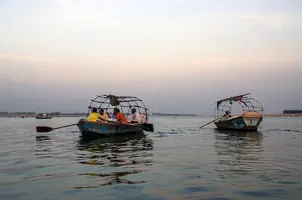
The Ganga has been the holy river of Hinduism since ancient times. Near Prayagraj, the Yamuna joins her. Explore next: Prayagraj
Meet the people and places in this story
Also named in this story
- Sita
- Sita is worshipped as an incarnation of the goddess Lakshmi and stands at the heart of the Ramayana as Rama's wife.
- Dasharatha
- Dasharatha was the king of Ayodhya and the father of Rama, Bharata, Lakshmana and Shatrughna.
- Lakshmana
- Lakshmana was Rama's younger brother, the son of King Dasharatha and Queen Sumitra.
- Vishvamitra
- Vishvamitra was a king who, the Valmiki Ramayana tells, became a brahmarshi, a sage of the highest rank, through long austerity.
- Sagara
- A king of Ayodhya and Rama's ancestor, whose sons dug through the earth for his sacrificial horse.
- Kapila
- A great sage, described in the Ramayana as a form of Vishnu, near whom the horse was found.
- Amshuman
- Sagara's grandson, who found the horse and learned how his uncles could be freed.
- Dilipa
- Amshuman's son and Bhagiratha's father, who also tried to bring down the Ganga.
- Bhagiratha
- The king whose austerities brought the Ganga down to earth.
- Ganga
- The sacred river, worshipped as a goddess, eldest daughter of the Himalaya.
- Brahma
- The creator god, who granted Bhagiratha's wish.
- Shiva
- The great god, who caught the Ganga's fall in his matted hair.
- Jahnu
- A sage who drank the Ganga when she flooded his sacrifice, then let her go.
- Indra
- King of the gods, who in the Bhagavata Purana stole Sagara's horse.
- Vishnu
- The god who preserves the world; the Ramayana calls the sage Kapila a form of him.
- Keshini
- Sagara's elder queen, mother of Asamanja.
- Asamanja
- Sagara's son by Keshini, and father of Amshuman.
- Sumati
- Sagara's younger queen, mother of the sixty thousand sons.
- Raghu and Aja
- Kings of Rama's line; Aja was Dasharatha's father.
- Himalaya
- The great mountain, honoured as a god (Himavat), and father of the Ganga.
Sources
- Valmiki Ramayana, Bala Kanda sarga 35 · Verified
- Valmiki Ramayana, Bala Kanda 1.40.10–30 · Verified
- Valmiki Ramayana, Bala Kanda 1.42.12–25 · Verified
- Valmiki Ramayana, Bala Kanda sarga 43 · Verified
- Valmiki Ramayana, Bala Kanda 1.44.2–6 · Verified
- Valmiki Ramayana, Bala Kanda 1.38.2 · Verified
- Valmiki Ramayana, Bala Kanda 1.70.30–43 · Verified
- Encyclopaedia Britannica, "Ganges River" · Verified
- Bhagavata Purana, Canto 9, chapter 8 · Verified
- Bhagavata Purana, Canto 9, chapter 9 9.9.1–13 · Verified