5-minute story
The churning of the ocean
5 min read · as told in the Bhagavata Purana (Book 8), with the Vishnu Purana
A garland on the ground
The sage Durvasa was walking the earth when he saw a heavenly woman carrying a garland of heavenly flowers. He asked for it, and she gave it to him gladly. He wore it on his head for a while, and when he met Indra, king of the gods, riding his elephant Airavata, he threw the garland to him as a gift.
Indra placed it on Airavata’s head. The elephant caught the scent, lifted the garland with his trunk and flung it to the ground.
Durvasa was enraged. Indra had not honoured his gift, he said, and so the three worlds would lose Shri, their prosperity and good fortune. And so it happened. Plants and herbs withered. Sacrifices stopped. Even the ascetics gave up their austerities. As goodness drained out of the world, the gods grew weak, and the asuras, their rivals, rose against them and defeated them in battle.
A strange piece of advice
The beaten gods went to Brahma, the creator. He led them to Vishnu, on the shore of the ocean of milk, and prayed to him on their behalf. Vishnu appeared before them, and his advice was not what they expected.
Make a truce with the asuras, he told them. The time is in their favour now. Even a snake and a mouse will share a basket when it suits them both. Together, churn the ocean of milk, and from it will come amrita, the nectar that frees the drinker from death. A poison will rise first, he warned. Do not be afraid of it. And when treasures rise from the waves, do not be greedy for them, and do not be angry.
The churning begins
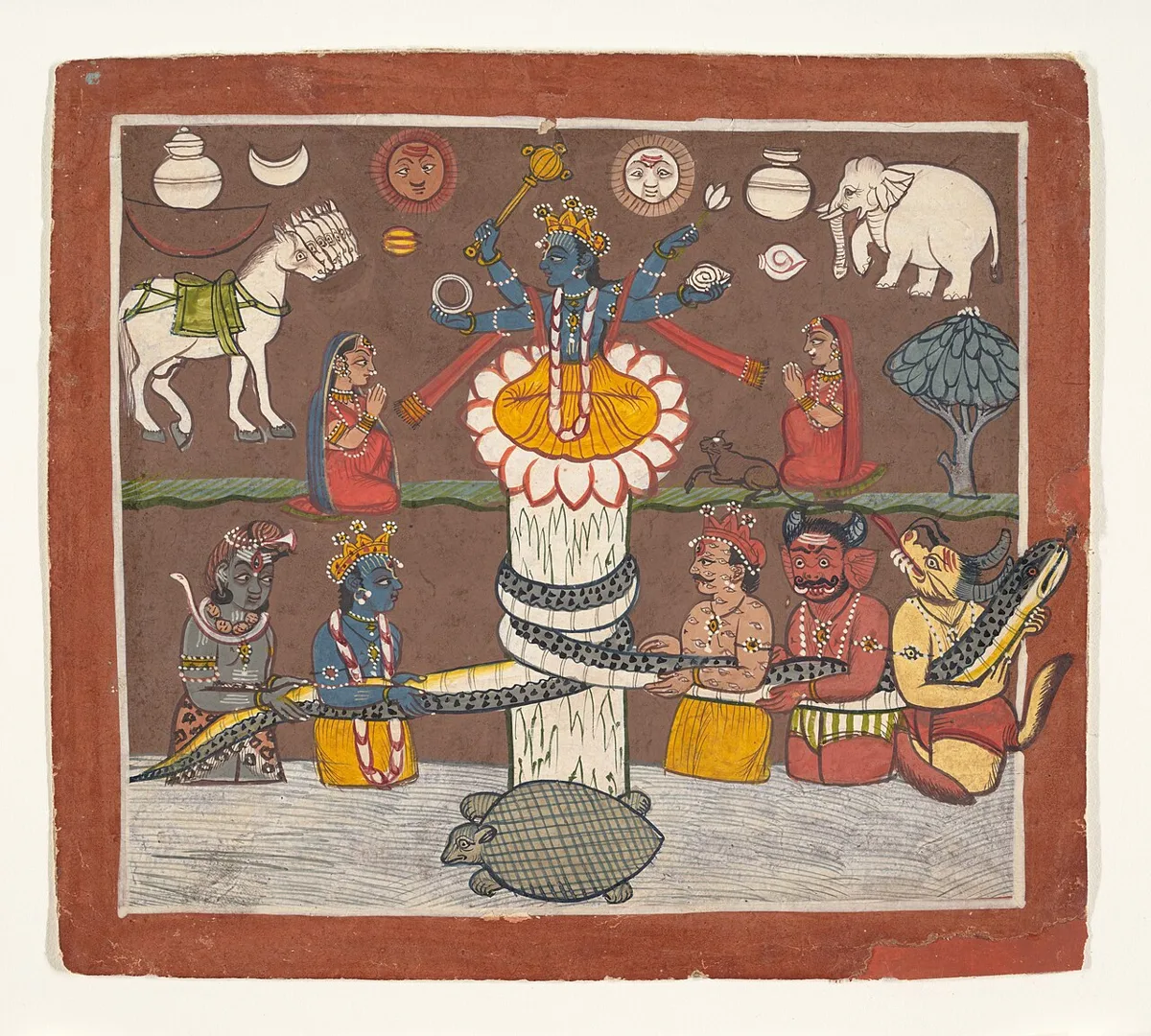
The gods and asuras took Mount Mandara to be their churning rod, and called Vasuki, king of the serpents, to be the rope. They coiled him around the mountain. Vishnu took hold of the serpent’s head, and the gods followed him. But the asuras protested: they would not hold the tail. Vishnu smiled, let go of the head and took the tail instead, and the gods went with him.
They began to pull, first one side and then the other. But the mountain had nothing beneath it, and it sank into the ocean. Both sides stood dismayed. Then Vishnu took the form of a vast tortoise, dived into the water, and raised the mountain on his back. The churning began again, and Vishnu, the Bhagavata Purana says, enjoyed the turning of the mountain on his back as if someone were scratching it.
Vasuki’s fiery breath scorched the asuras at his head, and the gods too were tired. Still the nectar did not come. So Vishnu himself took hold of the serpent and churned.
The poison
The first thing the ocean gave was not nectar but poison, halahala, so fierce that it spread in every direction and no one could escape it. The gods went to Shiva on Mount Kailasa and prayed to him to save the worlds.
Shiva was moved by compassion. He told his wife Bhavani that he would drink the poison so that living beings could be safe, and she agreed. He took all of it in his palm and drank it. The poison stayed in his throat and left a blue mark there, which the Bhagavata Purana calls an ornament to him. A few drops fell from his hand, and those, the Purana says, became the venom of scorpions, cobras and poisonous plants.
The treasures of the ocean
Now the ocean began to give up its treasures. First came the cow Surabhi, which the sages took for the offerings of their sacrifices. Then a horse as white as the moon, Uccaihshravas, and Bali, king of the asuras, claimed it. Then the elephant Airavata. Then the Kaustubha jewel, which Vishnu took to wear on his chest, and the parijata flower that adorns the heavens, and the apsaras, the dancers of heaven.
Then the goddess Lakshmi rose from the waves. The Vishnu Purana says she stood on an open lotus. She chose Vishnu as her husband, and went to him. Explore next: Why is Lakshmi worshipped on Diwali?
The pot of nectar
Last of all rose Dhanvantari, a form of Vishnu learned in the science of medicine, dressed in yellow and carrying a jug full of nectar. Before anyone could stop them, the asuras snatched it from his hands. Then they began to quarrel over who should drink first, and the weaker among them said the gods had churned too and deserved their share.
In the middle of the quarrel, a woman of unearthly beauty appeared. The asuras forgot their argument and crowded around her, asking who she was and whether she would settle their dispute. It was Vishnu, as Mohini. She warned them not to put their trust in her so easily. They handed her the pot anyway, and promised to accept whatever she decided.
She seated the gods and the asuras in two rows. With sweet words she kept the asuras content, and she served the nectar to the gods. The asuras, bound by their promise and still charmed, said nothing.
The head that would not die
One asura, Rahu, saw what was happening. He disguised himself as a god and sat in their row, and drank. But the sun and the moon recognised him and called out, and Vishnu’s discus cut off his head. His body, which the nectar had not reached, fell dead. His head had tasted the nectar, and could not die. The Bhagavata Purana says that Brahma made it a planet, and that ever since, Rahu has pursued the sun and the moon, and that is why there are eclipses.
Drops of nectar
The story lives on in one of the largest gatherings on earth. The Kumbh Mela, the Puranas tell, is held where drops of this nectar fell to earth: at Haridwar, Ujjain, Nashik and Prayagraj. Explore next: Prayagraj
Meet the people and places in this story
Also named in this story
- Vishnu
- The god who preserves the world; in this story he advises the gods, becomes a tortoise and appears as Mohini.
- Shiva
- The god who drank the poison from the ocean to save all beings.
- Durvasa
- A sage whose curse left the three worlds without prosperity.
- Indra
- King of the gods, whose slight to Durvasa's garland brought on the curse.
- Vasuki
- The king of serpents, used as the churning rope.
- Dhanvantari
- A form of Vishnu learned in medicine, who rose from the ocean carrying the pot of nectar.
- Brahma
- The creator god, who led the weakened gods to Vishnu.
- Lakshmi
- Goddess of wealth and good fortune, who rose from the ocean and chose Vishnu.
- Airavata
- Indra's elephant, who threw down Durvasa's garland and later rose from the churned ocean.
- Rahu
- An asura who stole a sip of the nectar; his undying head is said to cause eclipses.
- Mohini
- The enchanting woman's form Vishnu took to win the nectar back for the gods.
- Bhavani
- Shiva's wife, the goddess Parvati, who agreed that he should drink the poison.
- Bali
- King of the asuras, who took the white horse.
- Surabhi
- A cow that rose from the ocean, which the sages took for their offerings.
- Uccaihshravas
- The white horse that rose from the ocean, claimed by Bali.
Sources
- Bhagavata Purana, Canto 8, chapter 5 8.5.15–25 · Verified
- Bhagavata Purana, Canto 8, chapter 6 8.6.19–25 · Verified
- Bhagavata Purana, Canto 8, chapter 7 8.7.1–46 · Verified
- Bhagavata Purana, Canto 8, chapter 8 8.8.1–35 · Verified
- Bhagavata Purana, Canto 8, chapter 9 8.9.1–26 · Verified
- Vishnu Purana, Book 1, chapter 9 1.9.2–16, 1.9.98–104 · Verified
- Encyclopaedia Britannica, "Kumbh Mela" · Verified