5-minute story
The birth of Ganesha
5 min read · as told in the Shiva Purana (Rudra Samhita, Kumara Khanda)
A story told many ways
The sage Narada had just heard the story of Kartikeya, Shiva’s son, and he was delighted. Now he asked Brahma, the creator, to tell him how Ganesha was born. Brahma agreed, but first he said something important. This story, he said, has been told differently in different ages of the world. In this telling, Shiva cut off the child’s head and gave him an elephant’s head in its place.
Someone of her own
Long after Shiva and Parvati were married, Parvati’s companions Jaya and Vijaya came to her with a thought. Shiva’s door was kept by his attendants, the ganas, and they all answered to Shiva. She had no one who was truly her own. She should have an attendant of her own, they said.
Parvati thought it over. Then one day, while she was bathing, Shiva came in without warning, and she made up her mind.
From the paste on her body she shaped a boy. He was handsome and strong. She dressed him in fine clothes and ornaments, blessed him, and called him her son. She gave him a staff and set him at her door, and told him that no one was to come in without her leave. Then she went back to her bath.
A stranger at the door
Soon Shiva arrived. The boy had never seen him before, and did not know who he was. He stood in the doorway with his staff and would not let him in.
Shiva told him that he was Parvati’s husband. The boy did not move. When Shiva tried to pass, the boy struck him with his staff. Shiva grew angry. He did not force his way in; instead he called his ganas and told them to find out who this boy was, and waited outside.
The ganas argue
The ganas went to the door and told the boy to stand aside. He told them they would not pass. They tried taunts, and then threats. He answered them back and stayed where he was. Shiva laughed at his ganas for being held off by one boy, and told them to beat him.
Inside, Parvati heard the noise and sent a friend to look. The friend came back urging her not to give in. Parvati hesitated for a moment, then decided: whatever came, she would not yield. She sent word to the boy to hold his post.
The ganas came back to Shiva. A fight with a child at his own wife’s door, Shiva said, was hardly proper. But he would not look as if he had given way either. There would be a battle.
The battle
The boy fought alone against the ganas and drove them back. Then the gods came, and he struck even their leaders with his staff. Vishnu joined the fight. Powers sent by Parvati strengthened the boy. When Shiva himself came with his trident, the boy struck it from his hand. Shiva took up his bow, and the boy broke it.
Vishnu admired his courage and his beauty, and still fought on. The boy hurled an iron club at him, and Vishnu split it with his discus. The fighting went on and on. Then, while the boy was turned towards Vishnu, Shiva came at him with his trident and cut off his head.
Both armies fell silent. Narada went to Parvati and told her what had happened.
The mother’s grief
Parvati’s grief turned to fury. She sent forth countless powers of her own, goddesses who fell upon the gods and seized them, and no one could stand against them. The gods despaired. Only Parvati’s favour could save them now.
So Narada and the sages went to her. They bowed before her and sang her praises. At first she only looked at them in anger. They kept praying, begging her for peace. At last she spoke. There would be peace, she said, if her son lived again, and if he was given an honoured place among them all, as a leader.
An elephant’s head
The gods brought her answer to Shiva. Go north, he told them. Cut off the head of the first creature you meet, and fit it to the boy’s body.
They washed the boy’s body and went north, and the first creature they met was an elephant with a single tusk. They brought back its head and set it on the boy’s body. Then they called on Shiva’s power with Vedic mantras and sprinkled the body with holy water, and the boy stirred and woke, as if from sleep. He had an elephant’s face and a red glow, and he was beautiful. They brought him to Parvati, and her joy returned.
Worshipped first
Shiva placed his hand on the boy’s head. “This is another son of mine,” he told the gods. They crowned him chief of Shiva’s ganas, and Shiva confirmed it. Then the gods made a declaration. He would be the remover of obstacles. In every worship, he would be worshipped first, and they afterwards.
And so, in many Hindu homes, every new beginning still starts with a prayer to Ganesha.
Other tellings
As Brahma warned at the start, this is one telling. In others, the child loses his head not to Shiva’s trident but to the glance of the planet Shani. The ten-day festival of Ganesh Chaturthi, in August or September, is devoted to him. Another Purana story shows Shiva saving the whole world. Explore next: The churning of the ocean
Meet the people and places in this story
Also named in this story
- Ganesha
- Son of Shiva and Parvati, the elephant-headed god of beginnings and remover of obstacles.
- Parvati
- The goddess, Shiva's wife and Ganesha's mother.
- Shiva
- The great god, Parvati's husband, who accepted Ganesha as his son.
- Kartikeya
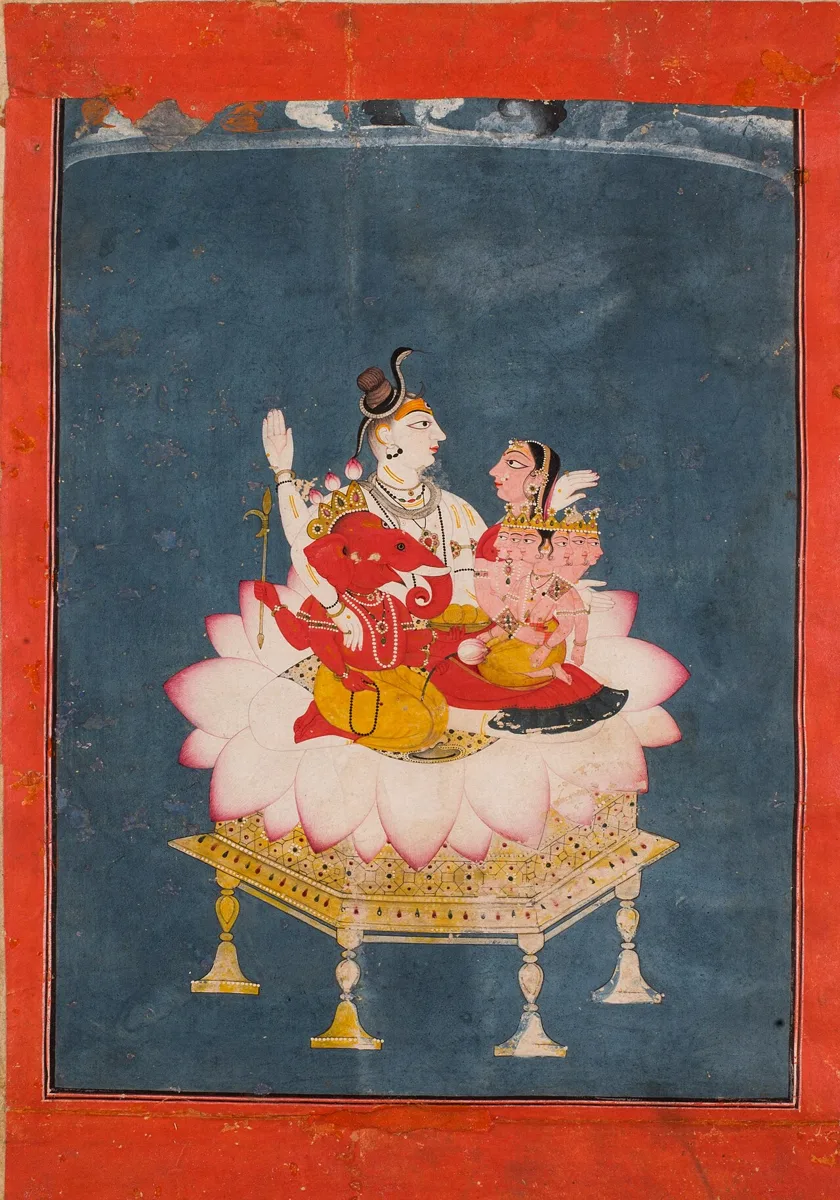
- Ganesha's brother, the other son of Shiva and Parvati, shown in the painting above.
- Jaya and Vijaya
- Parvati's companions, who suggested she have an attendant of her own.
- Vishnu
- The god who fought the boy alongside the other gods.
- Narada
- The sage who brought Parvati word of the battle and led the pleas for peace.
- Brahma
- The creator god, who tells this story to Narada in the Shiva Purana.
- Shani
- The planet Saturn; in some tellings his glance, not Shiva's trident, costs the child his head.
Sources
- Shiva Purana, Rudra Samhita, Kumara Khanda, chapter 13 2.4.13.5–39 · Verified
- Shiva Purana, Rudra Samhita, Kumara Khanda, chapter 14 · Verified
- Shiva Purana, Rudra Samhita, Kumara Khanda, chapter 16 2.4.16.1–37 · Verified
- Shiva Purana, Rudra Samhita, Kumara Khanda, chapter 17 2.4.17.4–59 · Verified
- Shiva Purana, Rudra Samhita, Kumara Khanda, chapter 18 2.4.18.3, 17, 22–23, 31 · Verified
- Encyclopaedia Britannica, "Ganesha" · Verified