Story
Varaha raises the earth
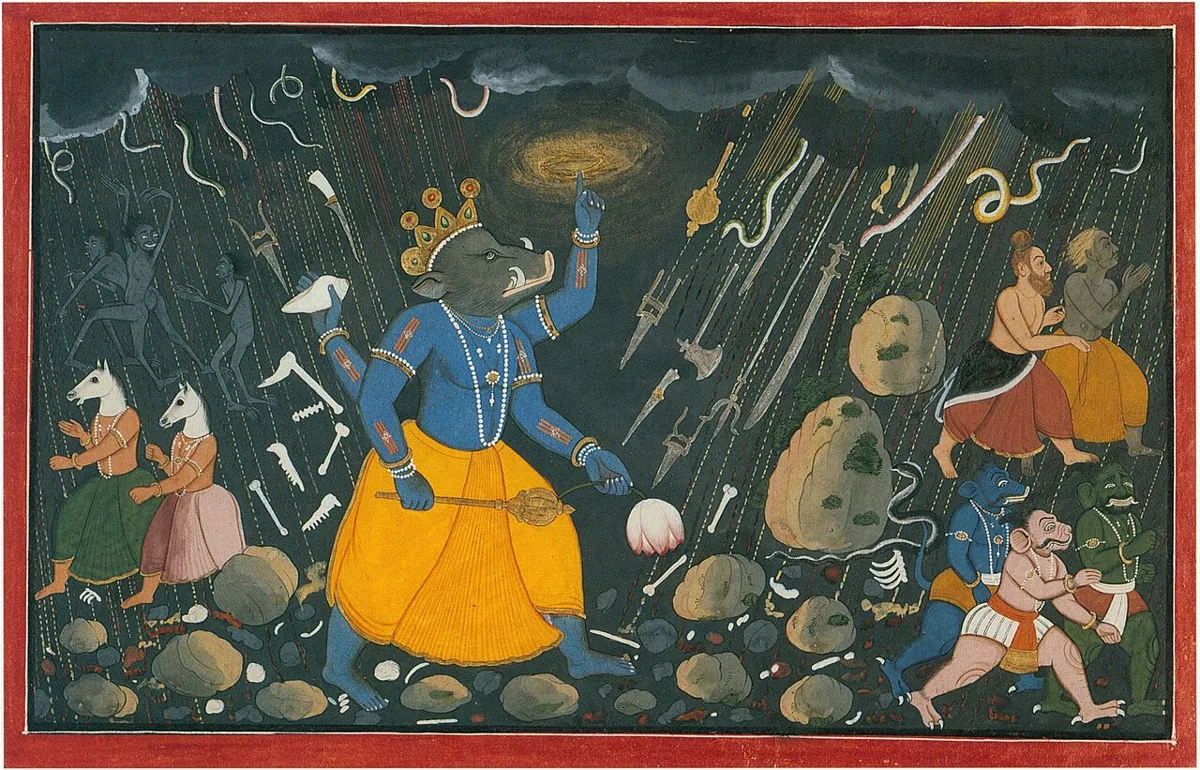
When the earth lay sunk beneath the great waters, a tiny boar no bigger than a thumb came out of Brahma's nostril and grew to an immense size. It was Vishnu as Varaha, who dived into the ocean, lifted the earth on his tusks, and killed the asura Hiranyaksha who tried to stop him.
Read the 4-minute story4 min read · told as scenes, from the Bhagavata Purana (Book 3, chapters 13, 17, 18 and 19)
- The drowned earthManu asks Brahma where his children can live, for the earth lies beneath the waters.
- A boar from Brahma's nostrilA tiny boar, no bigger than a thumb, appears and grows to the size of an elephant.
- Into the oceanVaraha dives deep, finds the earth by her scent, and lifts her on his tusks.
- Hiranyaksha attacksThe asura mocks him and rushes at him with his club.
- The battleVaraha sets the earth safely on the water and fights him, club against club.
- The earth restoredWith one blow below the ear, Varaha strikes him down, and the sages praise him.
Understand more
Simple
Svayambhuva Manu, the first father of humankind, asked Brahma where he and his children could live, since the earth was drowned beneath the great waters. Brahma did not know how to lift her out.
As he thought about it, a tiny boar, no bigger than the top of a thumb, came out of his nostril. In moments it grew as big as an elephant, and its roar filled the worlds. Brahma and the sages knew it was Vishnu.
Varaha dived into the ocean, found the earth by her scent, and rose with her balanced on his tusks. The asura Hiranyaksha attacked him in the waters.
Varaha set the earth safely on the water and fought Hiranyaksha with his club until, with one blow below the ear, he struck him down. The sages praised him, and the earth was given back to the world.
Detailed
Where the story is told
The Bhagavata Purana tells this story twice, in Book 3. A short version (chapter 13) says Varaha killed the asura Hiranyaksha in the water as he rose with the earth; a longer one (chapters 17 to 19) tells of their battle above the waves. This page follows both.
The story is set at the beginning of creation. Svayambhuva Manu, the first father of humankind, asks Brahma where he and his children are to live, for the earth lies sunk beneath the great waters, and Brahma does not know how to lift her out.
What the Bhagavata Purana draws out
The Lord as a boar. Varaha comes out of Brahma’s nostril no bigger than the top of a thumb, and grows to the size of a great elephant. Though he is the Lord himself, he searches for the earth the way a boar does, by her scent. The sages, sprinkled with the water that falls from his body as he rises, say they are purified by it.
The earth first. When Hiranyaksha finds him and mocks him, Varaha bears the insults quietly. He first sets the earth safely on the water, giving her the power to float, and only then turns to fight.
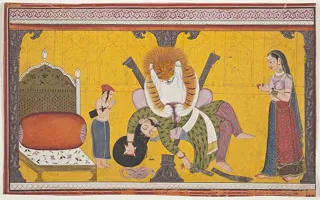
An enemy’s death. Brahma marvels that Hiranyaksha died with the Lord before his eyes. That thought returns in the stories of Hiranyaksha’s brother, Hiranyakashipu, and of the two doorkeepers they once were. Explore next: Narasimha and Prahlada
Where the story leads
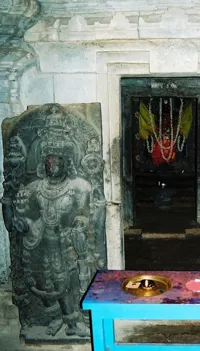
The Bhagavata Purana says the two asura brothers had once been Vishnu’s own doorkeepers. Explore next: Jaya and Vijaya, the doorkeepers
Keep exploring
 StoryJaya and Vijaya, the doorkeepers
 StoryNarasimha and Prahlada
 StoryMatsya and the great flood
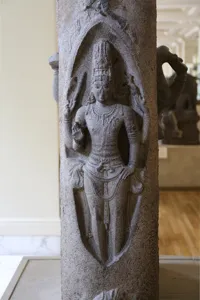 StoryShiva's pillar of fire
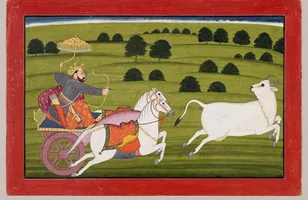 StoryPrithu milks the earth
Also named on this page
- Varaha
- Vishnu's avatar as a boar.
- Vishnu
- The god who preserves the world; Varaha is one of his avatars.
- Brahma
- The creator god, from whose nostril Varaha appeared.
- Svayambhuva Manu
- The first Manu, who asked Brahma where humankind could live.
- Hiranyaksha
- An asura, Hiranyakashipu's brother, who fought Varaha.
- Hiranyakashipu
- Hiranyaksha's brother, who swore revenge on Vishnu.
Sources
- Bhagavata Purana, Canto 3, chapter 13 3.13.14–33 · Verified
- Bhagavata Purana, Canto 3, chapter 13 3.13.34–47 · Verified
- Bhagavata Purana, Canto 3, chapter 17 3.17.20–31 · Verified
- Bhagavata Purana, Canto 3, chapter 18 3.18.1–28 · Verified
- Bhagavata Purana, Canto 3, chapter 19 3.19.23–31 · Verified