5-minute story
Narasimha and Prahlada
5 min read · as told in the Bhagavata Purana (Book 7, chapters 2 to 10)
A brother’s death
Hiranyaksha was dead. Vishnu, in his form as the great boar Varaha, had killed him, and his brother Hiranyakashipu could not bear it. He bit his lips, his eyes blazed, and he took up his trident. Vishnu, he told the asuras gathered around him, had taken the gods’ side. He would cut off Vishnu’s head with this very trident, and the gods, whose life was Vishnu, would wither like the branches of a fallen tree.
To make himself strong enough, he went to the valley of Mount Mandara. There he stood on his toes, arms raised, gazing at the sky, and did not move. His austerity went on and on, until at last Brahma, the creator, came to him and offered him whatever he wished.
A boon with no gaps
Hiranyakashipu had thought carefully. Let him not die, he asked, at the hands of anything Brahma had created. Not inside any house, and not outside. Not by day, and not by night. Not on the ground, and not in the sky. Not by any weapon. Not by man or animal, god or asura or great serpent. Let him have no rival, and rule over every living being. Brahma granted it all.
Now nothing could touch him, or so he believed.
A child who would not change
While Hiranyakashipu was away at his austerities, the gods had raided his palace, and Indra had carried off his queen, who was expecting a child. The sage Narada stopped him. The child she carried, Narada said, was a great devotee of Vishnu and could not be killed. Indra let her go, and Narada sheltered her in his hermitage until her husband returned. Every day he taught her about Vishnu. She later forgot what she had heard. Her unborn son remembered every word.
That son was Prahlada. When he was old enough, his father sent him to be taught by Shanda and Amarka, sons of Shukracharya, the asuras’ teacher. One day Hiranyakashipu took the boy on his lap and asked him what was the best thing he had learned.
To hear about Vishnu, Prahlada answered. To sing of him and remember him. To serve him, worship him, pray to him. To be his servant and his friend, and to give oneself to him completely.
His father threw him from his lap in fury.
Everything fails
Hiranyakashipu ordered his servants to kill the boy. They struck him with tridents as he sat in meditation, and the blows had no effect. They threw him under the feet of elephants and among great snakes. They cast spells on him, hurled him from a hilltop and gave him poison. They starved him and left him in the cold, the wind, fire and water, and crushed him under heavy stones. Prahlada survived everything.
The Holi bonfires remember one more attempt, told across India though not in the Bhagavata Purana: Hiranyakashipu’s sister Holika, who could not be burned, took Prahlada into a fire, and it was Holika who burned.
The pillar
At last Hiranyakashipu faced his son himself in the great hall. By whose strength, he shouted, was this boy so fearless?
By the same strength that is yours, Prahlada said calmly. All strength comes from the Lord. He asked his father to give up his anger and see everyone as equal.
Hiranyakashipu laughed at him. If this Lord was everywhere, why was he not in the pillar in front of them? He would cut off Prahlada’s head, he said; let his God come and save him. He drew his sword, rose from his throne, and struck the pillar with his fist.
From inside the pillar came a sound so terrible that the gods in their heavens thought their worlds were cracking. The asuras in the hall looked around in fear and could not tell where it came from.
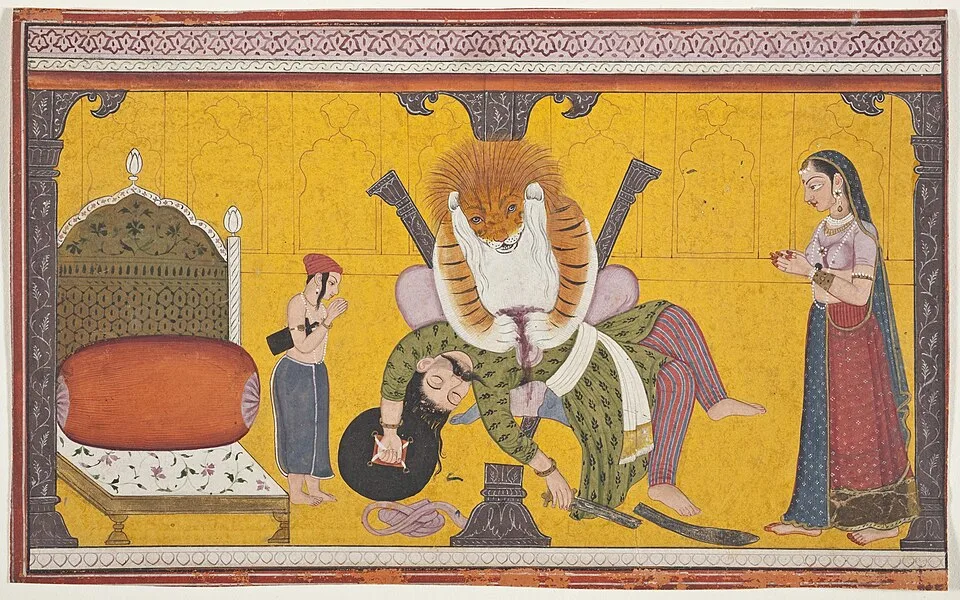
Then, to make Prahlada’s words true, Vishnu stepped out of the pillar. His form was neither man nor lion. His eyes were like molten gold. A shining mane framed his face, his teeth were terrible, and his many arms held the conch, the discus, the club and the lotus. This was Narasimha.
Neither man nor lion
Hiranyakashipu did not run. He rushed at Narasimha with his club, and Narasimha caught him as easily as Garuda catches a snake. For a moment he let him slip free, and Hiranyakashipu came at him again with sword and shield. Narasimha laughed aloud, and caught him again.
He carried him to the doorway of the hall, sat down, laid him across his lap, and killed him with his nails.
Every part of the boon had been kept, and none of it saved him. The one who killed him was neither man nor animal. The doorway was neither inside nor outside. His lap was neither the ground nor the sky. His nails were no weapon. And Britannica adds that it was dusk, neither day nor night.
The boy who calmed him
Narasimha sat on the throne, still blazing with anger. Brahma, Shiva, Indra and all the gods came with folded hands and sang his praises, and Shiva asked him to protect Prahlada. But none of them dared go near him. Even the goddess Lakshmi could not approach.
So Brahma turned to the boy. Go, he said, and calm him.
Prahlada walked forward and bowed down before Narasimha. And Narasimha lifted him up and placed his hand on his head.
Prahlada’s wish
Narasimha offered him any boon he wanted. Prahlada asked for nothing for himself, only that no worldly desire should ever take root in his heart. And one thing more: that his father be forgiven.
Your father is already purified, Narasimha told him, and twenty-one generations of your family with him. Then he told Prahlada to rule his father’s kingdom, and Brahma and Shukracharya placed him on the throne.
The Bhagavata Purana adds a last turn to the story. Hiranyaksha and Hiranyakashipu were born again, as Kumbhakarna and the ten-headed Ravana, and were killed by Rama. Explore next: Ravana
Meet the people and places in this story
Also named in this story
- Rama
- Rama is the central figure of the Ramayana, the eldest son of King Dasharatha of Ayodhya, and is worshipped by Hindus as the seventh avatar of Vishnu.
- Narasimha
- Vishnu's form as half man, half lion, who protects his devotee Prahlada.
- Prahlada
- Hiranyakashipu's son, honoured as one of the greatest devotees of Vishnu.
- Hiranyakashipu
- An asura king who won a boon from Brahma and made war on Vishnu.
- Hiranyaksha
- Hiranyakashipu's brother, killed by Vishnu as the boar Varaha.
- Vishnu
- The god who preserves the world; Narasimha is one of his avatars.
- Varaha
- Vishnu's avatar as a boar.
- Brahma
- The creator god, who granted Hiranyakashipu's boon.
- Narada
- The sage who taught Prahlada about Vishnu before he was born.
- Holika
- Hiranyakashipu's sister, who burned in the fire meant for Prahlada.
- Kumbhakarna
- Ravana's brother; in the Bhagavata Purana, Hiranyaksha born again.
- Shiva
- The great god, among those who praised Narasimha and asked him to protect Prahlada.
- Lakshmi
- Goddess of good fortune and Vishnu's wife, who could not approach Narasimha in his anger.
- Indra
- King of the gods, who seized Prahlada's mother before Narada freed her.
- Shanda and Amarka
- Prahlada's teachers, the sons of Shukracharya.
- Shukracharya
- The teacher and priest of the asuras.
- Garuda
- The great eagle who carries Vishnu.
Sources
- Bhagavata Purana, Canto 7, chapter 2 7.2.1–9 · Verified
- Bhagavata Purana, Canto 7, chapter 3 7.3.2, 7.3.35–38 · Verified
- Bhagavata Purana, Canto 7, chapter 5 7.5.23–24, 7.5.39–44 · Verified
- Bhagavata Purana, Canto 7, chapter 7 · Verified
- Bhagavata Purana, Canto 7, chapter 8 7.8.6–41 · Verified
- Bhagavata Purana, Canto 7, chapter 9 7.9.1–6 · Verified
- Bhagavata Purana, Canto 7, chapter 10 7.10.7, 7.10.15–24, 7.10.35–37 · Verified
- Encyclopaedia Britannica, "Narasimha" · Verified
- Encyclopaedia Britannica, "Holi" · Verified