3-minute story
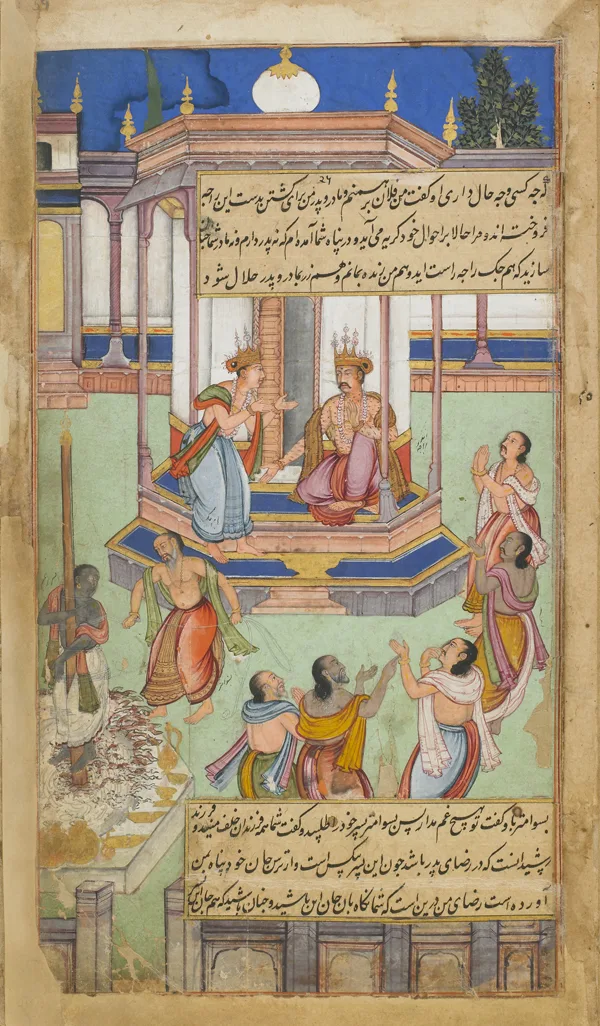
Shunahshepa at the sacrifice
3 min read · as told in the Bhagavata Purana (Book 9, chapters 7 and 16) and the Valmiki Ramayana (Bala Kanda, sargas 61 and 62), told side by side
Two tellings
This is the story of a boy named Shunahshepa, who was tied to a sacrificial post, and was saved. It is told in the Bhagavata Purana, and it is told in the Valmiki Ramayana, and the two tellings are different. Here are both.
A king’s promise
In the Bhagavata Purana, King Harishchandra had everything a king could want, except a son. On the advice of the sage Narada, he prayed to Varuna, god of the waters. Give me a son, he said, and I will offer that son to you in sacrifice.
A son was born, and Harishchandra named him Rohita. And Varuna came to collect.
The king looked at his baby, and could not do it. An animal cannot be offered until it is ten days old, he said. Come back then.
Varuna came back. Not until his teeth come, said the king. The teeth came. Not until they fall out. They fell out. Not until the new ones grow. They grew. Not until he is old enough to fight like a warrior. And each time, Varuna waited.
Six years in the forest
When Rohita grew up and understood what his father had promised, he took his bow and ran into the forest.
Varuna struck Harishchandra with a terrible illness. Rohita heard, and turned for home. But on the road an old man stopped him: go on travelling, see the holy places. The old man was really Indra, king of the gods. Each year it happened again, for five years.
In the sixth year, Rohita came home. With him he brought a boy he had bought from a man named Ajigarta: his second son, Shunahshepa, to be offered in Rohita’s place.
Saved
The sacrifice began, with the greatest sages of the age as priests: Vishvamitra, Jamadagni and Vasishtha among them. Harishchandra was cured.
And Shunahshepa, bound as the offering, prayed to the gods. They heard him, and by their mercy he was set free.
Vishvamitra took the boy as his own son. He is your eldest brother now, he told his hundred sons. The younger fifty welcomed him. The elder fifty refused, and their father cursed them. From then on, the boy was called Devarata, “given by the gods”.
The Ramayana’s telling
The Valmiki Ramayana tells it another way.
King Ambarisha of Ayodhya was performing a sacrifice, when Indra carried off the animal that was to be offered. Find another, said the priest, or a person in its place, and quickly.
The king searched everywhere, and came at last to the sage Richika. A hundred thousand cows, he said, for one of your sons.
Not my eldest, said Richika. Not my youngest, said his wife. And the middle son, Shunahshepa, spoke up: then it must be me.
The uncle
On the way to the sacrifice, they stopped at Pushkara. There Shunahshepa saw the great sage Vishvamitra, his mother’s brother, and ran to him and fell into his lap. I have no one, he cried. You are my only protector.
Vishvamitra turned to his own sons. Take his place, he said. They refused, and he cursed them.
Then he taught the boy two sacred hymns. Sing these, he said, when you are tied to the post.
The hymns
At the sacrifice, Shunahshepa was bound to the post, dressed in red. And there he sang the hymns, praising Indra, and Upendra, Indra’s younger brother.
Indra was pleased. He granted the boy a long life. And Ambarisha’s sacrifice was completed.
In both tellings, a frightened boy called out to the gods, and was heard.
Meet the people and places in this story
Also named in this story
- Ayodhya
- In the Ramayana, Ayodhya is the capital of the kingdom of Kosala, where Rama is born and later crowned.
- Shunahshepa
- A sage's son, saved at a sacrifice; also called Devarata.
- Harishchandra
- A king of the solar line, famous for truthfulness.
- Rohita
- Harishchandra's son.
- Varuna
- God of the waters.
- Narada
- The travelling sage.
- Indra
- King of the gods.
- Ajigarta
- Shunahshepa's father, in the Bhagavata Purana.
- Richika
- A sage, Shunahshepa's father, in the Valmiki Ramayana.
- Ambarisha
- A king of Ayodhya, in the Valmiki Ramayana's telling.
- Jamadagni
- A sage, father of Parashurama.
- Upendra
- A name of Vishnu, as Indra's younger brother.
- Pushkara
- A sacred lake in Rajasthan, a place of pilgrimage.
Sources
- Bhagavata Purana, Canto 9, chapter 7 9.7.8–23 · Verified
- Bhagavata Purana, Canto 9, chapter 16 9.16.30–37 · Verified
- Valmiki Ramayana, Bala Kanda, sargas 61–62 1.61.5–23; 1.62.1–28 · Verified
- Bhagavata Purana, Canto 9, chapter 7 9.7.8–23 · Verified
- Bhagavata Purana, Canto 9, chapter 16 9.16.30–37 · Verified
- Valmiki Ramayana, Bala Kanda, sargas 61–62 1.61.5–23; 1.62.1–28 · Verified