5-minute story
Shiva's bow and the wedding of Rama and Sita
5 min read · as told in the Valmiki Ramayana, Bala Kanda
The road to Mithila
Rama and his brother Lakshmana were still young when they set out with the sage Vishvamitra. On the way, the sages travelling with them spoke of King Janaka of Mithila, who was holding a great sacrifice. They urged Rama to come and see Janaka’s bow, a jewel among bows. No god, no demon, no human had ever been able to string it, they said, and kings who tried could not even lift it.
So they turned towards Mithila. They found the place of sacrifice full of carts and hermitages and thousands of learned brahmanas. Janaka hurried out to welcome Vishvamitra, with his family priest Shatananda at his side. Then the king looked at the two young men standing with the sage, their bows and quivers on their shoulders.
He asked who they were. They walked like lions, he said, and lit up the land the way the sun and moon light up the sky. Whose sons were they, and why had they come on foot? Vishvamitra told him: these were the sons of King Dasharatha of Ayodhya, and they had come to see his bow.
The story of the bow
Janaka told them how the bow had come to his family. Long ago, at the sacrifice of Daksha, the god Shiva had raised it against the gods, because they had not given him his share of the offerings. When the gods won back his favour, he gave the bow to them, and it was entrusted to Devarata, one of Janaka’s ancestors. It had been kept in the family ever since and honoured with perfumes and incense.
Then he told them of his daughter. Once, as he ploughed a field to prepare it for a sacrifice, a girl rose up out of the furrow. She was born of no mother. He named her Sita and raised her as his own.
He had made a promise, Janaka said. Sita would marry only the man who proved his strength by stringing Shiva’s bow. Kings had come from everywhere to try. Not one could so much as grasp it.
The bow breaks
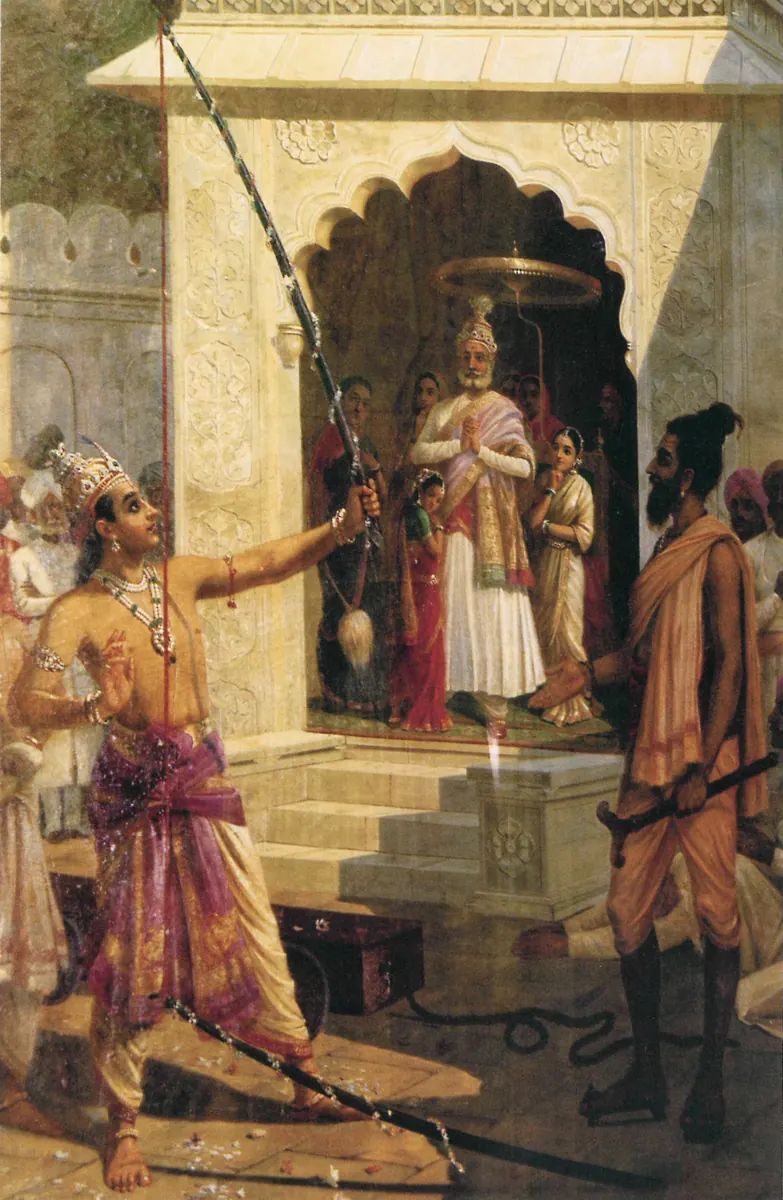
At Janaka’s command, the bow was brought out. It lay in an iron chest on a cart with eight wheels, and a great crowd of men strained to pull it in.
With Vishvamitra’s leave, Rama opened the chest and asked if he might touch the bow and try to lift it.
He took the bow by its middle and raised it as if it were a toy. In front of all the watching kings, he strung it. Then he drew the string back, further and further, until the great bow broke in two.
The crash was like thunder. The earth shook as if a mountain were splitting apart. Almost everyone who heard it fell senseless. Only four stayed on their feet: Janaka, Vishvamitra, Rama and Lakshmana.
When calm returned, Janaka spoke in wonder at what he had seen. His promise was fulfilled, he said. Sita would be Rama’s wife.
A message to Ayodhya
Janaka sent his ministers in swift chariots to Ayodhya, to tell King Dasharatha everything and bring him to Mithila.
Dasharatha set out at once. The sage Vasishtha and other sages went ahead, and the army followed the king. After four days they reached Janaka’s kingdom. Janaka came out to welcome the old king, and Dasharatha’s heart filled with joy at the sight of his sons, Rama and Lakshmana.
Janaka asked that the wedding take place as soon as his sacrifice was complete. Dasharatha gladly agreed.
Four weddings
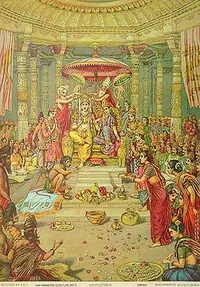
On the wedding day, Vasishtha prepared the altar and lit the sacred fire. Janaka led Sita forward and placed her before the fire. He told Rama that this was his daughter, that she would be his companion in dharma, and asked him to take her hand.
On the same day, Rama’s three brothers were married too: Lakshmana to Urmila, Bharata to Mandavi and Shatrughna to Shrutakirti. The four couples walked around the fire, the altar, the king and the sages. The epic tells that flowers fell from the sky, heavenly drums sounded, and celestial musicians sang.
A challenge on the road
As the wedding party travelled home, they were met on the road by the sage Parashurama, son of Jamadagni. He was a brahmana who had taken up arms, and long ago, in anger at his father’s unjust killing, he had fought the warrior kings again and again. He carried a bow that had once belonged to the god Vishnu. Ignoring King Dasharatha’s pleas for his sons, he spoke only to Rama. Let Rama string this bow and set an arrow on it, he said, and if he could, Parashurama would meet him in single combat.
Out of respect for his father, Rama held back his anger. Then he took the bow and arrow from Parashurama’s hand and strung the bow.
But he would not take Parashurama’s life, for Parashurama was a brahmana and connected to his teacher Vishvamitra. Yet an arrow set on that bow could not be wasted. So Rama offered him a choice: the arrow would strike either his power to travel freely, won through long austerity, or the higher worlds he had earned.
Parashurama was stunned. In that moment he recognised Rama as Vishnu himself, and said there was no shame in being bested by him. He asked Rama to strike the worlds he had won, and leave him his power to travel. Rama released the arrow. Parashurama walked respectfully around Rama, and left for Mount Mahendra. Explore next: Rama
Meet the people and places in this story
Also named in this story
- Ayodhya
- In the Ramayana, Ayodhya is the capital of the kingdom of Kosala, where Rama is born and later crowned.
- Dasharatha
- Dasharatha was the king of Ayodhya and the father of Rama, Bharata, Lakshmana and Shatrughna.
- Bharata
- Bharata was Rama's younger brother, the son of King Dasharatha and Queen Kaikeyi.
- Lakshmana
- Lakshmana was Rama's younger brother, the son of King Dasharatha and Queen Sumitra.
- Vishvamitra
- Vishvamitra was a king who, the Valmiki Ramayana tells, became a brahmarshi, a sage of the highest rank, through long austerity.
- Vasishtha
- Vasishtha is the family priest of Ayodhya in the Valmiki Ramayana.
- Janaka
- Janaka is the king of Mithila and Sita's father in the Valmiki Ramayana.
- Shatrughna
- Shatrughna is the youngest of King Dasharatha's four sons in the Valmiki Ramayana, Sumitra's son and Lakshmana's twin.
- Shatananda
- Janaka's family priest.
- Shiva
- The god whose bow had come down in Janaka's family.
- Daksha
- At Daksha's sacrifice, long ago, Shiva raised the bow against the gods.
- Devarata
- Janaka's ancestor, to whom the bow was entrusted.
- Urmila, Mandavi and Shrutakirti
- The brides of Lakshmana, Bharata and Shatrughna, married on the same day as Rama and Sita.
- Parashurama
- A sage, son of Jamadagni, who challenged Rama with Vishnu's bow and then recognised him as Vishnu.
- Jamadagni
- Parashurama's father, whose unjust killing set Parashurama against the warrior kings.
- Vishnu
- The god whose bow Parashurama carried. Parashurama recognised Rama as Vishnu himself.
Sources
- Valmiki Ramayana, Bala Kanda 1.31.5–13 · Verified
- Valmiki Ramayana, Bala Kanda sarga 50 · Verified
- Valmiki Ramayana, Bala Kanda sarga 66 · Verified
- Valmiki Ramayana, Bala Kanda sarga 67 · Verified
- Valmiki Ramayana, Bala Kanda sarga 69 · Verified
- Valmiki Ramayana, Bala Kanda sarga 73 · Verified
- Valmiki Ramayana, Bala Kanda sarga 75 · Verified
- Valmiki Ramayana, Bala Kanda sarga 76 · Verified
- Valmiki Ramayana, Bala Kanda 1.31.5–13 · Verified
- Valmiki Ramayana, Bala Kanda sarga 66 · Verified
- Valmiki Ramayana, Bala Kanda sarga 67 · Verified
- Valmiki Ramayana, Bala Kanda sarga 73 · Verified