3-minute story
Krishna and Narakasura
3 min read · as told in the Bhagavata Purana (Book 10, chapter 59), with the Diwali day that recalls it
What Naraka took
Naraka was a son of the earth, and he was strong. He had taken the jeweled earrings of Aditi, the mother of all the gods. He had taken the royal umbrella of Varuna, god of the waters. He had even seized a place of the gods on the peak of Mount Mandara.
And in his palace, he kept sixteen thousand princesses, carried off by force from their homes.
Indra, king of the gods, could do nothing. So he came to Krishna and told him everything.
The flight
Krishna called Garuda, the great eagle. He climbed onto his back, and his queen Satyabhama climbed up beside him. Then Garuda spread his wings and flew to Naraka’s city, Pragjyotisha.
The walls of Pragjyotisha
The city was built to keep everyone out. Around it stood a ring of hills. Inside the hills were weapons that fired by themselves. Inside those, walls of water, fire and wind. And over all of it hung a net of deadly wires.
Krishna broke the hills with his club. He broke the weapons with his arrows. He broke the water, the fire and the wind with his spinning disc. He cut the wires with his sword.
Then he raised his conch, Panchajanya, and blew. The sound was so great that the city’s magic seals cracked apart.
Mura
In the moat around the palace slept Mura, an asura with five heads. The sound of the conch woke him.
He rose up out of the water, all five mouths roaring, and hurled his trident straight at Garuda. Krishna’s arrows broke it into pieces in the air. Mura came at him with a club, and Krishna shattered that too. Then Krishna’s disc flew, and Mura’s five heads fell, and his body sank back into the water.
Naraka
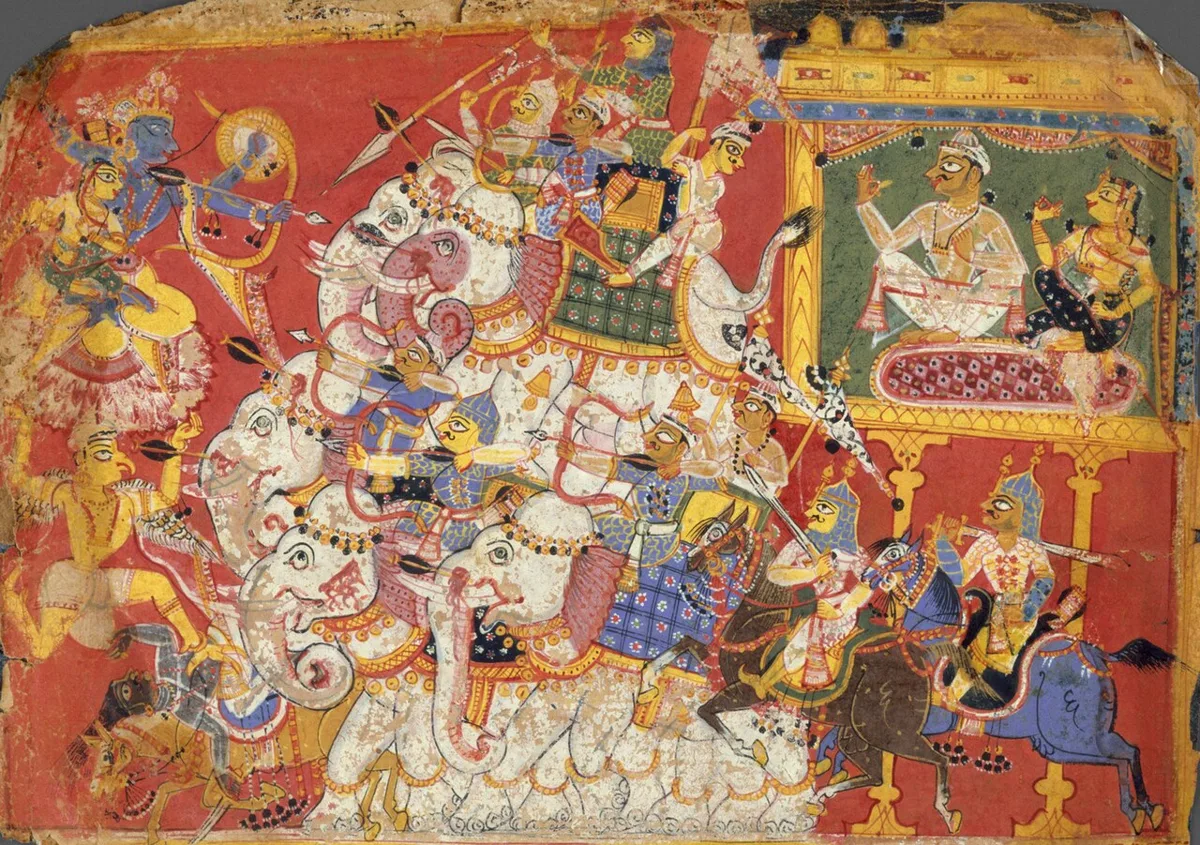
Now Naraka himself came out, riding a great elephant, with an army behind him.
Krishna drove back the army. Naraka flung his spear at Krishna; it did not even scratch him. Then Krishna sent his disc spinning through the air, and it struck off Naraka’s head as he sat on his elephant.
The mother
Then the earth goddess herself came to Krishna. Naraka had been her son.
She brought Aditi’s earrings and Varuna’s umbrella, and a garland, and laid them at Krishna’s feet. She prayed to him. Then she brought forward a small, frightened boy: Naraka’s son. Please, she said, protect him.
Krishna promised that the boy would be safe.
Sixteen thousand
Krishna walked into Naraka’s palace. There he found the sixteen thousand princesses, who had been taken from their homes and kept there.
They looked at the one who had come to free them, and each one, in her heart, chose him as her husband. Krishna sent them all to Dvaraka, with great honour and great treasure, and later married them, each in a palace of her own.
The flower tree
Krishna and Satyabhama flew on to the city of the gods, and Krishna returned Aditi’s earrings to her himself.
In the gardens of heaven grew the parijata tree, with its wonderful flowers. Satyabhama longed for it. So Krishna pulled it up, set it on Garuda’s back, and carried it home to plant in her garden.
Remembered
People still remember Naraka’s fall. In South India, Diwali celebrates Krishna’s victory over Narakasura. And the second day of Diwali, Naraka Chaturdashi, is kept in memory of it.
Meet the people and places in this story
Also named in this story
- Krishna
- Worshipped as God, and as an avatar of Vishnu; in this story king in Dvaraka.
- Naraka
- An asura king, son of the earth, also called Bhauma and Narakasura.
- Aditi
- Mother of the gods.
- Varuna
- God of the waters.
- Indra
- King of the gods.
- Satyabhama
- One of Krishna's queens, daughter of Satrajit.
- Garuda
- The great eagle who carries Vishnu.
- Mura
- A five-headed asura who guarded Naraka's city.
- Panchajanya
- Krishna's conch.
Sources
- Bhagavata Purana, Canto 10, chapter 59 10.59.2–22 · Verified
- Bhagavata Purana, Canto 10, chapter 59 10.59.23–42 · Verified
- Encyclopaedia Britannica, "Diwali" · Verified
- Bhagavata Purana, Canto 10, chapter 59 10.59.2–22 · Verified
- Bhagavata Purana, Canto 10, chapter 59 10.59.23–42 · Verified
- Encyclopaedia Britannica, "Diwali" · Verified