Story
Krishna and Narakasura
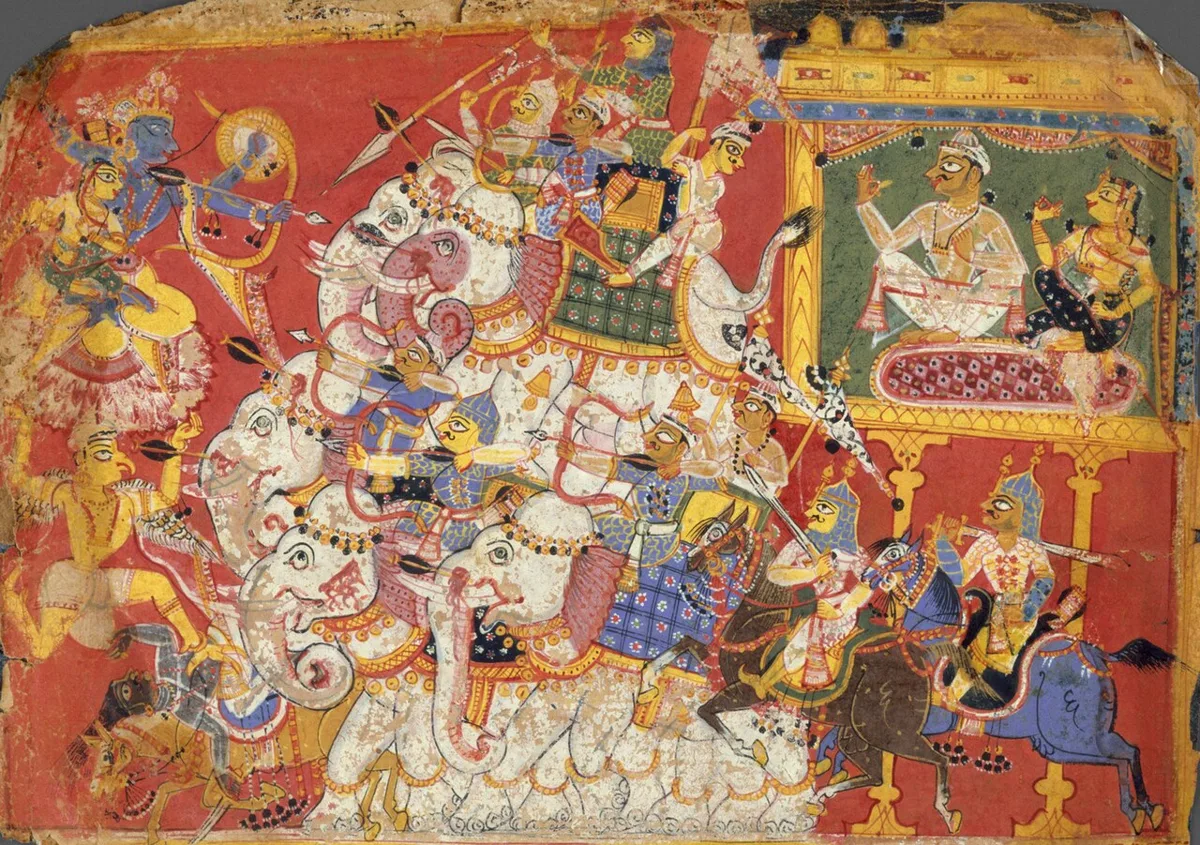
Naraka, a mighty asura and a son of the earth, had stolen the earrings of Aditi, mother of the gods, and held sixteen thousand princesses captive in his fortress city. Krishna flew there on Garuda with his queen Satyabhama, broke through the fortress's defences, killed Naraka's general Mura and then Naraka himself, and set the princesses free; many Hindus remember this victory at Diwali, as Naraka Chaturdashi.
Read the 3-minute story3 min read · told as scenes, from the Bhagavata Purana (Book 10, chapter 59), with the Diwali day that recalls it
- The stolen earringsNaraka steals Aditi's earrings, and Indra asks Krishna for help.
- To the fortressKrishna flies on Garuda with Satyabhama, and breaks through every defence.
- MuraKrishna kills the five-headed Mura, who guards the moat.
- Naraka fallsKrishna strikes Naraka down with his disc. The earth goddess returns the earrings.
- The princesses freedSixteen thousand captive princesses are set free.
- DiwaliMany Hindus recall the victory on Naraka Chaturdashi, the second day of Diwali.
Understand more
Simple
Naraka, also called Bhauma, son of the earth, had stolen the earrings of Aditi, mother of the gods, the umbrella of Varuna and a place of the gods on Mount Mandara. Indra came to Krishna for help.
Krishna flew on Garuda with his wife Satyabhama to Naraka's city, Pragjyotisha. It was guarded by hills, weapons, water, fire, wind and a net of deadly wires. Krishna broke through each defence, and killed Mura, the five-headed asura who guarded the moat.
Naraka came out on an elephant with his army. Krishna drove back the army and, with his disc, struck down Naraka. The earth goddess, Naraka's mother, brought Krishna the stolen earrings, prayed to him, and asked him to protect Naraka's young son, which he did.
In the palace Krishna found sixteen thousand princesses Naraka had taken by force. He freed them and sent them to Dvaraka, and they chose him as their husband. Many Hindus remember Naraka's defeat on the second day of Diwali, Naraka Chaturdashi.
Detailed
Where the story is told
This page follows the Bhagavata Purana, Book 10, chapter 59. Naraka is also called Bhauma, “son of the earth”. He had stolen the earrings of Aditi, mother of the gods, the royal umbrella of Varuna, god of the waters, and a place of the gods on Mount Mandara, and Indra, king of the gods, came to Krishna for help.
What the Bhagavata Purana draws out
Every wall broken. Naraka’s city, Pragjyotisha, is ringed with hills, weapons that fire by themselves, water, fire, wind and a net of deadly wires. Krishna breaks each defence in turn, and the five-headed asura Mura, who guards the moat, falls to his disc.
A mother’s prayer. After Naraka falls, the earth goddess, his mother, returns everything he had taken, prays to Krishna, and places Naraka’s frightened young son in his care. Krishna promises the child protection.
Captives freed. In Naraka’s palace Krishna finds sixteen thousand princesses whom Naraka had carried off by force. He sends them to Dvaraka with great honour, and later marries them all.
Krishna’s queen Satyabhama rides beside him on Garuda, and on the way home, at her request, he brings the heavenly parijata tree to her garden in Dvaraka. Explore next: The Syamantaka jewel
Where the story lives on
This victory is remembered far beyond the Purana. In South India, Diwali celebrates Krishna’s defeat of Narakasura, and the second day of the festival, Naraka Chaturdashi, recalls it. Explore next: Diwali
Keep exploring
 TraditionDiwali
 StoryThe Syamantaka jewel
 StoryKrishna lifts Govardhan hill
 StoryThe birth of Krishna
 StoryKrishna and the serpent Kaliya
Also named on this page
- Krishna
- Worshipped as God, and as an avatar of Vishnu; in this story king in Dvaraka.
- Naraka
- An asura king, son of the earth, also called Bhauma and Narakasura.
- Aditi
- Mother of the gods.
- Varuna
- God of the waters.
- Indra
- King of the gods.
- Satyabhama
- One of Krishna's queens, daughter of Satrajit.
- Garuda
- The great eagle who carries Vishnu.
- Mura
- A five-headed asura who guarded Naraka's city.
Sources
- Bhagavata Purana, Canto 10, chapter 59 10.59.2–22 · Verified
- Bhagavata Purana, Canto 10, chapter 59 10.59.23–42 · Verified
- Encyclopaedia Britannica, "Diwali" · Verified