4-minute story
Durga and Mahishasura
4 min read · as told in the Devi Mahatmya (Markandeya Purana)
A hundred years of war
The Devi Mahatmya, a sacred text within the Markandeya Purana, tells of a war between the gods and the asuras that lasted a full hundred years. The asuras were led by Mahisha, often called Mahishasura, “the buffalo asura”. The gods were led by Indra, their king.
At the end of it, the gods were beaten. Mahisha took Indra’s place as lord of heaven. He took over the powers of the sun, of Indra, of fire and wind, of the moon, of Yama and Varuna and the other gods. Driven out of heaven, the gods wandered the earth like mortals.
The gods’ complaint
The defeated gods, with Brahma at their head, went to Shiva and Vishnu. They told them everything: how Mahisha had taken their places one by one, and the insults they had suffered. We seek refuge in you, they said. Think how he may be slain.
As Vishnu and Shiva listened, they grew angry.
A goddess born of light
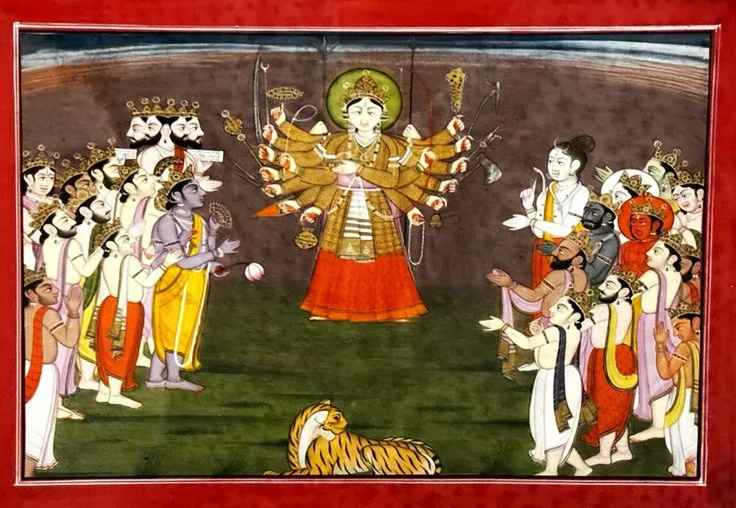
From the faces of Vishnu, Brahma and Shiva, a great radiance poured out. Light streamed too from Indra and from every other god, and all of it flowed together into one blazing mass, like a mountain on fire, filling every direction with its flames.
That light took the form of a woman, and her radiance filled the three worlds. Every god’s energy became part of her. Shiva’s energy formed her face, Yama’s her hair, Vishnu’s her arms. Brahma’s became her feet, the sun’s her toes, Kubera’s her nose, and fire’s her three eyes. From every god something came, and in her, all of it was one.
The gods looked at her and rejoiced.
Gifts from every god
Then each god gave her a weapon, drawn from his own. Shiva drew a trident out of his trident and gave it to her. Vishnu brought forth a discus from his discus. Varuna gave her a conch and a noose, Agni a spear, Vayu a bow and quivers of arrows. Indra gave her a thunderbolt and the bell from his elephant Airavata. Yama gave a staff, Brahma a string of beads and a water pot, and the sun gave her his rays. Vishvakarma, the craftsman of the gods, gave her an axe and armour. The ocean gave her garlands and a lotus to hold. The Himalaya gave her a lion to ride.
Honoured with all these gifts, she laughed aloud, again and again. The sound filled the sky. The worlds shook, the oceans heaved and the mountains trembled. The gods called out “Victory!” to her, and the sages bowed and praised her.
The armies come
Mahisha saw the three worlds in turmoil and rushed towards the sound, surrounded by his asuras. There he saw the goddess, her feet pressing down the earth, her crown touching the sky, her thousand arms reaching to every horizon.
The battle began. Mahisha’s generals, Chikshura and Chamara and many more, came at her with chariots, elephants, horses and foot soldiers beyond counting. One by one, and army by army, she struck them down.
Every form he took
Then Mahishasura himself came, in the form of a buffalo. He scattered her attendants and shook the earth.
She cast her noose and bound him. He threw off the buffalo’s body and became a lion. As she raised her sword, he became a man with a sword and shield. As she cut him down with her arrows, he became a huge elephant and seized her lion with his trunk. She cut off the trunk with her sword. Then he became a buffalo again, and shook the three worlds.
He hurled mountains at her, and her arrows shattered them. Then she leapt on him, pressed him down with her foot, and struck him with her trident. Held by her power, he could only half emerge from his own mouth. And with her great sword, she struck off his head.
His army was destroyed, and the gods and the sages rejoiced.
The gods’ prayer
Indra and the gods bowed low and sang a long hymn in her praise. They called her the power that fills the whole world, the good fortune in the homes of the good. She was terrible in battle, they sang, and yet she was kind even to her enemies.
Pleased, she told them to ask for anything they wished. You have already done everything, they said. But they asked two things more. Whenever we remember you, destroy our great sufferings. And whoever praises you with these hymns, bless them with prosperity and a happy home.
She granted it, and vanished from their sight.
Nine nights
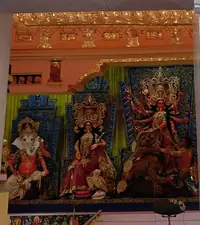
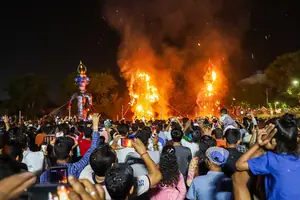
To this day, this victory is remembered at Navratri and Durga Puja, when the Goddess is honoured for nine nights, and on the tenth day, Vijayadashami. Explore next: Navratri and Durga Puja
Meet the people and places in this story
Also named in this story
- Durga
- The goddess formed from the radiance of all the gods; the Devi Mahatmya calls her by many names, among them Chandika.
- Mahishasura
- The buffalo asura who drove the gods from heaven.
- Indra
- King of the gods, whose throne Mahishasura took.
- Brahma, Vishnu and Shiva
- The three great gods, from whose anger the goddess's radiance first poured.
- Varuna
- God of the waters, who gave the goddess a conch.
- Himalaya
- The mountain, honoured as a god (Himavan), who gave the goddess her lion.
- Yama
- God of death, whose energy formed the goddess's hair.
- Kubera
- God of wealth, whose energy formed part of the goddess.
- Agni
- God of fire, who gave the goddess a spear.
- Vayu
- God of the wind, who gave the goddess a bow and arrows.
- Vishvakarma
- The craftsman of the gods, who gave her an axe and armour.
- Airavata
- Indra's elephant, whose bell Indra gave the goddess.
- Chikshura and Chamara
- Two of Mahishasura's generals.
Sources
- Devi Mahatmya (Markandeya Purana), Chapter 2, "Slaughter of the armies of Mahishasura" · Verified
- Devi Mahatmya (Markandeya Purana), Chapter 3, "Slaying of Mahishasura" · Verified
- Devi Mahatmya (Markandeya Purana), Chapter 4, "Devi Stuti" · Verified
- Devi Mahatmya (Markandeya Purana), Chapter 3 (adhyaya 83 in this edition) · Verified
- Encyclopaedia Britannica, "Durga" · Verified