Story
Daksha curses Narada
Daksha, a son of Brahma charged with filling the world with life, sent his sons to prepare to become fathers; twice the sage Narada met them and turned their minds to the Lord instead, and they never came home. In his grief and anger Daksha cursed Narada to have no home anywhere, and Narada, who could have cursed him back, calmly accepted, as the Bhagavata Purana tells.
Read the 3-minute story3 min read · told as scenes, from the Bhagavata Purana (Book 6, chapter 5)
- Ten thousand sonsDaksha sends the Haryashvas to Narayana-saras to prepare to have families.
- RiddlesNarada speaks to them in riddles about the body, the soul, the Lord and time.
- A different pathThe sons choose to devote themselves to the Lord, and never return.
- A thousand moreDaksha's next sons, the Savalashvas, follow their brothers.
- The curseDaksha curses Narada to have no home anywhere.
- So be itNarada accepts the curse calmly, without cursing him back.
Understand more
Simple
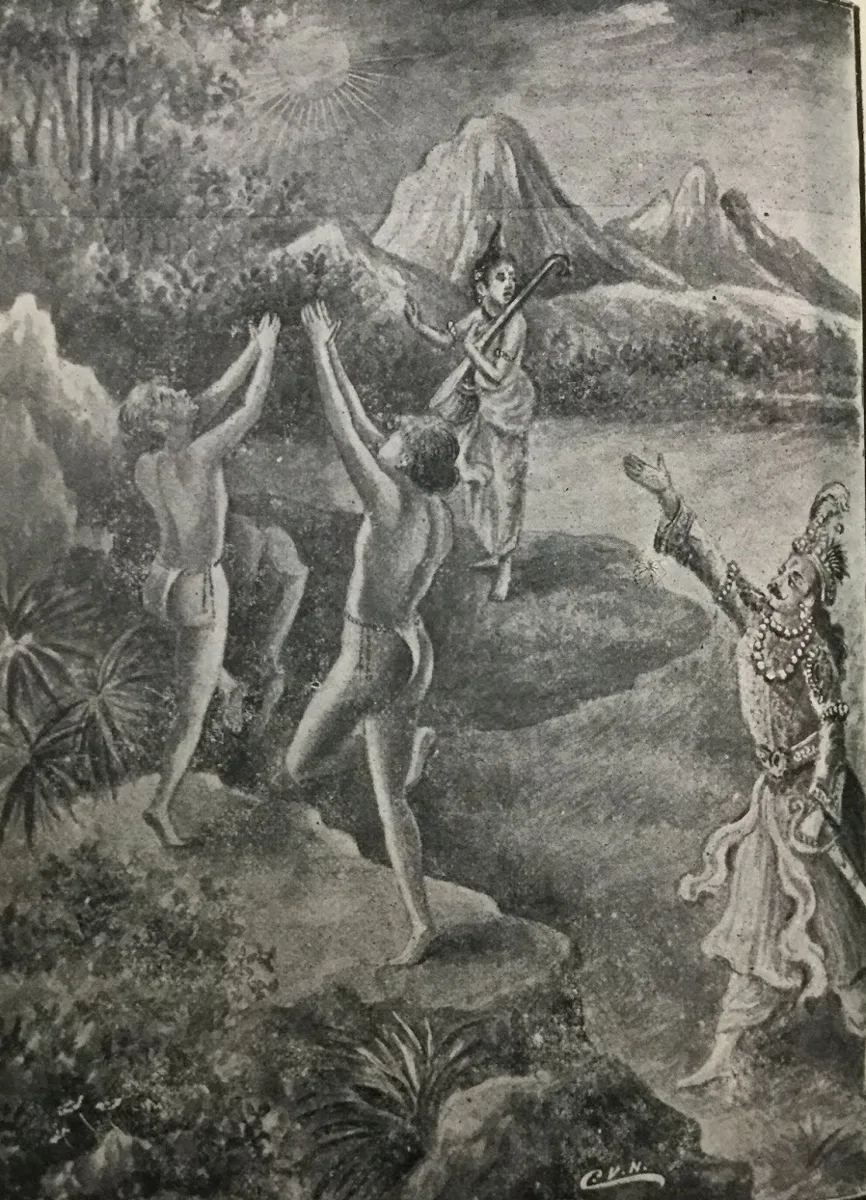
Daksha was given the task of bringing living beings into the world. He had ten thousand sons, the Haryashvas, and sent them west, to the holy lake Narayana-saras, to prepare themselves to have families of their own.
There Narada met them, and spoke to them in riddles, about a kingdom with only one man, a hole from which no one returns, a river that flows both ways and a wheel of razors. Thinking the riddles through, the sons understood them as lessons about the body, the soul, the Lord and time, and they chose to devote themselves to the Lord instead.
Brahma consoled Daksha, and he had a thousand more sons, the Savalashvas. They went to the same lake, and Narada met them too, and they followed their brothers.
Daksha was furious. He called Narada a false saint who broke up families, and cursed him to have no home anywhere. Narada, who could have cursed him back, simply said, so be it.
Detailed
Where the story is told
This page follows the Bhagavata Purana, Book 6, chapter 5. Daksha is a son of Brahma, given the task of bringing living beings into the world, and the sage Narada is the Purana’s great wandering devotee of Vishnu.
What the Bhagavata Purana draws out
Riddles that point inward. Narada speaks to Daksha’s sons in riddles: a kingdom with one man in it, a hole from which no one returns, a river that flows both ways, a house of twenty-five elements, a swan, a wheel of razors and thunderbolts. The sons read each one as a lesson. The kingdom is the body and its one true master is the Lord; the river is the world, always made and unmade; the swan is scripture, which tells spirit from matter; the wheel is time.
Two duties in tension. Daksha sees his sons’ choice as theft. In his anger he says Narada has taken them before they paid their debts to the sages, the gods and the ancestors, and breaks up families.
Patience in the face of a curse. Daksha curses Narada to have no home anywhere. Narada could have cursed him back, and says only “so be it” (tad badham). The Purana holds this up as the mark of a true saint.
Where the story leads
Narada accepted the curse, and in the Bhagavata Purana he is always travelling from world to world, singing the names of the Lord. On one of his journeys he met a five-year-old prince on his way to the forest. Explore next: Dhruva, the pole star
Keep exploring
 StoryDhruva, the pole star
 StoryPrithu milks the earth
 StoryBhrigu tests the three gods
 StoryNarasimha and Prahlada
Also named on this page
- Daksha
- A son of Brahma, a father of living beings.
- Narada
- The travelling sage, devoted to the Lord.
- Brahma
- The creator god.
- Vishnu
- The god who preserves the world.
Sources
- Bhagavata Purana, Canto 6, chapter 5 6.5.1–24 · Verified
- Bhagavata Purana, Canto 6, chapter 5 6.5.24–44 · Verified