3-minute story
Daksha curses Narada
3 min read · as told in the Bhagavata Purana (Book 6, chapter 5)
Ten thousand sons
Daksha was a son of Brahma, the creator, and he had a great task: to fill the world with living beings.
He had ten thousand sons, called the Haryashvas. They were gentle, good, obedient boys. When their father told them to go and prepare to have families of their own, they set off at once, towards the west.
They came to Narayana-saras, a holy lake where the river Sindhu meets the sea. Many sages lived there. The brothers bathed in the lake, and began a long, hard practice of prayer and fasting, to carry out their father’s wish.
Riddles
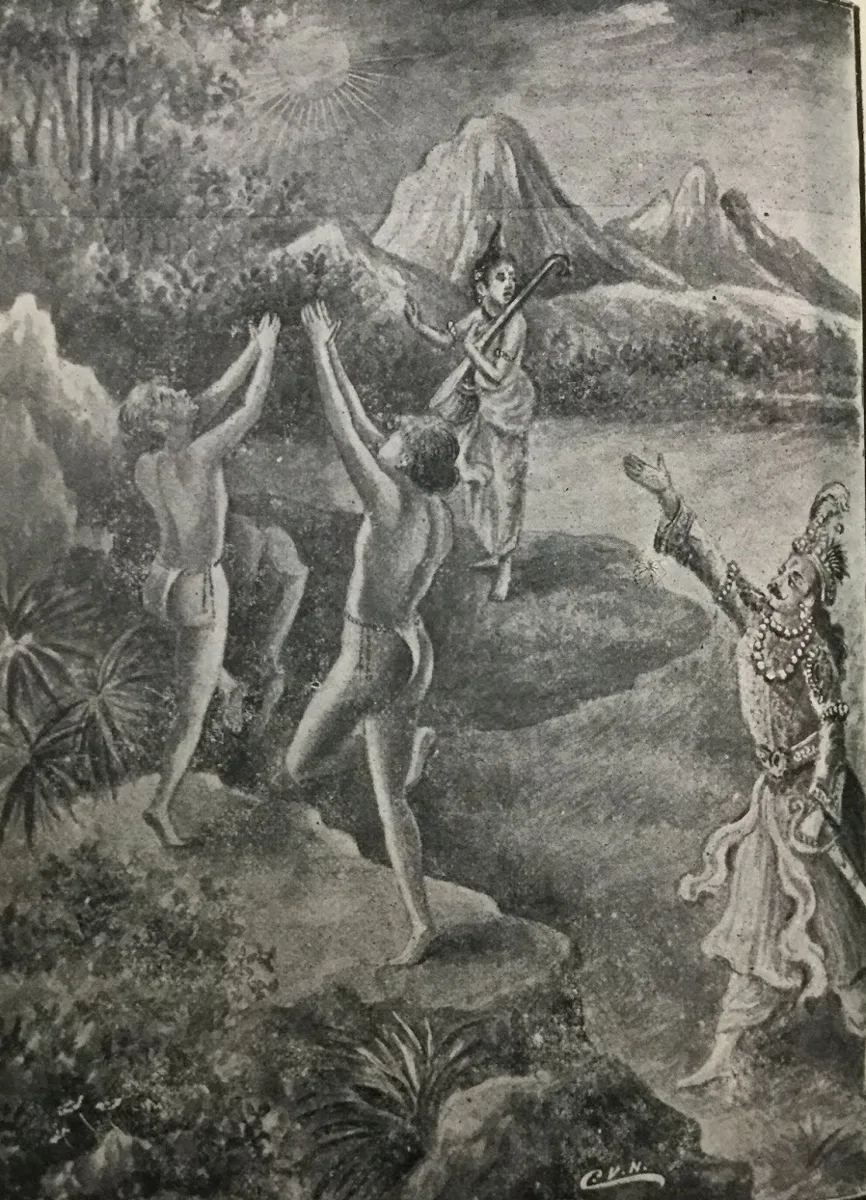
One day the sage Narada, who travels everywhere, came by and saw them. He sat down and spoke to them in riddles.
Have you seen the kingdom where only one man lives? The hole that no one ever comes out of? The river that flows both ways at once? The house built of twenty-five things? The swan with the strange voice? The wheel of razors and thunderbolts that spins by itself?
You are only boys, Narada said. How can you obey your father, when you do not even know what he really wants?
What the riddles meant
The brothers thought hard.
The kingdom, they realised, was the body. The one man who truly lives in it, and rules everything, is the Lord. The hole that no one comes back out of is the Lord’s own world: once you reach it, you never fall back. The river flowing both ways is the world, always being made and always being unmade. The swan is scripture, which can tell what is spirit from what is matter. And the wheel of razors, always turning, is time.
They looked at each other. Why spend our lives on things that time will cut away? they said. And they took Narada as their teacher, and set off on the path to the Lord. They never came home.
A thousand more
Daksha waited, and his sons did not return. When he learned what had happened, he was heartbroken.
Brahma comforted him, and Daksha had a thousand more sons, the Savalashvas. They too went to the lake. They too bathed and fasted and prayed.
And Narada came to them as well. Your brothers found the true path, he told them. Follow them. And they did. They did not come home either.
The curse
This time, Daksha was furious.
He found Narada and shouted at him. You dress like a saint, but you are no saint! Twice you have taken my sons, before they could do their duty to the sages, the gods and the ancestors. You break up families. You turn friends into enemies.
Then he cursed him. From now on, you will have no home anywhere. You will wander, and never rest.
So be it
Narada was a great sage. He could easily have cursed Daksha back.
But he did not. He listened quietly, and then he said just two words: so be it.
And so Narada goes on travelling, from world to world, never staying long in one place, singing the names of the Lord, and helping anyone who wants to find him.
Also named in this story
- Daksha
- A son of Brahma, a father of living beings.
- Narada
- The travelling sage, devoted to the Lord.
- Brahma
- The creator god.
Sources
- Bhagavata Purana, Canto 6, chapter 5 6.5.1–24 · Verified
- Bhagavata Purana, Canto 6, chapter 5 6.5.24–44 · Verified
- Bhagavata Purana, Canto 6, chapter 5 6.5.1–24 · Verified
- Bhagavata Purana, Canto 6, chapter 5 6.5.24–44 · Verified