4-minute story
Krishna lifts Govardhan hill
4 min read · as told in the Bhagavata Purana (Book 10)
A boy among the cowherds
In the Bhagavata Purana, Krishna was born in the prison of King Kamsa, and that same night his father Vasudeva carried him across the Yamuna to the home of the cowherd Nanda and laid him beside Nanda’s wife, Yashoda. So Krishna grew up in Vraja, among cowherds and their cattle, with his brother Balarama, herding the calves in the forests and on the slopes of Govardhan hill.
The preparations
One year, Krishna saw the cowherds busy with great preparations: food being cooked, offerings gathered, everything made ready for a sacrifice. He knew perfectly well what it was for, but he went to his father and asked him, respectfully, what all this was. What was it for, and whom did it honour? Was it written in the scriptures, or was it simply the custom?
Nanda explained. Indra, king of the gods, is lord of the rain clouds, he said. The clouds are his, and the rain they pour gives life to every creature. So people worship Indra with sacrifices, and with what the rain brings them they keep the three aims of life: dharma, wealth and happiness. This is our custom, handed down to us. To give it up out of greed or fear or dislike would not be right.
Krishna’s answer
Krishna gave a very different answer. A living being, he said, is born by its own karma, and by its own karma it is happy or sorrowful, and dies. If karma decides what happens to us, what can Indra do? He cannot change what someone’s own actions bring them. Clouds, he went on, pour rain because of the workings of nature, and the rain falls everywhere, on forests and fields alike.
So let each do their own work well, Krishna said. A cowherd’s work is caring for cows. Our homes are not in cities or towns or villages. We live in the forests and on the hills. So let us honour the cows, the brahmanas, and Govardhan hill. Use everything you have prepared for Indra. Cook all kinds of food, feed the brahmanas and everyone else, even the dogs, give grass to the cows, and then dress well and walk around the hill.
A new kind of offering
Nanda and the elders listened, and agreed. They did all that Krishna said. They fed the brahmanas and gave them cows, offered food to the hill, and gave grass to the cows. Then, putting the cows in front, they walked around Govardhan, while the women of Vraja rode in ox-drawn wagons and sang of Krishna.
Then Krishna took on a vast form. “I am Govardhan hill!” he declared, and he ate the offerings. Alongside the people of Vraja, he bowed down to that form himself. See how the hill has shown us its favour, he said.
Indra’s anger
Indra learned that his sacrifice had been set aside, and he was furious. He believed himself the master of the world. These cowherds, he said, had given up their old ways for a talkative child. He called up the clouds of destruction and sent them over Vraja: break their pride, he told them, and destroy their cattle.
The clouds came. Lightning flashed, thunder roared, and the wind howled. Rain fell in columns, with hailstones, until the whole land was flooded and no one could tell high ground from low. The cows shivered in the wind and rain. The cowherds and their families, frozen and frightened, came to Krishna. Krishna, they cried, save the cows from Indra’s anger, and save us.
The hill on one hand
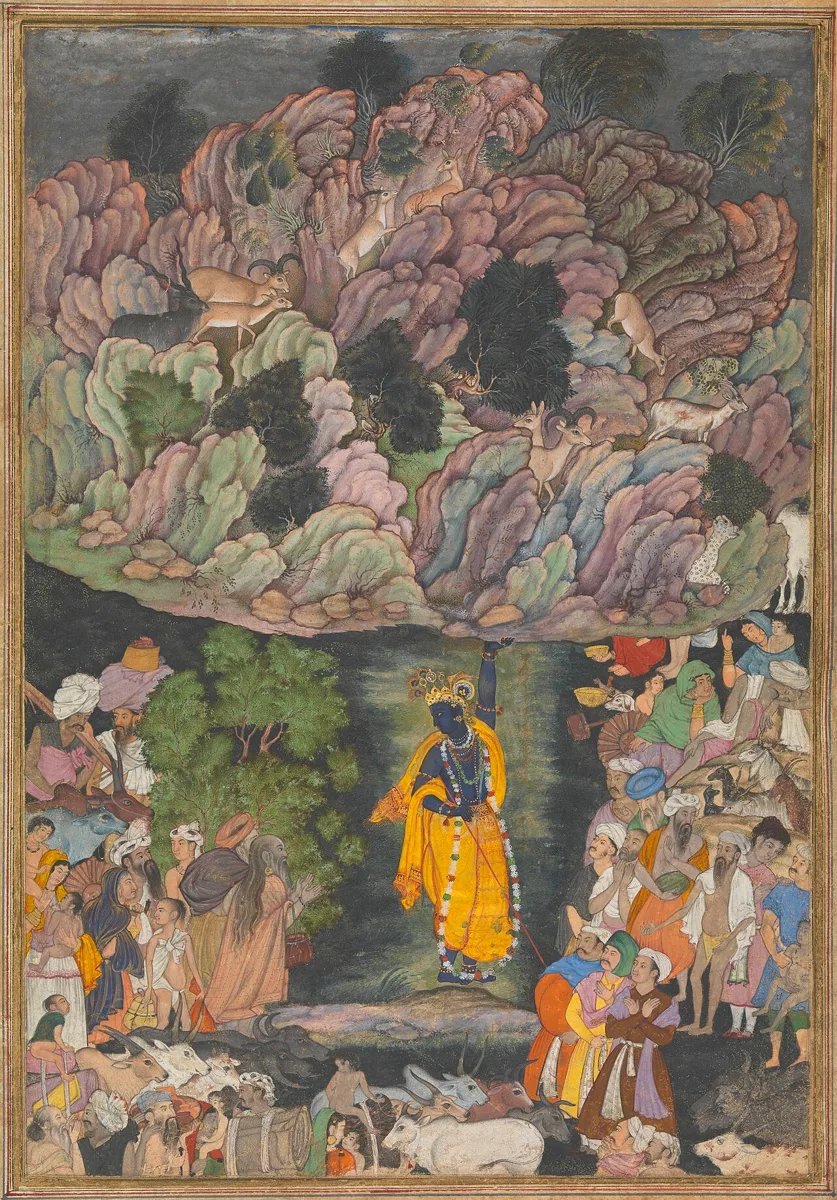
Krishna saw at once that this was Indra’s doing. He walked up to Govardhan, and with one hand he lifted the whole hill, as easily as a child picks up a mushroom.
Come under the hill, he told them, with your cows and everything you own. Don’t be afraid that it will fall from my hand. There is room here for all of you.
So they came, with their cows and calves and their wagons and belongings, and sheltered beneath the hill. And there Krishna stood for seven days, holding it up, forgetting hunger and thirst and any thought of his own comfort, while the people of Vraja looked at him in wonder.
The storm ends
Indra was astonished. He saw what Krishna had done, and his pride fell away. He called back his clouds. The sky cleared, the wind stopped, and the sun came out.
Krishna told the cowherds they could come out now, and bring their cows and belongings with them. When everyone was out, he set the hill back in its place.
The people of Vraja rushed to him. Some embraced him, some bowed down, and the women offered him water mixed with yogurt, and blessings. In the sky, the gods showered flowers and blew conch shells, and the musicians of heaven sang. And Krishna, with Balarama and his friends, went back to herding the cows.
At Diwali
Many Hindus remember this day at Diwali time. The fourth day of the festival, Govardhan Puja or Annakut, recalls how Krishna lifted the hill to shelter the cowherds from Indra’s rain. Explore next: Diwali
Meet the people and places in this story

Also named in this story
- Krishna
- Worshipped as God, and as an avatar of Vishnu; in this story a young cowherd boy in Vraja.
- Nanda
- Krishna's foster father, leader of the cowherds of Vraja.
- Yashoda
- Nanda's wife, in whose home Krishna was raised.
- Indra
- King of the gods and god of rain, who sent the storm.
- Balarama
- Krishna's elder brother, who herded the cows with him.
- Vasudeva
- Krishna's father, who carried him as a newborn to Nanda's home.
- Kamsa
- The king in whose prison Krishna was born.
Sources
- Bhagavata Purana, Canto 10, chapter 24 10.24.1–38 · Verified
- Bhagavata Purana, Canto 10, chapter 25 10.25.1–33 · Verified
- Bhagavata Purana, Canto 10, chapter 3 10.3.51 · Verified
- Encyclopaedia Britannica, "Diwali" · Verified
- Bhagavata Purana, Canto 10, chapter 24 10.24.1–38 · Verified
- Bhagavata Purana, Canto 10, chapter 25 10.25.1–33 · Verified
- Bhagavata Purana, Canto 10, chapter 3 10.3.51 · Verified
- Encyclopaedia Britannica, "Diwali" · Verified