Story
Krishna and the twin trees
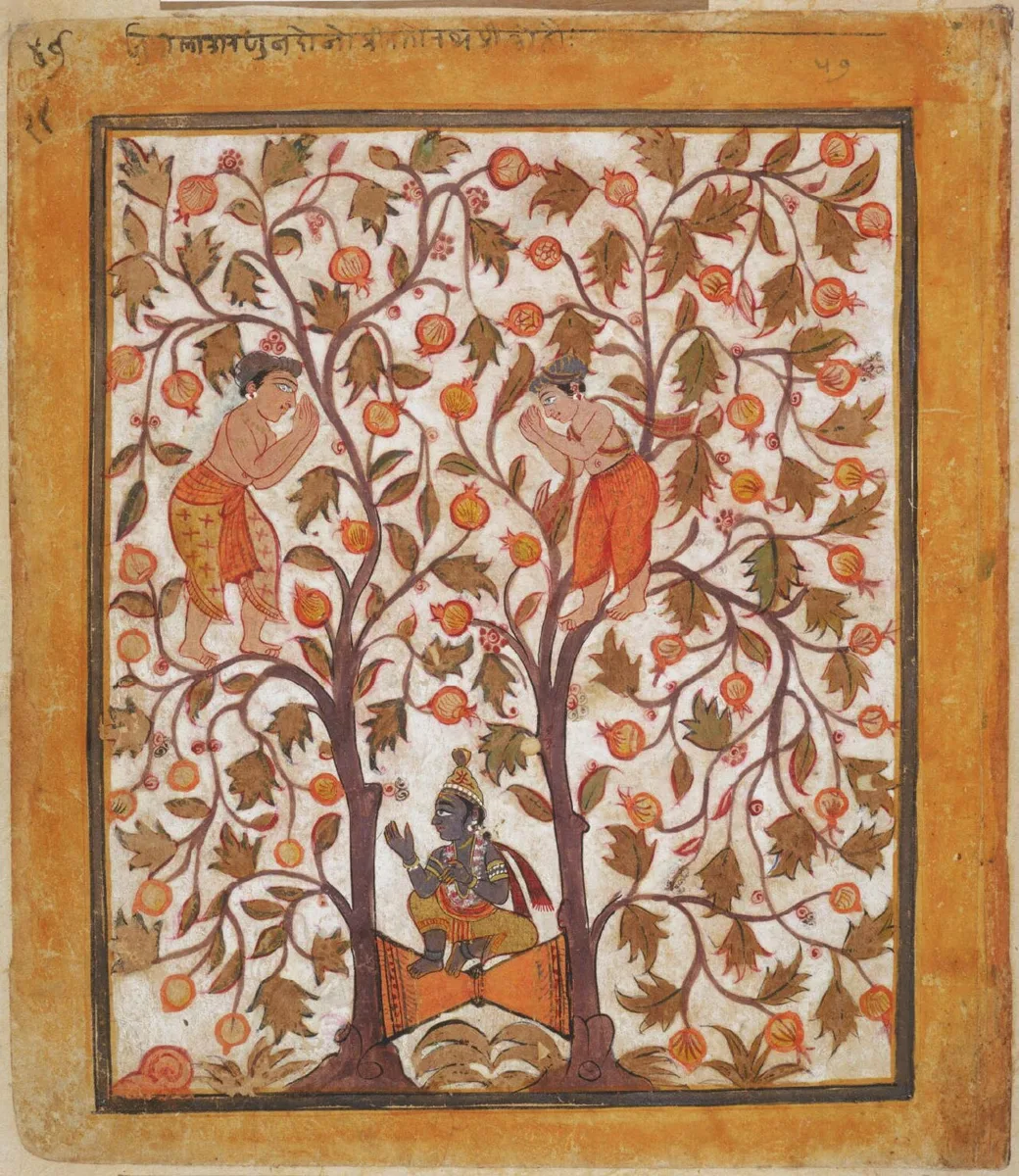
When the child Krishna broke a pot of yogurt and fed the butter to monkeys, his mother Yashoda tried to tie him to a wooden mortar, but every rope fell two fingers short until he let himself be bound. Dragging the mortar between two great arjuna trees, he pulled them down, and freed two sons of Kubera who had been cursed by the sage Narada to stand there as trees.
Read the 4-minute story4 min read · told as scenes, from the Bhagavata Purana (Book 10, chapters 9, 10 and 11)
- The broken potLeft alone while the milk boils over, the child Krishna breaks the yogurt pot and feeds butter to the monkeys.
- Two fingers shortEvery rope Yashoda ties falls short, until Krishna, seeing her tired, lets himself be bound.
- Narada's curseLong before, Narada had cursed two proud sons of Kubera to stand as trees until they saw the Lord.
- The trees fallKrishna drags the mortar between the twin arjuna trees and pulls them down.
- FreedNalakuvara and Manigriva step out, praise Krishna and go home.
- UntiedThe cowherds cannot believe a child did this. Nanda smiles and unties his son.
Understand more
Simple
One day Yashoda was churning yogurt herself and singing about her son. Krishna, wanting to nurse, held the churning rod to stop her, and she took him on her lap. When the milk on the stove began to boil over, she set him down to see to it.
Angry at being left, Krishna broke the yogurt pot with a stone and went off to eat the fresh butter, sharing it with the monkeys. Yashoda caught him and decided to tie him to a wooden mortar so he could not get into more mischief.
Every rope she tied fell two fingers short, however many she joined. Only when he saw his mother tired and sweating did Krishna let himself be bound.
Tied to the mortar, he crawled between two tall arjuna trees. The mortar caught between them, he pulled, and both trees crashed down. From them stepped Nalakuvara and Manigriva, sons of Kubera, freed from the sage Narada's curse.
Detailed
Where the story is told
This page follows the Bhagavata Purana, Book 10, chapters 9 to 11, from Krishna’s childhood in Vraja with his foster parents, Yashoda and Nanda. Explore next: The birth of Krishna
What the Bhagavata Purana draws out
Bound only by love. Every rope Yashoda tries is two fingers too short, however many she joins together. Only when Krishna sees how tired his mother is does he let himself be tied. The Lord who cannot be bound is held by her love.
A curse that is also a blessing. The twin arjuna trees were Nalakuvara and Manigriva, sons of Kubera, the god of wealth. Proud of their wealth, they ignored the sage Narada, who cursed them to stand as trees. But the curse carried a promise: one day they would see the Lord face to face and be freed. Krishna drags the mortar between the trees, the Purana says, to make Narada’s words come true, and he tells the brothers that the curse had been a mercy.
Love that does not see. When the cowherds come running at the crash, the children tell them what happened. Out of affection, Nanda and the elders cannot believe that a little child pulled down two great trees. Nanda simply smiles, and unties his son.
Where the story leads
Later, the Bhagavata Purana tells, the boy Krishna would bewilder even Brahma, the creator. Explore next: Krishna outwits Brahma
Keep exploring
 StoryThe birth of Krishna
 StoryKrishna outwits Brahma
 StoryKrishna and the serpent Kaliya
 StoryKrishna lifts Govardhan hill
Also named on this page
- Krishna
- Worshipped as God, and as an avatar of Vishnu; in this story a small child in Vraja.
- Yashoda
- Nanda's wife, who raised Krishna as her own.
- Nanda
- Chief of the cowherds of Vraja, Krishna's foster father.
- Nalakuvara
- A son of Kubera, cursed to stand as a tree.
- Manigriva
- Nalakuvara's brother, cursed with him.
- Kubera
- God of wealth, father of Nalakuvara and Manigriva.
- Narada
- The wandering sage whose curse was also a blessing.
Sources
- Bhagavata Purana, Canto 10, chapter 9 10.9.1–18 · Verified
- Bhagavata Purana, Canto 10, chapter 10 10.10.1–43 · Verified
- Bhagavata Purana, Canto 10, chapter 11 10.11.1–6 · Verified