3-minute story
Jaya and Vijaya, the doorkeepers
3 min read · as told in the Bhagavata Purana (Book 3, chapters 15 and 16; Book 7, chapters 1 and 10)
Four children at the gate
Long ago, four great sages set out for Vaikuntha, the world of Vishnu. They were the Kumaras: Sanaka, Sanatana, Sanandana and Sanat-kumara. They were the oldest of all beings, older than the worlds they wandered, and yet they looked like little boys of five. The open sky was their only clothing. They went wherever they pleased, and what pleased them most was the Lord.
They came to Vaikuntha longing to see him. They walked through the first gate, and the second, and on through six gates in all, and no one stopped them.
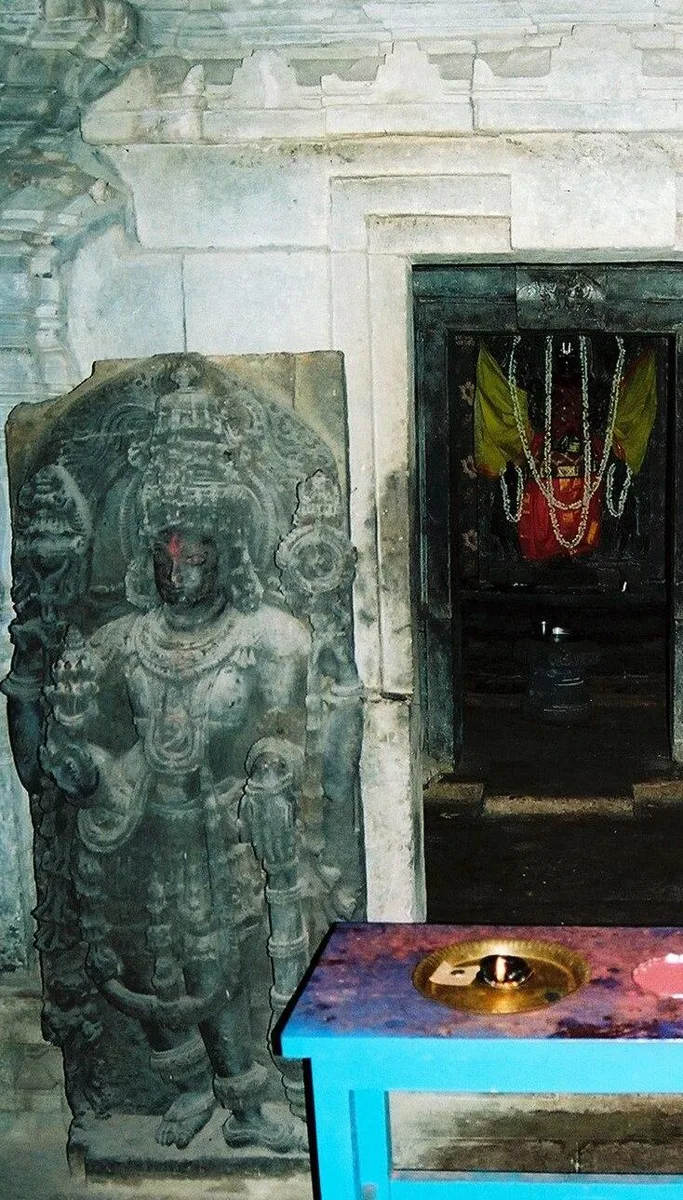
At the seventh gate stood two doorkeepers, the chief guards of Vishnu’s own door. Their names were Jaya and Vijaya. They looked at the four small sages, and they barred the way.
The sages’ anger
The Kumaras’ eyes turned red with anger.
How can this be, they asked, here in Vaikuntha, where there is no quarrel and no fear? Who are these two, so full of themselves that they stand between the Lord and those who love him? Such a spirit does not belong in the Lord’s world. Let them go down to the material world, where such pride belongs.
The fall begins
Jaya and Vijaya understood what they had done, and they were terrified. They threw themselves at the sages’ feet. They did not ask to be forgiven. They accepted the punishment. They asked for only one thing: that wherever they fell, however low, they would never forget the Lord.
The Lord at the gate
Vishnu heard what had happened at his door. He came at once, with the goddess Lakshmi at his side, and the sages, seeing him at last, were overwhelmed.
Vishnu honoured them. My servants have insulted you, he said, and so the offence is mine. He praised the sages and the brahmanas as dearer to him than anything. The Kumaras did not know what to say. They could not tell what he intended, speaking as though they had done him a favour.
Then Vishnu told them something more. What had happened was his own will. Jaya and Vijaya would be born in a family of asuras, but they would not be away for long. Soon they would come back to him.
At that, Jaya and Vijaya lost their shining brightness and fell from Vaikuntha. The gods cried out to see them go. They fell into the womb of Diti, the mother of the asuras.
The first birth
Much later, the sage Narada told the rest of the story to King Yudhishthira.
In their first birth, Jaya and Vijaya were born to Diti as two mighty brothers, Hiranyaksha and Hiranyakashipu. They became Vishnu’s fiercest enemies. Vishnu came as the boar Varaha and killed Hiranyaksha in the ocean. Then he came as Narasimha, half man and half lion, and killed Hiranyakashipu in the doorway of his own hall. Explore next: Narasimha and Prahlada
The second birth
In their second birth they were Ravana, the ten-headed king of Lanka, and his giant brother Kumbhakarna. Again they set themselves against Vishnu, and again he came, this time as Rama, and his arrows struck them both down. They died, the Bhagavata Purana says, with their minds fixed on him, just as before.
The third birth
In their third birth they were two kings, Shishupala and Dantavakra, who hated Krishna, and Krishna killed them too.
Home
Why did the curse end so soon, with the Lord’s own hand each time? Narada’s answer is surprising. All through those three lives, Jaya and Vijaya never stopped thinking about Vishnu. They thought of him with anger and hatred, but they thought of him constantly. And that constant thought of the Lord, even as an enemy, carried them back to him.
After their third death, the two doorkeepers returned to Vaikuntha, to the gate they had once guarded, and to the Lord they had asked never to forget.
Meet the people and places in this story
Also named in this story
- Rama
- Rama is the central figure of the Ramayana, the eldest son of King Dasharatha of Ayodhya, and is worshipped by Hindus as the seventh avatar of Vishnu.
- Lanka
- Lanka is Ravana's island fortress across the sea, where he held Sita captive.
- Jaya
- One of Vishnu's two chief doorkeepers in Vaikuntha.
- Vijaya
- The other of Vishnu's two chief doorkeepers.
- Kumaras
- Four great sages who look like children though they are the oldest of beings.
- Vishnu
- The god who preserves the world, whose world is Vaikuntha.
- Lakshmi
- Goddess of good fortune, Vishnu's wife.
- Hiranyaksha
- An asura, killed by Vishnu as the boar Varaha.
- Hiranyakashipu
- An asura king, killed by Vishnu as Narasimha.
- Varaha
- Vishnu's avatar as a boar.
- Narasimha
- Vishnu's avatar as half man, half lion.
- Kumbhakarna
- Ravana's giant brother, killed by Rama.
- Shishupala
- A king who hated Krishna, killed by him.
- Dantavakra
- A king who hated Krishna, killed by him.
- Krishna
- Worshipped as God, and as an avatar of Vishnu.
- Diti
- Mother of the asuras, in whose womb Jaya and Vijaya were first born.
- Narada
- The sage who tells this story to King Yudhishthira.
- Yudhishthira
- The eldest of the Pandava brothers, who heard this story from Narada.
Sources
- Bhagavata Purana, Canto 3, chapter 15 3.15.30–37 · Verified
- Bhagavata Purana, Canto 3, chapter 16 3.16.4–37 · Verified
- Bhagavata Purana, Canto 7, chapter 1 7.1.35–47 · Verified
- Bhagavata Purana, Canto 7, chapter 10 7.10.35–38 · Verified
- Bhagavata Purana, Canto 3, chapter 15 3.15.30–37 · Verified
- Bhagavata Purana, Canto 3, chapter 16 3.16.4–37 · Verified
- Bhagavata Purana, Canto 7, chapter 1 7.1.35–47 · Verified
- Bhagavata Purana, Canto 7, chapter 10 7.10.35–38 · Verified