4-minute story
Gajendra, the elephant king
4 min read · as told in the Bhagavata Purana (Book 8, chapters 2 to 4)
The mountain in the ocean of milk
Out of the ocean of milk rises a mountain called Trikuta. The Bhagavata Purana describes it as vast, with three great peaks of gold, silver and iron, its slopes full of trees, streams and singing birds. In one of its valleys lies Ritumat, the garden of Varuna, god of the waters, where every tree flowers and fruits in every season. And in that garden is a lake, its water clear, its surface covered with golden lotuses.
The elephant king
Gajendra, the king of the elephants, lived in the forests of Trikuta with his wives and his herd. Wherever he walked, lions and tigers fled from his scent, and the smaller animals followed him without fear.
One day, with his herd thirsty and himself tired and perspiring, he led them down to the lake. He waded in, bathed, and drank his fill. Then, like a fond father, he filled his trunk and sprayed his wives and children, and let them drink and bathe in their turn.
The crocodile
Under the water a crocodile was waiting, and a strong one. It seized Gajendra’s leg.
Gajendra pulled. The crocodile held. His wives cried out in fear. The other elephants came to help, and pushed and pulled with all their strength, but the crocodile would not let go.
The struggle went on, day after day, year after year, for a thousand years, and the gods in heaven watched in amazement. The crocodile only grew stronger. Gajendra grew weaker, in his body, his mind and his senses, until he knew he could not win.
No one else
At last Gajendra understood something he had never had to think about before. Not his wives, not his herd, not his own great strength could save him now. He was afraid of death. And so he decided to take shelter of the Supreme Lord, the one who protects even from time, from whom death itself runs away.
Gajendra had not always been an elephant. In a former life he had been a king who prayed to the Lord every day, and now, by the Lord’s grace, a prayer from that life came back to him. He fixed his mind on it and began.
The prayer
He bowed to the Lord who lives in every heart, the root of everything. He prayed to the one whom even the gods and sages cannot understand, like an actor whose true thoughts are hidden behind his costume. He prayed to the one who cannot be called man or god or animal, who cannot be described except by saying “not this, not this”.
He did not want to go on living as an elephant, he said, covered in darkness. He wanted to be free.
Because Gajendra did not call on any god by name, the Bhagavata Purana says, Brahma, Shiva, Indra and the other gods did not come. But the Lord, who lives in every heart, heard him.
The lotus
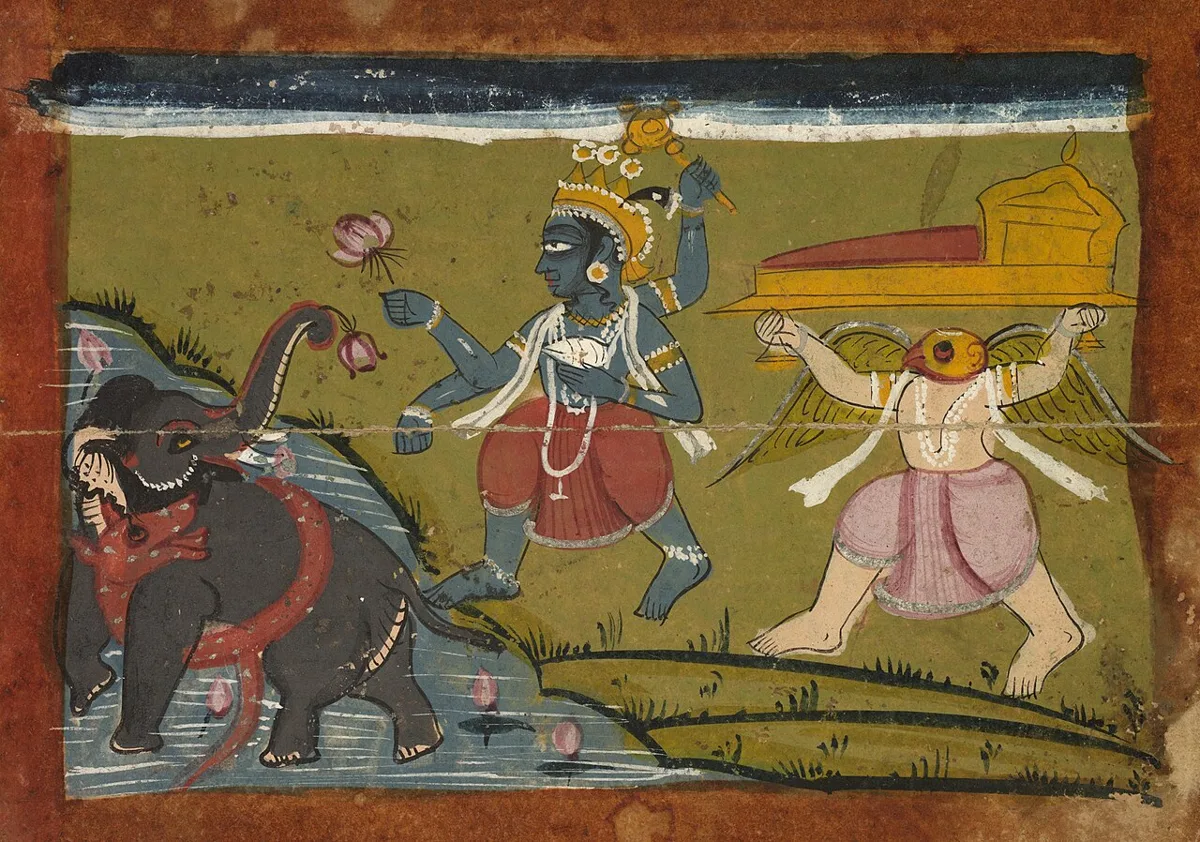
Vishnu came on Garuda, carrying his discus. Gajendra, still caught in the water, saw him coming. He plucked a lotus with his trunk, raised it high, and bowed to him with all his heart.
Vishnu stepped down from Garuda. He pulled the elephant and the crocodile out of the lake together, and with his discus he cut open the crocodile’s mouth. Gajendra was free.
Two curses end
The crocodile changed in an instant. In its place stood Huhu, a beautiful gandharva. Long ago, bathing with heavenly women, he had playfully pulled the leg of the sage Devala, who was bathing nearby, and the sage had cursed him to become a crocodile. Now, freed, Huhu walked around Vishnu, bowed, and went home to the world of the gandharvas.
Gajendra was changed too. He had been Indradyumna, a devoted king of the Pandya country in the south. One day, as he sat in silent worship, the great sage Agastya arrived, and the king did not rise to welcome him. Agastya cursed him to be born as a dull elephant. Indradyumna accepted the curse as the Lord’s will, and even in an elephant’s body, he never forgot his prayers.
At Vishnu’s touch, his elephant’s body fell away. He took on a form like Vishnu’s own, with four arms and yellow garments, and went with Vishnu as his companion.
A promise
Vishnu made a promise that day. Anyone who rises at the end of the night, he said, and remembers him and this story, and prays to him as Gajendra did, will come to him at the end of their life.
Gajendra’s mountain rose from the ocean of milk, the same ocean the gods and asuras churned for the nectar of immortality. Explore next: The churning of the ocean
Also named in this story
- Gajendra
- The elephant king saved by Vishnu; in his former life, King Indradyumna.
- Vishnu
- The god who preserves the world, who came to save Gajendra.
- Garuda
- The great eagle who carries Vishnu.
- Varuna
- God of the waters, whose garden held the lake.
- Indradyumna
- A devoted king of the Pandya country, who was born as Gajendra.
- Agastya
- A great sage, whose curse made Indradyumna an elephant.
- Huhu
- A gandharva, cursed by the sage Devala to become the crocodile.
- Devala
- A sage, whose curse made Huhu a crocodile.
- Brahma
- The creator god, who did not come, because the prayer named no particular god.
- Shiva
- The great god, who did not come, because the prayer named no particular god.
Sources
- Bhagavata Purana, Canto 8, chapter 2 8.2.1–33 · Verified
- Bhagavata Purana, Canto 8, chapter 3 8.3.1–33 · Verified
- Bhagavata Purana, Canto 8, chapter 4 8.4.3–13, 8.4.25 · Verified
- Bhagavata Purana, Canto 8, chapter 2 8.2.1–33 · Verified
- Bhagavata Purana, Canto 8, chapter 3 8.3.1–33 · Verified
- Bhagavata Purana, Canto 8, chapter 4 8.4.3–13, 8.4.25 · Verified